Lei Yuqian, Cui Yupeng, Cui Ruifeng, Chen Xiugui, Wang Junjuan, Lu Xuke, Wang Delong, Wang Shuai, Guo Lixue, Zhang Yuexin, Rui Cun, Fan Yapeng, Han Mingge, Zhao Lanjie, Zhang Hong, Liu Xiaoyu, Xu Nan, Wang Jing, Huang Hui, Feng Xixian, Xi Yanlong, Ni Kesong, Zhang Menghao, Jiang Tiantian, Ye Wuwei
Zhengzhou Research Base, State Key Laboratory of Cotton Biology, School of Agricultural Sciences, Zhengzhou University, Zhengzhou, Henan, China.
State Key Laboratory of Cotton Biology, Institute of Cotton Research of Chinese Academy of Agricultural Sciences, Anyang, Henan, China.
Front Genet. 2023 Jun 7;14:1169104. doi: 10.3389/fgene.2023.1169104. eCollection 2023.
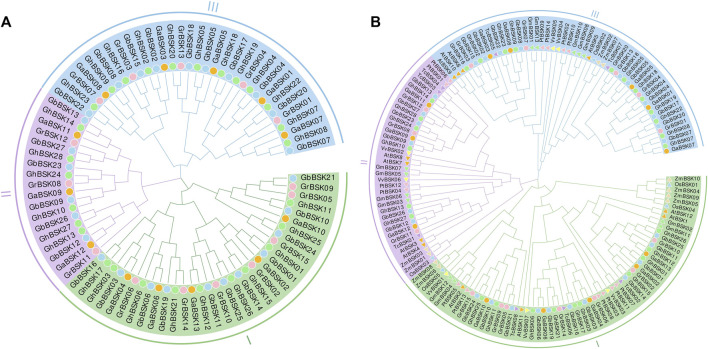
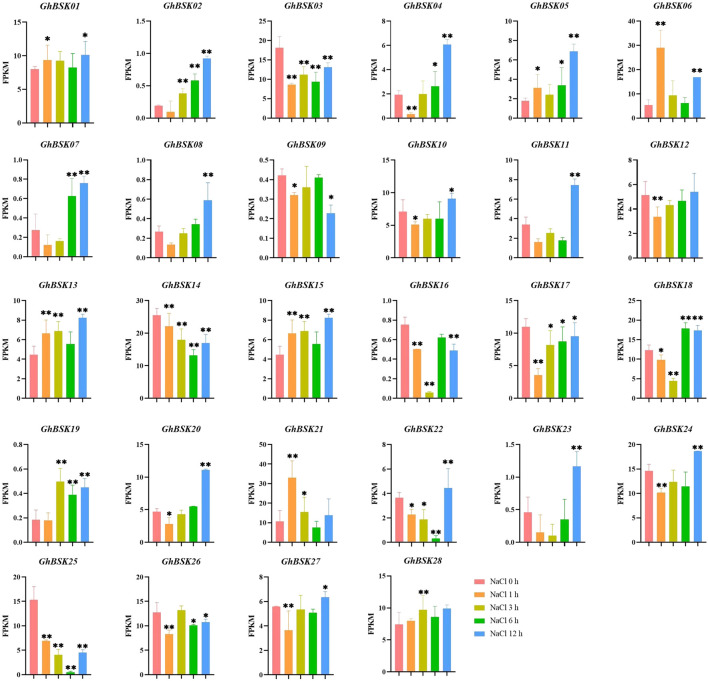
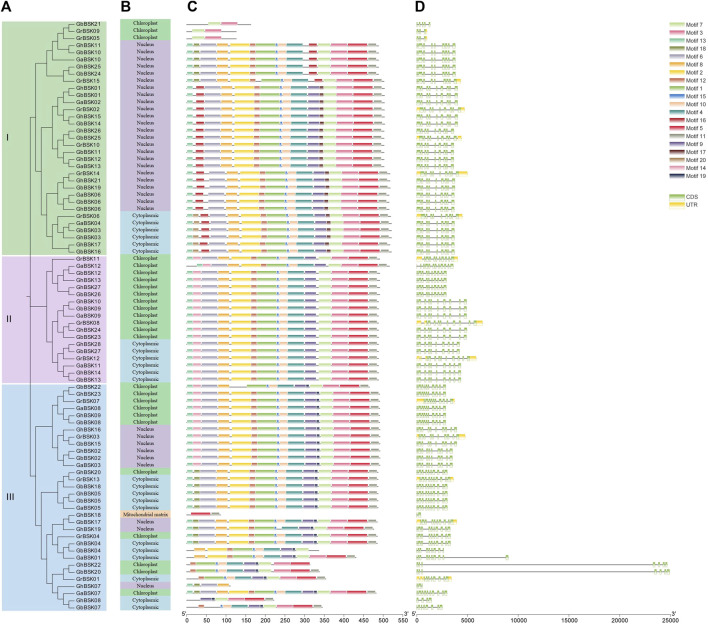
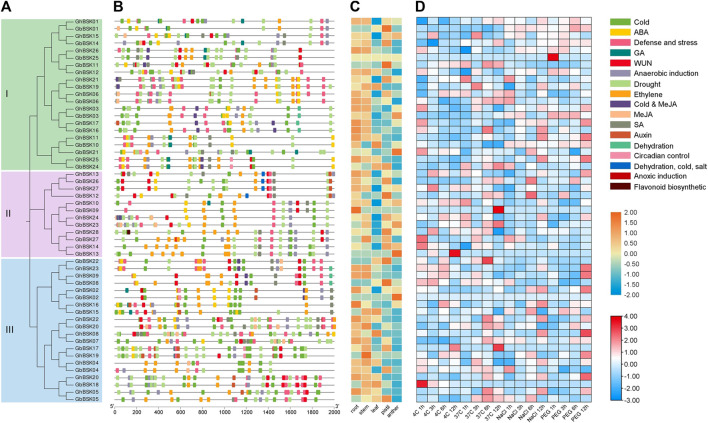
Identification, evolution, and expression patterns of BSK (BR signaling kinase) family genes revealed that BSKs participated in the response of cotton to abiotic stress and maintained the growth of cotton in extreme environment. The steroidal hormone brassinosteroids (BR) play important roles in different plant biological processes. This study focused on BSK which were downstream regulatory element of BR, in order to help to decipher the functions of BSKs genes from cotton on growth development and responses to abiotic stresses and lean the evolutionary relationship of cotton BSKs. BSKs are a class of plant-specific receptor-like cytoplasmic kinases involved in BR signal transduction. In this study, bioinformatics methods were used to identify the cotton BSKs gene family at the cotton genome level, and the gene structure, promoter elements, protein structure and properties, gene expression patterns and candidate interacting proteins were analyzed. In the present study, a total of 152 BSKs were identified by a genome-wide search in four cotton species and other 11 plant species, and phylogenetic analysis revealed three evolutionary clades. It was identified that BSKs contain typical PKc and TPR domains, the N-terminus is composed of extended chains and helical structures. Cotton BSKs genes show different expression patterns in different tissues and organs. The gene promoter contains numerous -acting elements induced by hormones and abiotic stress, the hormone ABA and Cold-inducing related elements have the highest count, indicating that cotton BSK genes may be regulated by various hormones at different growth stages and involved in the response regulation of cotton to various stresses. The expression analysis of BSKs in cotton showed that the expression levels of , , and were significantly increased with salt-inducing. This study is helpful to analyze the function of cotton BSKs genes in growth and development and in response to stress.
BSK(BR信号激酶)家族基因的鉴定、进化及表达模式表明,BSK参与了棉花对非生物胁迫的响应,并维持了棉花在极端环境下的生长。甾体激素油菜素内酯(BR)在不同的植物生物学过程中发挥着重要作用。本研究聚焦于作为BR下游调控元件的BSK,以帮助解析棉花中BSK基因在生长发育及对非生物胁迫响应方面的功能,并了解棉花BSK的进化关系。BSK是一类参与BR信号转导的植物特异性类受体胞质激酶。在本研究中,运用生物信息学方法在棉花基因组水平上鉴定棉花BSK基因家族,并对基因结构、启动子元件、蛋白质结构与性质、基因表达模式及候选相互作用蛋白进行了分析。在本研究中,通过对四个棉花物种及其他11种植物物种进行全基因组搜索,共鉴定出152个BSK,系统发育分析揭示了三个进化分支。已鉴定出BSK含有典型的PKc和TPR结构域,其N端由延伸链和螺旋结构组成。棉花BSK基因在不同组织和器官中表现出不同的表达模式。基因启动子含有大量受激素和非生物胁迫诱导的顺式作用元件,其中激素ABA和冷诱导相关元件数量最多,表明棉花BSK基因可能在不同生长阶段受多种激素调控,并参与棉花对各种胁迫的响应调节。棉花中BSK的表达分析表明, 、 、 和 的表达水平随盐诱导显著增加。本研究有助于分析棉花BSK基因在生长发育及胁迫响应中的功能。