Department of Zoology, Trinity College Dublin, Dublin, D02 F6N2, Ireland.
Department of Plant Sciences, University of Oxford, Oxford, OX1 3RB, UK.
J Phycol. 2022 Jun;58(3):364-376. doi: 10.1111/jpy.13251. Epub 2022 May 12.
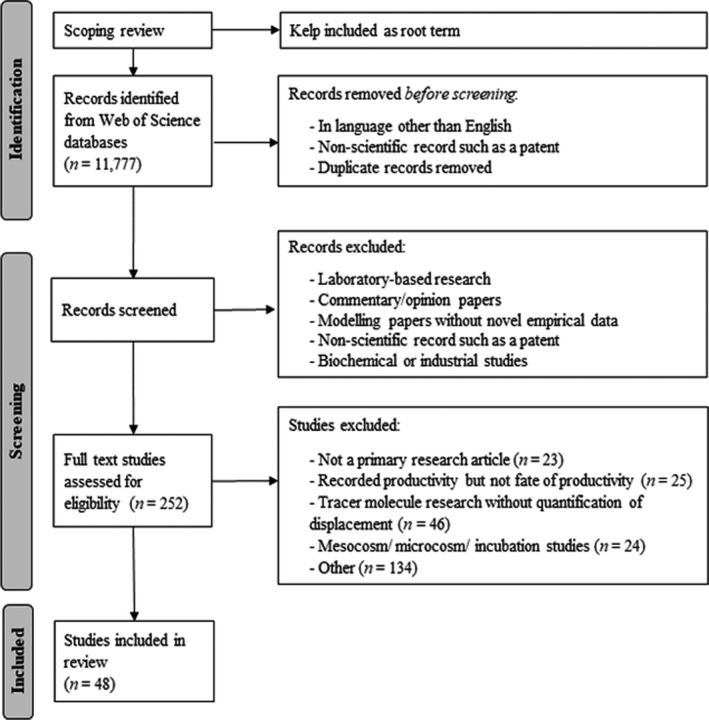
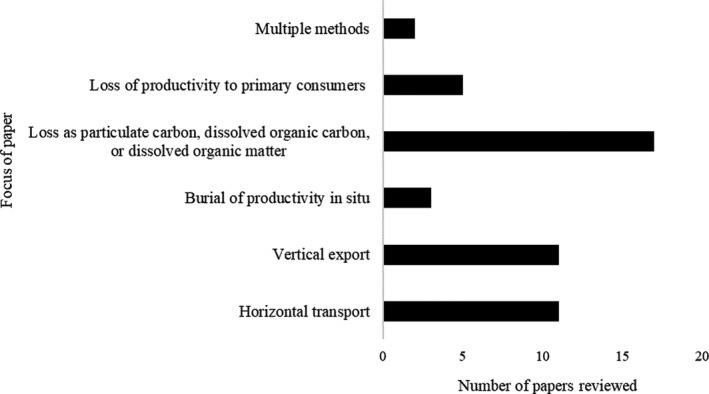
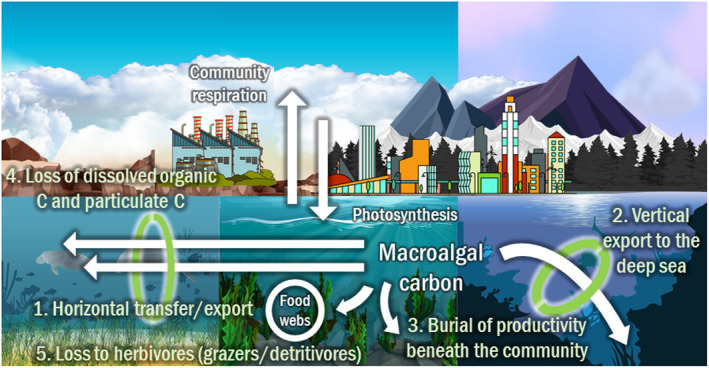
The role of marine primary producers in capturing atmospheric CO has received increased attention in the global mission to mitigate climate change. Yet, our understanding of carbon sequestration performed by macroalgae has been limited to a relatively small number of studies that have estimated the ultimate fate of macroalgal-derived carbon. This systematic review was conducted to provide a timely synthesis of the methods used to determine the fate of macroalgal carbon in this rapidly expanding research area. It also aimed to provide suggestions for more effective future research. We found that the most common methods to estimate the fate of macroalgal carbon can be categorized into groups based on those that quantify: (i) export of macroalgal carbon to other environments-known as horizontal transport; (ii) sequestration of macroalgal carbon into deep-sea sediments-known as vertical transport; (iii) burial of macroalgal carbon directly beneath a benthic community; (iv) the loss of macroalgal carbon as particulate carbon or dissolved carbon to the water column; (v) the loss of macroalgal carbon to primary consumers; and finally (vi) those studies that combined multiple methods in one location. Based on this review, several recommendations for future research were formulated, which require the combination of multiple methods in a whole system analysis approach.
海洋初级生产者在捕获大气 CO 方面的作用在全球气候变化缓解任务中受到了越来越多的关注。然而,我们对大型藻类进行碳固存的理解仅限于相对较少的研究,这些研究估计了大型藻类衍生碳的最终命运。本系统综述旨在及时综合用于确定该快速发展的研究领域中大型藻类碳命运的方法。它还旨在为更有效的未来研究提供建议。我们发现,估计大型藻类碳命运的最常用方法可以根据以下方法进行分类:(i) 将大型藻类碳输出到其他环境中,称为水平运输;(ii) 将大型藻类碳固存到深海沉积物中,称为垂直运输;(iii) 大型藻类碳直接埋在底栖生物群下;(iv) 大型藻类碳作为颗粒碳或溶解碳损失到水柱中;(v) 大型藻类碳被初级消费者消耗;最后 (vi) 那些在一个地点结合多种方法的研究。基于这项综述,制定了一些未来研究的建议,这些建议需要在整个系统分析方法中结合多种方法。