Biological Physics Research Group, Clarendon Laboratory, Department of Physics, University of Oxford, Oxford OX1 3PU, UK.
Institute of Fundamental and Frontier Sciences, University of Electronic Science and Technology of China, Chengdu, Sichuan 611731, China.
Nucleic Acids Res. 2023 Aug 25;51(15):8085-8101. doi: 10.1093/nar/gkad511.
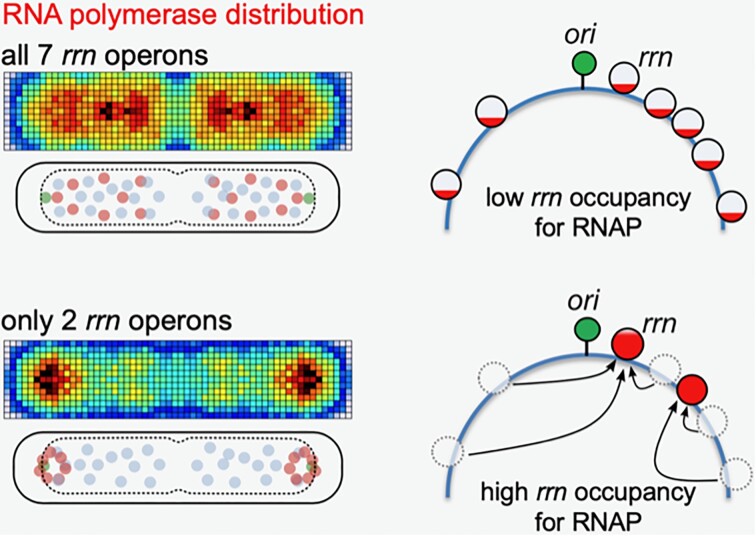
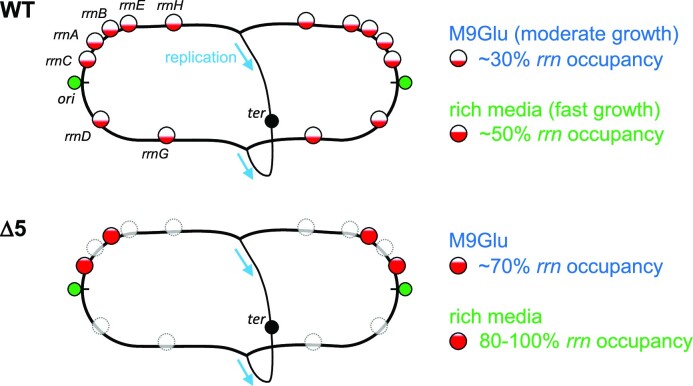
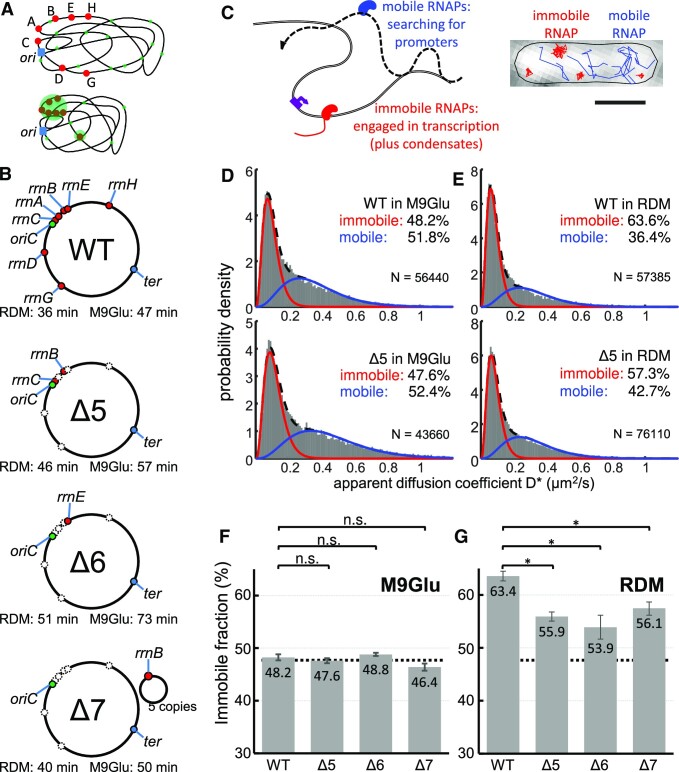
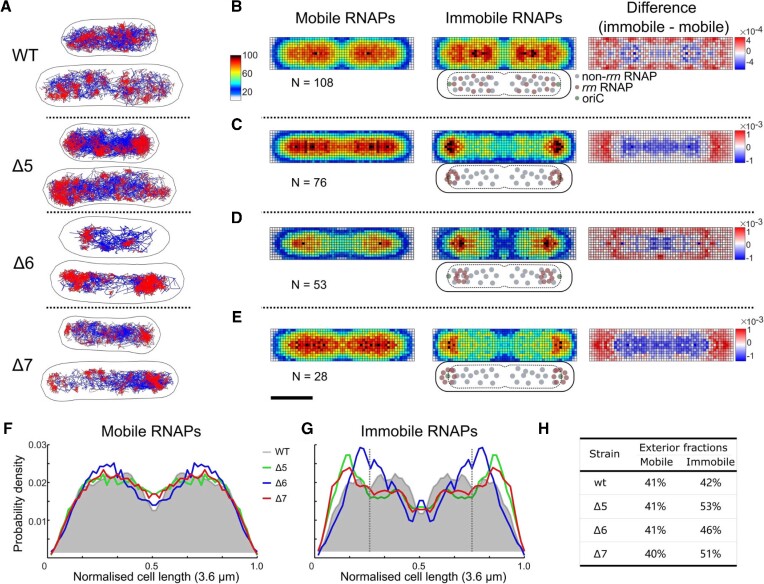
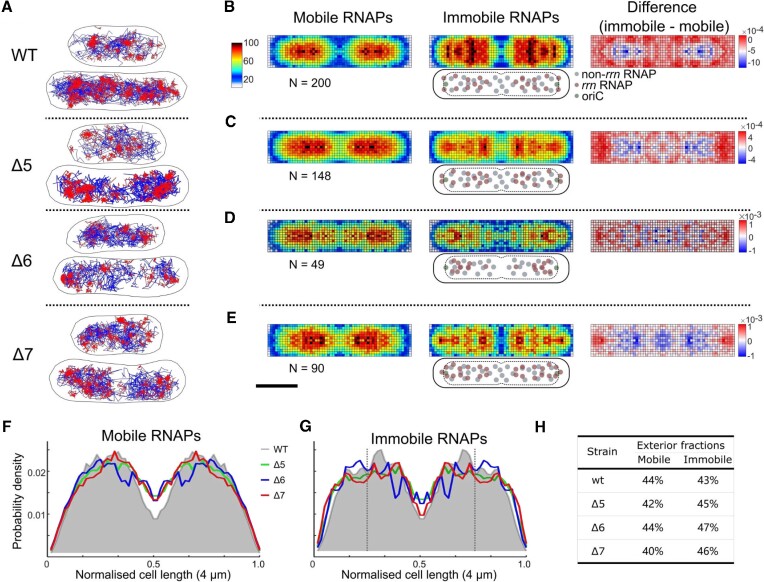
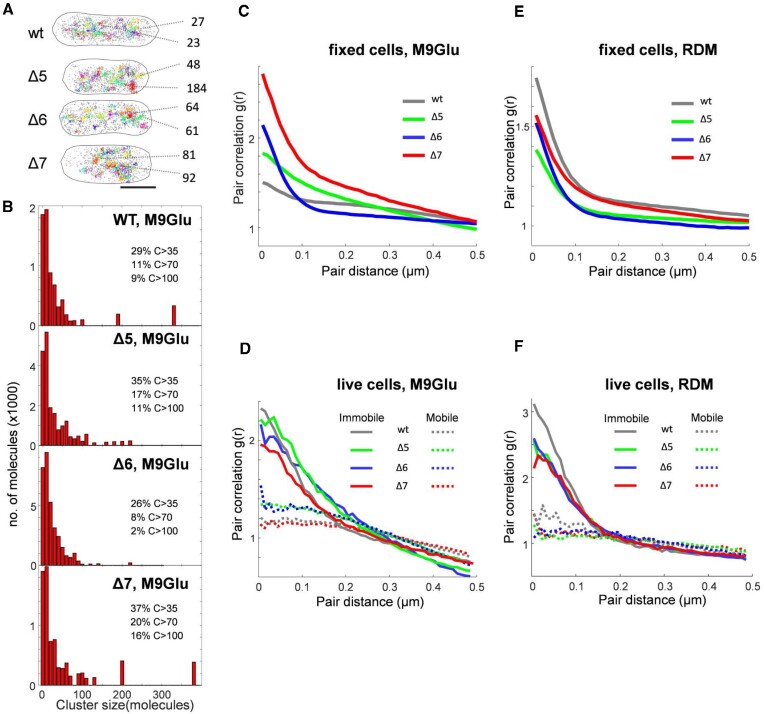
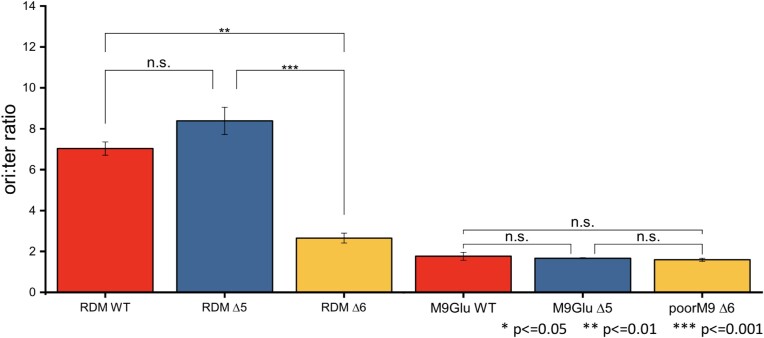
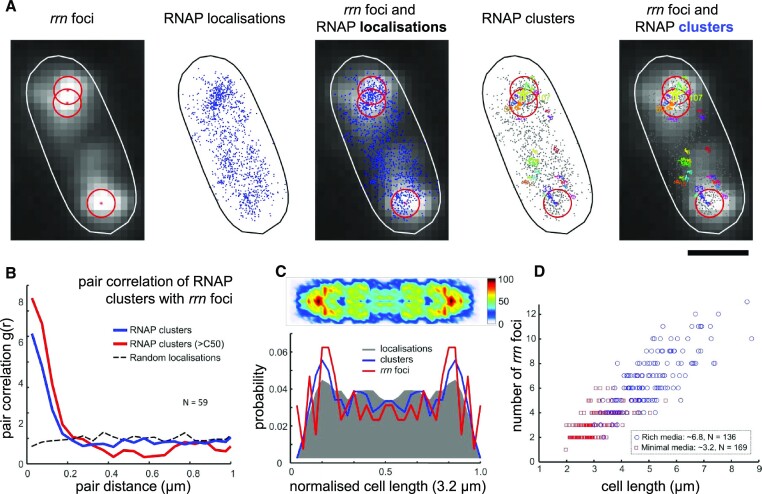
Bacterial transcription by RNA polymerase (RNAP) is spatially organized. RNAPs transcribing highly expressed genes locate in the nucleoid periphery, and form clusters in rich medium, with several studies linking RNAP clustering and transcription of rRNA (rrn). However, the nature of RNAP clusters and their association with rrn transcription remains unclear. Here we address these questions by using single-molecule tracking to monitor the subcellular distribution of mobile and immobile RNAP in strains with a heavily reduced number of chromosomal rrn operons (Δrrn strains). Strikingly, we find that the fraction of chromosome-associated RNAP (which is mainly engaged in transcription) is robust to deleting five or six of the seven chromosomal rrn operons. Spatial analysis in Δrrn strains showed substantial RNAP redistribution during moderate growth, with clustering increasing at cell endcaps, where the remaining rrn operons reside. These results support a model where RNAPs in Δrrn strains relocate to copies of the remaining rrn operons. In rich medium, Δrrn strains redistribute RNAP to minimize growth defects due to rrn deletions, with very high RNAP densities on rrn genes leading to genomic instability. Our study links RNAP clusters and rrn transcription, and offers insight into how bacteria maintain growth in the presence of only 1-2 rrn operons.
细菌的 RNA 聚合酶 (RNAP) 转录具有空间组织性。转录高度表达基因的 RNAP 位于核区周围,并在富含营养的培养基中形成聚集体,有几项研究将 RNAP 聚集体与 rRNA (rrn) 的转录联系起来。然而,RNAP 聚集体的性质及其与 rrn 转录的关联仍不清楚。在这里,我们通过使用单分子跟踪技术来监测具有大量减少染色体 rrn 操纵子(Δrrn 菌株)的菌株中移动和固定 RNAP 的亚细胞分布,从而解决了这些问题。引人注目的是,我们发现与染色体相关的 RNAP(主要参与转录)的分数在删除五个或六个七个染色体 rrn 操纵子后仍然很强。在 Δrrn 菌株中的空间分析表明,在适度生长过程中,RNAP 发生了大量重新分布,聚集体在细胞端帽处增加,而剩余的 rrn 操纵子就位于那里。这些结果支持了一种模型,即在 Δrrn 菌株中,RNAP 重新定位到剩余 rrn 操纵子的副本。在丰富的培养基中,Δrrn 菌株重新分配 RNAP 以最小化由于 rrn 缺失而导致的生长缺陷,rrn 基因上的 RNAP 密度非常高,导致基因组不稳定。我们的研究将 RNAP 聚集体和 rrn 转录联系起来,并深入了解了细菌在只有 1-2 个 rrn 操纵子的情况下如何维持生长。