Department of Clinical Haematology, Oxford University Hospitals NHS Foundation Trust, Oxford, UK; Radcliffe Department of Medicine, University of Oxford, Oxford, UK.
Centre for Clinical Brain Sciences, University of Edinburgh, Edinburgh, UK.
Lancet Neurol. 2023 Jul;22(7):557-567. doi: 10.1016/S1474-4422(23)00157-6.
The risk of death from spontaneous intracerebral haemorrhage is increased for people taking antiplatelet drugs. We aimed to assess the feasibility of randomising patients on antiplatelet drug therapy with spontaneous intracerebral haemorrhage to desmopressin or placebo to reduce the antiplatelet drug effect.
DASH was a phase 2, randomised, placebo-controlled, multicentre feasibility trial. Patients were recruited from ten acute stroke centres in the UK and were eligible if they had an intracerebral haemorrhage with stroke symptom onset within 24 h of randomisation, were aged 18 years or older, and were taking an antiplatelet drug. Participants were randomly assigned (1:1) to a single dose of intravenous desmopressin 20 μg or matching placebo. Treatment allocation was concealed from all staff and patients involved in the trial. The primary outcome was feasibility, which was measured as the number of eligible patients randomised and the proportion of eligible patients approached, and analysis was by intention to treat. The trial was prospectively registered with ISRCTN (reference ISRCTN67038373), and it is closed to recruitment.
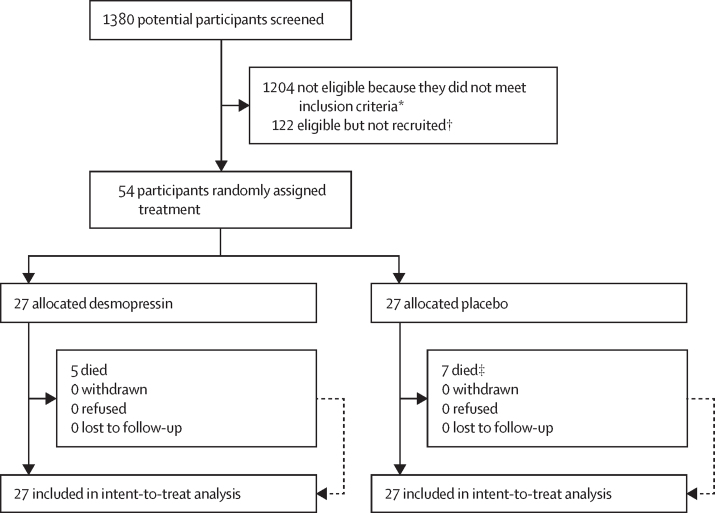
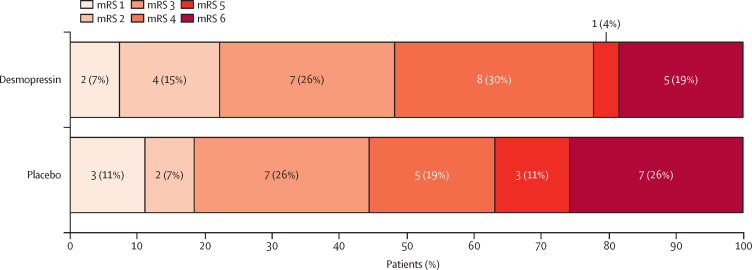
Between April 1, 2019, and March 31, 2022, 1380 potential participants were screened for eligibility. 176 (13%) participants were potentially eligible, of whom 57 (32%) were approached, and 54 (31%) consented and were subsequently recruited and randomly assigned to receive desmopressin (n=27) or placebo (n=27). The main reason for eligible patients not being recruited was the patient arriving out of hours (74 [61%] of 122 participants). The recruitment rate increased after the enrolment period was extended from 12 h to 24 h, but it was then impaired due to the COVID-19 pandemic. Of the 54 participants included in the analysis (mean age 76·4 years [SD 11·3]), most were male (36 [67%]) and White (50 [93%]). 53 (98%) of 54 participants received all of their allocated treatment (one participant assigned desmopressin only received part of the infusion). No participants were lost to follow-up or withdrew from the trial. Death or dependency on others for daily activities at day 90 (modified Rankin Scale score >4) occurred in six (22%) of 27 participants in the desmopressin group and ten (37%) of 27 participants in the placebo group. Serious adverse events occurred in 12 (44%) participants in the desmopressin group and 13 (48%) participants in the placebo group. The most common adverse events were expansion of the haemorrhagic stroke (four [15%] of 27 participants in the desmopressin group and six [22%] of 27 participants in the placebo group) and pneumonia (one [4%] of 27 participants in the desmopressin group and six [22%] of 27 participants in the placebo group).
Our results show it is feasible to randomise patients with spontaneous intracerebral haemorrhage who are taking antiplatelet drugs to desmopressin or placebo. Our findings support the need for a definitive trial to determine if desmopressin improves outcomes in patients with intracerebral haemorrhage on antiplatelet drug therapy.
National Institute for Health Research.
服用抗血小板药物的自发性脑出血患者死亡风险增加。我们旨在评估将接受自发性脑出血治疗的抗血小板药物患者随机分配接受去氨加压素或安慰剂以减少抗血小板药物效果的可行性。
DASH 是一项 2 期、随机、安慰剂对照、多中心可行性试验。如果患者在随机分组后 24 小时内出现脑出血并伴有卒中症状,年龄在 18 岁或以上,且正在服用抗血小板药物,则符合入组条件。参与者被随机分配(1:1)接受单剂量静脉内去氨加压素 20 μg 或匹配的安慰剂。治疗分配对所有参与试验的工作人员和患者均保密。主要结局是可行性,以随机分组的合格患者人数和合格患者的比例来衡量,并采用意向治疗进行分析。该试验在 ISRCTN(参考 ISRCTN67038373)进行了前瞻性注册,并已关闭招募。
在 2019 年 4 月 1 日至 2022 年 3 月 31 日期间,对 1380 名潜在参与者进行了筛查以确定其是否符合入组条件。有 176 名(13%)潜在参与者符合条件,其中 57 名(32%)被接触,54 名(31%)同意并随后被招募并随机分配接受去氨加压素(n=27)或安慰剂(n=27)。合格患者未被招募的主要原因是患者在非工作时间到达(122 名参与者中有 74 名[61%])。延长入组时间从 12 小时延长至 24 小时后,招募率有所提高,但随后因 COVID-19 大流行而受到影响。在纳入分析的 54 名参与者(平均年龄 76.4 岁[标准差 11.3])中,大多数为男性(36 [67%])和白人(50 [93%])。54 名参与者中的 53 名(98%)接受了全部分配的治疗(1 名被分配去氨加压素的参与者仅接受了部分输注)。没有参与者失访或退出试验。在第 90 天(改良 Rankin 量表评分>4),去氨加压素组有 6 名(22%)参与者死亡或依赖他人进行日常活动,安慰剂组有 10 名(37%)参与者死亡或依赖他人进行日常活动。去氨加压素组有 12 名(44%)参与者和安慰剂组有 13 名(48%)参与者发生严重不良事件。最常见的不良事件是脑出血扩大(去氨加压素组 27 名参与者中有 4 名[15%],安慰剂组有 6 名[22%])和肺炎(去氨加压素组有 1 名[4%],安慰剂组有 6 名[22%])。
我们的结果表明,将服用抗血小板药物的自发性脑出血患者随机分配接受去氨加压素或安慰剂是可行的。我们的发现支持需要进行一项确定的试验,以确定去氨加压素是否能改善接受抗血小板药物治疗的脑出血患者的结局。
英国国家卫生研究院。