The Daffodil Centre, The University of Sydney, A Joint Venture with Cancer Council NSW, 153 Dowling St, Woolloomooloo, Sydney, NSW, 2011, Australia.
Nepean Hospital, Sydney, NSW, Australia.
Pharmacoeconomics. 2023 Nov;41(11):1525-1537. doi: 10.1007/s40273-023-01291-6. Epub 2023 Jun 25.
Since 2016, new therapies have transformed the standard of care for lung cancer, creating a need for up-to-date evidence for health economic modelling. We developed a discrete event simulation of advanced lung cancer treatment to provide estimates of survival outcomes and healthcare costs in the Australian setting that can be updated as new therapies are introduced.
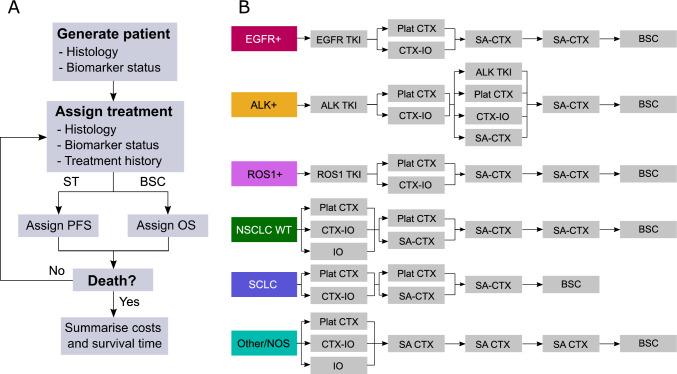
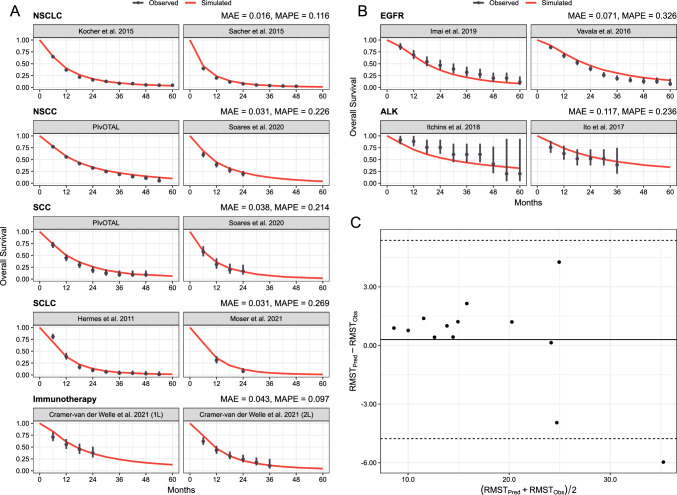
Treatment for advanced lung cancer was modelled under a clinician-specified treatment algorithm for Australia in 2022. Prevalence of lung cancer subpopulations was extracted from cBioPortal and the Sax Institute's 45 and Up Study, a large prospective cohort linked to cancer registrations. All costs were from the health system perspective for the year 2020. Pharmaceutical and molecular diagnostic costs were obtained from public reimbursement fees, while other healthcare costs were obtained from health system costs in the 45 and Up Study. Treatment efficacy was obtained from clinical trials and observational study data. Costs and survival were modelled over a 10-year horizon. Uncertainty intervals were generated with probabilistic sensitivity analyses. Overall survival predictions were validated against real-world studies.
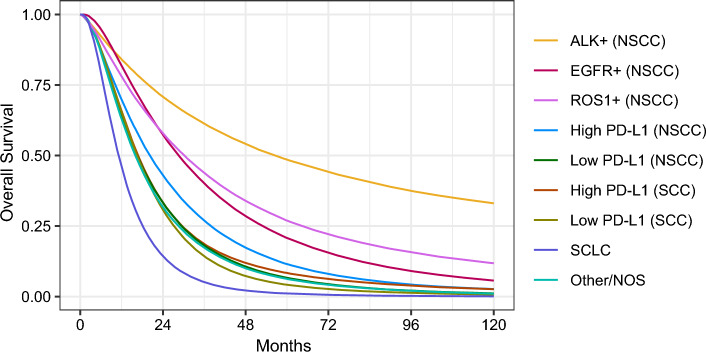
Under the 2022 treatment algorithm, estimated mean survival and costs for advanced lung cancer 10 years post-diagnosis were 16.4 months (95% uncertainty interval [UI]: 14.7-18.1) and AU$116,069 (95% UI: $107,378-$124,933). Survival and costs were higher assuming optimal treatment utilisation rates (20.5 months, 95% UI: 19.1-22.5; $154,299, 95% UI: $146,499-$161,591). The model performed well in validation, with good agreement between predicted and observed survival in real-world studies.
Survival improvements for advanced lung cancer have been accompanied by growing treatment costs. The estimates reported here can be used for budget planning and economic evaluations of interventions across the spectrum of cancer control.
自 2016 年以来,新的治疗方法改变了肺癌的治疗标准,因此需要针对澳大利亚的情况提供最新的健康经济模型证据。我们开发了一种用于治疗晚期肺癌的离散事件模拟,以提供澳大利亚的生存结果和医疗保健成本的估计值,并且可以随着新疗法的引入进行更新。
根据澳大利亚 2022 年的临床医生指定的治疗算法对晚期肺癌进行治疗建模。从 cBioPortal 和 Sax 研究所的 45 and Up 研究中提取肺癌亚群的患病率,这是一个与癌症登记相关的大型前瞻性队列。所有成本均来自 2020 年的健康系统角度。药物和分子诊断成本是从公共报销费用中获得的,而其他医疗保健成本则是从 45 and Up 研究中的健康系统成本中获得的。治疗效果是从临床试验和观察性研究数据中获得的。成本和生存数据在 10 年的时间范围内进行建模。通过概率敏感性分析生成不确定区间。使用真实世界研究对总体生存预测进行验证。
根据 2022 年的治疗算法,诊断后 10 年晚期肺癌的估计平均生存时间和成本分别为 16.4 个月(95%置信区间[UI]:14.7-18.1)和 116069 澳元(95%UI:107378-124933)。假设最佳治疗利用率(20.5 个月,95%UI:19.1-22.5;$154299,95%UI:$146499-$161591),生存和成本会更高。模型在验证中表现良好,真实世界研究中预测的生存与观察到的生存之间具有良好的一致性。
晚期肺癌的生存改善伴随着治疗成本的不断增加。这里报告的估计值可用于癌症控制各个方面的干预措施的预算规划和经济评估。