Catalano Michele, Bortolotto Chandra, Nicora Giovanna, Achilli Marina Francesca, Consonni Alessio, Ruongo Lidia, Callea Giovanni, Lo Tito Antonio, Biasibetti Carla, Donatelli Antonella, Cutti Sara, Comotto Federico, Stella Giulia Maria, Corsico Angelo, Perlini Stefano, Bellazzi Riccardo, Bruno Raffaele, Filippi Andrea, Preda Lorenzo
Department of Clinical, Surgical, Diagnostic and Pediatric Sciences, University of Pavia, Pavia, Italy and Radiology Department, Fondazione IRCCS Policlinico San Matteo, Pavia, Italy.
Department of Electrical, Computer and Biomedical Engineering, University of Pavia, Pavia, Italy.
Eur J Radiol Open. 2023 Dec;11:100497. doi: 10.1016/j.ejro.2023.100497. Epub 2023 Jun 19.
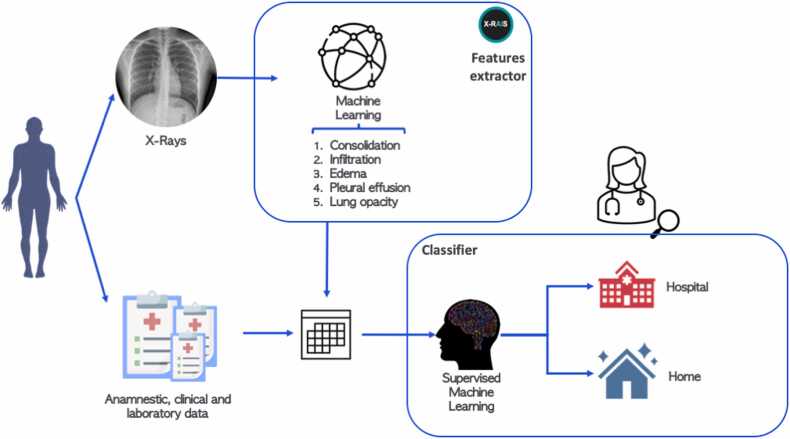
Artificial intelligence (AI) has proved to be of great value in diagnosing and managing infection. ALFABETO (ALL-FAster-BEtter-TOgether) is a tool created to support healthcare professionals in the triage, mainly in optimizing hospital admissions.
The AI was trained during the pandemic's "first wave" (February-April 2020). Our aim was to assess the performance during the "third wave" of the pandemics (February-April 2021) and evaluate its evolution. The neural network proposed behavior (hospitalization vs home care) was compared with what was actually done. If there were discrepancies between ALFABETO's predictions and clinicians' decisions, the disease's progression was monitored. Clinical course was defined as "favorable/mild" if patients could be managed at home or in spoke centers and "unfavorable/severe" if patients need to be managed in a hub center.
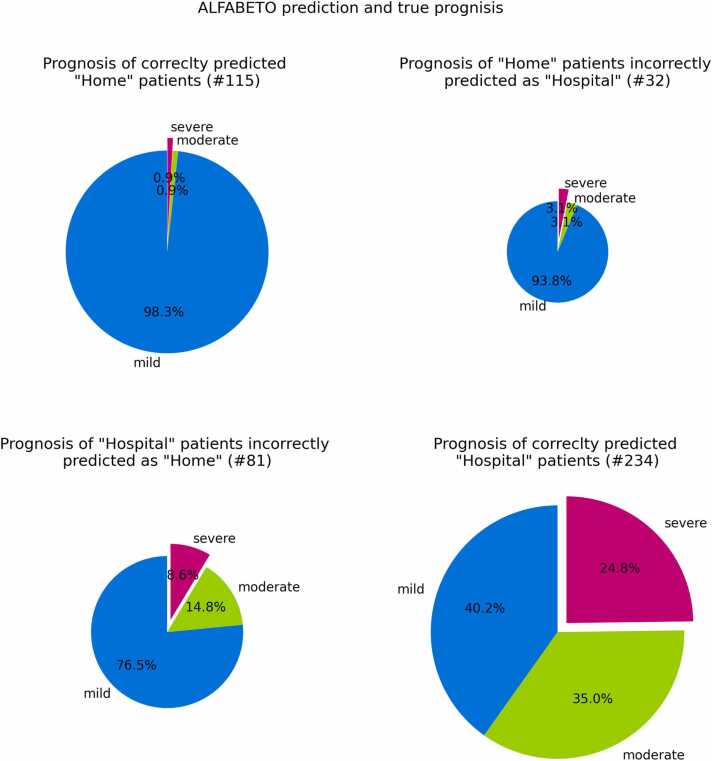
ALFABETO showed accuracy of 76%, AUROC of 83%; specificity was 78% and recall 74%. ALFABETO also showed high precision (88%). 81 hospitalized patients were incorrectly predicted to be in "home care" class. Among those "home-cared" by the AI and "hospitalized" by the clinicians, 3 out of 4 misclassified patients (76.5%) showed a favorable/mild clinical course. ALFABETO's performance matched the reports in literature.
The discrepancies mostly occurred when the AI predicted patients could stay at home but clinicians hospitalized them; these cases could be handled in spoke centers rather than hubs, and the discrepancies may aid clinicians in patient selection. The interaction between AI and human experience has the potential to improve both AI performance and our comprehension of pandemic management.
人工智能(AI)已被证明在感染的诊断和管理中具有巨大价值。ALFABETO(全更快更好在一起)是一种创建的工具,用于支持医疗保健专业人员进行分诊,主要是优化医院入院流程。
该人工智能在疫情的“第一波”(2020年2月至4月)期间进行了训练。我们的目标是评估疫情“第三波”(2021年2月至4月)期间的性能,并评估其演变情况。将神经网络提出的行为(住院与家庭护理)与实际发生的情况进行比较。如果ALFABETO的预测与临床医生的决定存在差异,则监测疾病的进展。如果患者可以在家中或分支中心进行管理,则临床过程定义为“良好/轻度”;如果患者需要在中心枢纽进行管理,则定义为“不良/严重”。
ALFABETO的准确率为76%,曲线下面积(AUROC)为83%;特异性为78%,召回率为74%。ALFABETO还显示出高精度(88%)。有81名住院患者被错误预测为“家庭护理”类别。在那些被人工智能判定为“家庭护理”但被临床医生判定为“住院”的患者中,4名分类错误的患者中有3名(76.5%)显示出良好/轻度的临床过程。ALFABETO的性能与文献报道相符。
差异主要发生在人工智能预测患者可以在家中但临床医生将其收治入院时;这些情况可以在分支中心而不是中心枢纽进行处理,并且这些差异可能有助于临床医生进行患者选择。人工智能与人类经验之间的相互作用有可能提高人工智能的性能以及我们对疫情管理的理解。