Dang Quang Minh, Wemple Ann H, Leopold Michael C
Department of Chemistry, Gottwald Center for the Sciences, University of Richmond, Richmond, VA 23173, USA.
Gels. 2023 May 25;9(6):437. doi: 10.3390/gels9060437.
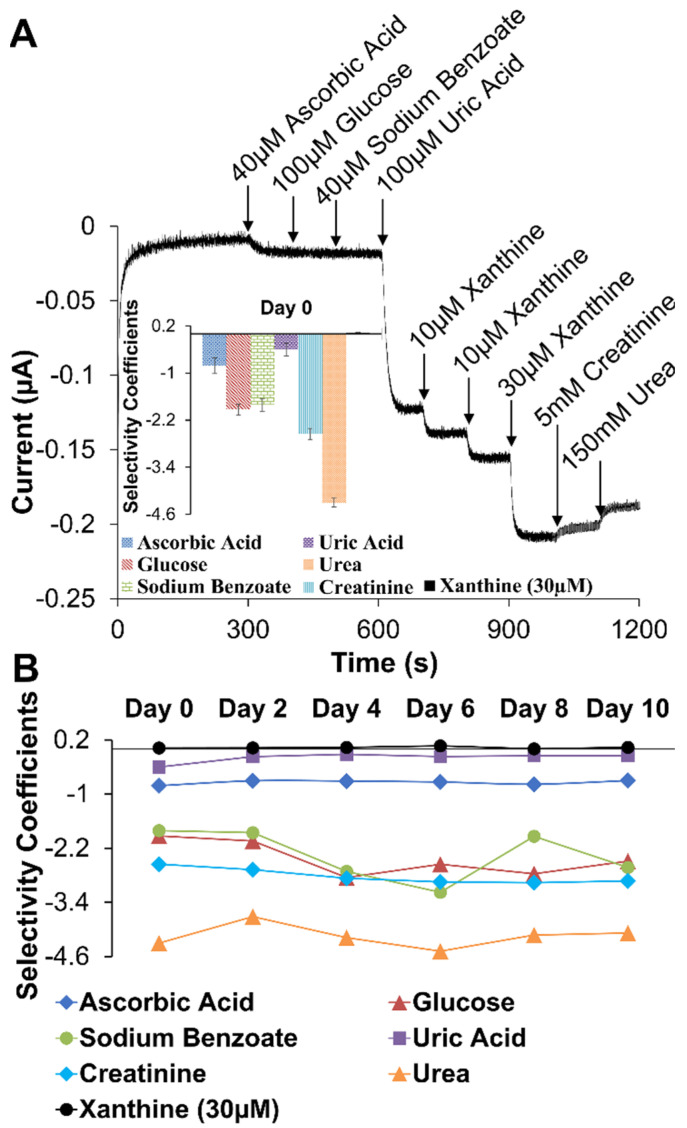
First-generation amperometric xanthine (XAN) biosensors, assembled via layer-by-layer methodology and featuring xerogels doped with gold nanoparticles (Au-NPs), were the focus of this study and involved both fundamental exploration of the materials as well as demonstrated usage of the biosensor in both clinical (disease diagnosis) and industrial (meat freshness) applications. Voltammetry and amperometry were used to characterize and optimize the functional layers of the biosensor design including a xerogel with and without embedded xanthine oxidase enzyme (XOx) and an outer, semi-permeable blended polyurethane (PU) layer. Specifically, the porosity/hydrophobicity of xerogels formed from silane precursors and different compositions of PU were examined for their impact on the XAN biosensing mechanism. Doping the xerogel layer with different alkanethiol protected Au-NPs was demonstrated as an effective means for enhancing biosensor performance including improved sensitivity, linear range, and response time, as well as stabilizing XAN sensitivity and discrimination against common interferent species (selectivity) over time-all attributes matching or exceeding most other reported XAN sensors. Part of the study focuses on deconvoluting the amperometric signal generated by the biosensor and determining the contribution from all of the possible electroactive species involved in natural purine metabolism (e.g., uric acid, hypoxanthine) as an important part of designing XAN sensors (schemes amenable to miniaturization, portability, or low production cost). Effective XAN sensors remain relevant as potential tools for both early diagnosis of diseases as well as for industrial food monitoring.
通过逐层方法组装而成、以掺杂金纳米颗粒(Au-NPs)的干凝胶为特色的第一代安培型黄嘌呤(XAN)生物传感器是本研究的重点,该研究既涉及对材料的基础探索,也展示了生物传感器在临床(疾病诊断)和工业(肉类新鲜度)应用中的使用情况。伏安法和安培法用于表征和优化生物传感器设计的功能层,包括含有和不含嵌入黄嘌呤氧化酶(XOx)的干凝胶以及外部半透性混合聚氨酯(PU)层。具体而言,研究了由硅烷前体形成的干凝胶的孔隙率/疏水性以及不同组成的PU对XAN生物传感机制的影响。结果表明,用不同的烷硫醇保护的Au-NPs掺杂干凝胶层是提高生物传感器性能的有效手段,包括提高灵敏度、线性范围和响应时间,以及随着时间的推移稳定XAN灵敏度并区分常见干扰物质(选择性)——所有这些特性均与大多数其他报道的XAN传感器相当或更优。该研究的一部分重点是对生物传感器产生的安培信号进行去卷积,并确定天然嘌呤代谢中所有可能的电活性物质(例如尿酸、次黄嘌呤)的贡献,这是设计XAN传感器(适用于小型化、便携性或低成本生产的方案)的重要组成部分。有效的XAN传感器作为疾病早期诊断和工业食品监测的潜在工具仍然具有重要意义。