Zemková Erika, Pacholek Martin
Department of Biological and Medical Sciences, Faculty of Physical Education and Sport, Comenius University in Bratislava, 81469 Bratislava, Slovakia.
Faculty of Health Sciences, University of Ss. Cyril and Methodius in Trnava, 91701 Trnava, Slovakia.
J Funct Morphol Kinesiol. 2023 Jun 6;8(2):75. doi: 10.3390/jfmk8020075.
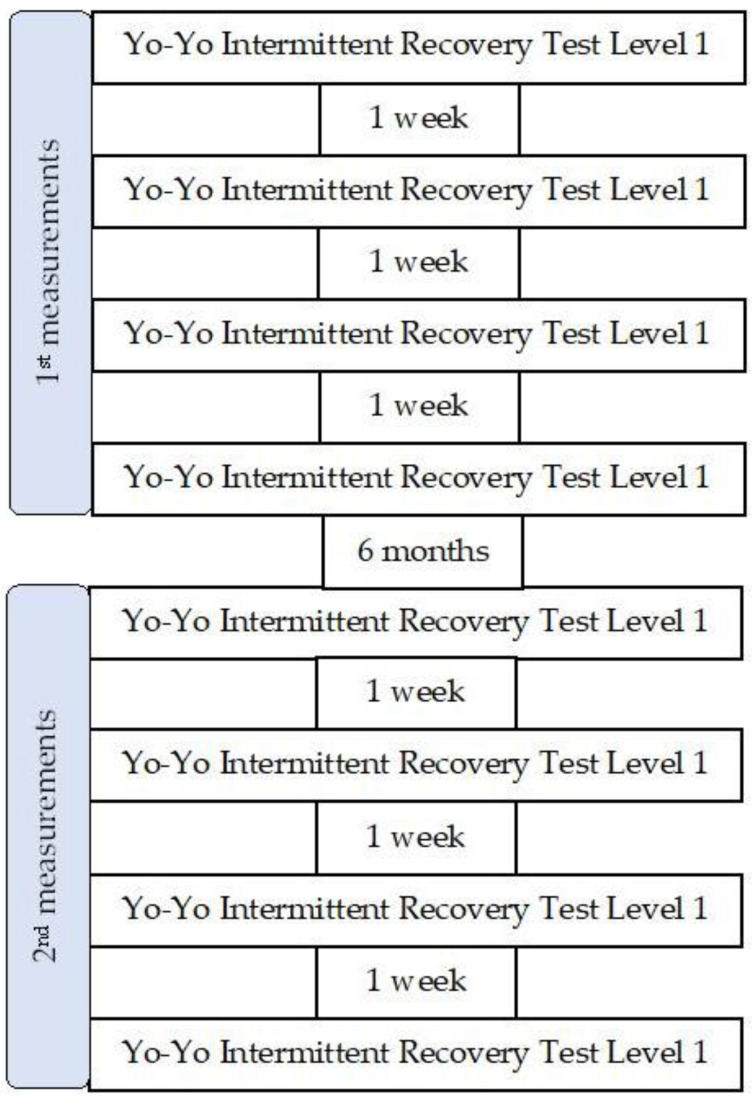
The Yo-Yo Intermittent Test is frequently used to monitor changes in athletes' performance in response to different interventions. However, the question remains as to whether, and to what extent, retakes of this test would contribute to these changes. This case study sought to determine the magnitude of practice effects, involving test repetition, on performance in the Yo-Yo Intermittent Recovery Test. A recreational soccer player performed four attempts of the Yo-Yo Intermittent Recovery Test-Level 1 (YYIR1) with a week's rest in between. The same participant repeated this test protocol (four attempts of the YYIR1) again after six months. Changes in distance covered, level achieved, maximal oxygen uptake, and heart rate between the first and last attempt were assessed. The smallest worthwhile change (SWC), the coefficient of variation (CV), and the 2CV were calculated to identify a trivial, a possibly meaningful, and a certainly meaningful change in YYIR1 performance. The distance covered in the first set of measurements increased from 1320 m to 1560 m (15.4%), which corresponds to a 4.6% increase in the level achieved (from 16.6 to 17.4). Similarly, the distance covered in the second set of measurements increased from 1280 m to 1560 m (17.9%), which corresponds to a 5.5% increase in the level achieved (from 16.5 to 17.4). The participant's performance changes fell outside of the SWC and the CV, but not the 2CV during both sets of measurements. These improvements in YYIR1 performance may be ascribed to practice with repeated attempts of the test by improving running technique at the turning point and/or by simply increasing the linear speed. This fact should always be kept in mind when interpreting the effects of training. Practitioners should differentiate between practice effects associated with repeated test execution and adaptation induced by conducting sport-specific training.
Yo-Yo间歇测试常用于监测运动员在不同干预措施下的成绩变化。然而,该测试的重测是否以及在多大程度上会导致这些变化,仍是个问题。本案例研究旨在确定Yo-Yo间歇恢复测试中测试重复所产生的练习效应的大小。一名业余足球运动员进行了四次Yo-Yo间歇恢复测试一级(YYIR1),每次测试间隔一周休息时间。该参与者在六个月后再次重复此测试方案(四次YYIR1测试)。评估了首次和末次测试之间的跑动距离、达到的级别、最大摄氧量和心率的变化。计算了最小有意义变化(SWC)、变异系数(CV)和2CV,以确定YYIR1成绩中的微小、可能有意义和肯定有意义的变化。第一组测量中的跑动距离从1320米增加到1560米(15.4%),这相当于达到的级别提高了4.6%(从16.6提高到17.4)。同样,第二组测量中的跑动距离从1280米增加到1560米(17.9%),这相当于达到的级别提高了5.5%(从16.5提高到17.4)。在两组测量中,参与者的成绩变化超出了SWC和CV,但未超出2CV。YYIR1成绩的这些提高可能归因于通过在转折点改进跑步技术和/或简单地提高直线速度而进行的测试重复练习。在解释训练效果时应始终牢记这一事实。从业者应区分与重复测试执行相关的练习效应和由进行特定运动训练引起的适应性变化。