Seo Bo Yun, Son KeunBaDa, Son Young-Tak, Dahal Ram Hari, Kim Shukho, Kim Jungmin, Hwang JunHo, Kwon Sung-Min, Lee Jae-Mok, Lee Kyu-Bok, Kim Jin-Wook
Department of Oral & Maxillofacial Surgery, School of Dentistry, Kyungpook National University, Daegu 41940, Republic of Korea.
Advanced Dental Device Development Institute (A3DI), Kyungpook National University, Daegu 41940, Republic of Korea.
J Funct Biomater. 2023 May 26;14(6):297. doi: 10.3390/jfb14060297.
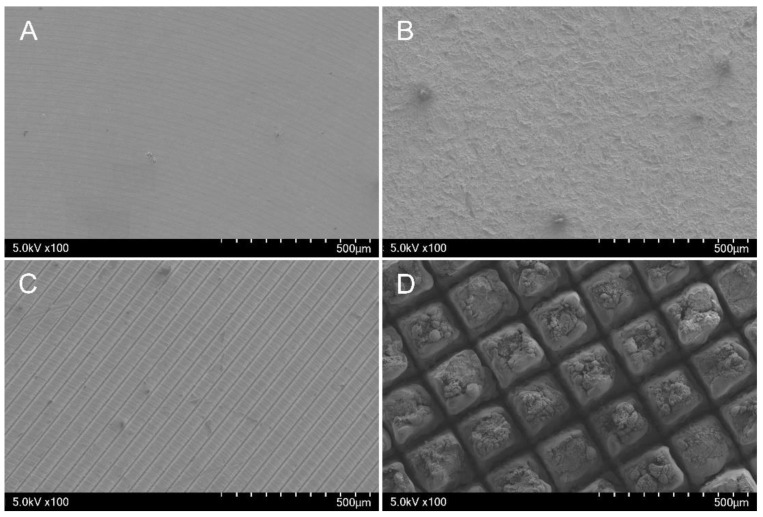
This study aimed to evaluate the impact of different surface treatments (machined; sandblasted, large grit, and acid-etched (SLA); hydrophilic; and hydrophobic) on dental titanium (Ti) implant surface morphology, roughness, and biofilm formation. Four groups of Ti disks were prepared using distinct surface treatments, including femtosecond and nanosecond lasers for hydrophilic and hydrophobic treatments. Surface morphology, wettability, and roughness were assessed. Biofilm formation was evaluated by counting the colonies of (Aa), (Pg), and (Pi) at 48 and 72 h. Statistical analysis was conducted to compare the groups using the Kruskal-Wallis H test and the Wilcoxon signed-rank test (α = 0.05). The analysis revealed that the hydrophobic group had the highest surface contact angle and roughness ( < 0.05), whereas the machined group had significantly higher bacterial counts across all biofilms ( < 0.05). At 48 h, the lowest bacterial counts were observed in the SLA group for Aa and the SLA and hydrophobic groups for Pg and Pi. At 72 h, low bacterial counts were observed in the SLA, hydrophilic, and hydrophobic groups. The results indicate that various surface treatments affect implant surface properties, with the hydrophobic surface using femtosecond laser treatment exerting a particularly inhibitory effect on initial biofilm growth (Pg and Pi).
本研究旨在评估不同表面处理(机械加工;喷砂、大颗粒及酸蚀(SLA);亲水;疏水)对牙科钛(Ti)种植体表面形态、粗糙度和生物膜形成的影响。使用不同的表面处理制备了四组钛盘,包括用于亲水和疏水表面处理的飞秒激光和纳秒激光。评估了表面形态、润湿性和粗糙度。通过在48小时和72小时时计数牙龈卟啉单胞菌(Pg)、伴放线聚集杆菌(Aa)和具核梭杆菌(Pi)的菌落来评估生物膜形成。采用Kruskal-Wallis H检验和Wilcoxon符号秩检验(α = 0.05)进行统计分析以比较各组。分析显示,疏水组具有最高的表面接触角和粗糙度(P < 0.05),而机械加工组在所有生物膜中的细菌计数均显著更高(P < 0.05)。在48小时时,Aa在SLA组中的细菌计数最低,Pg和Pi在SLA组和疏水组中的细菌计数最低。在72小时时,SLA组、亲水组和疏水组中的细菌计数较低。结果表明,各种表面处理会影响种植体表面特性,飞秒激光处理的疏水表面对初始生物膜生长(Pg和Pi)具有特别的抑制作用。