Yao Jun, Zhou Pengfei, Zhang Xin, Yuan Beilei, Pan Yong, Jiang Juncheng
College of Safety Science and Engineering, Nanjing Tech University, Nanjing 211816, China.
Jiangsu Key Laboratory of Hazardous Chemicals Safety and Control, Nanjing Tech University, Nanjing 211816, China.
Toxics. 2023 Jun 13;11(6):528. doi: 10.3390/toxics11060528.
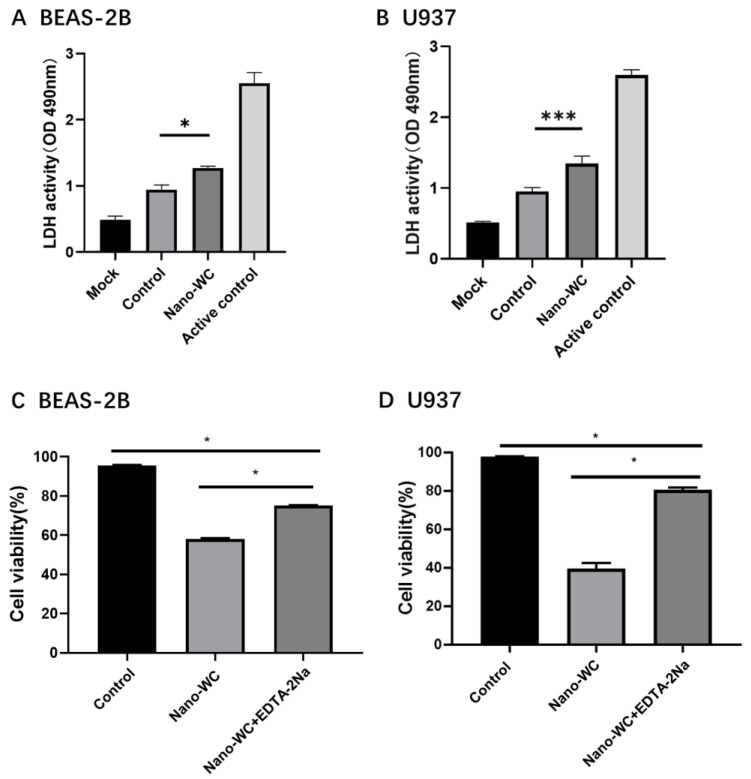
Tungsten carbide nanoparticles (nano-WC) are prevalent in composite materials, and are attributed to their physical and chemical properties. Due to their small size, nano-WC particles can readily infiltrate biological organisms via the respiratory tract, thereby posing potential health hazards. Despite this, the studies addressing the cytotoxicity of nano-WC remain notably limited. To this purpose, the BEAS-2B and U937 cells were cultured in the presence of nano-WC. The significant cytotoxicity of nano-WC suspension was evaluated using a cellular LDH assay. To investigate the cytotoxic impact of tungsten ions (W) on cells, the ion chelator (EDTA-2Na) was used to adsorb W from nano-WC suspension. Subsequent to this treatment, the modified nano-WC suspension was subjected to flow cytometry analysis to evaluate the rates of cellular apoptosis. According to the results, a decrease in W could mitigate the cellular damage and enhance cell viability, which indicated that W indeed exerted a significant cytotoxic influence on the cells. Overall, the present study provides valuable insight into the toxicological mechanisms underlying the exposure of lung cells to nano-WC, thereby reducing the environmental toxicant risk to human health.
碳化钨纳米颗粒(纳米WC)在复合材料中普遍存在,这归因于它们的物理和化学性质。由于其尺寸小,纳米WC颗粒可通过呼吸道轻易渗透到生物体内,从而构成潜在的健康危害。尽管如此,针对纳米WC细胞毒性的研究仍然非常有限。为此,在纳米WC存在的情况下培养BEAS-2B和U937细胞。使用细胞乳酸脱氢酶(LDH)测定法评估纳米WC悬浮液的显著细胞毒性。为了研究钨离子(W)对细胞的细胞毒性影响,使用离子螯合剂(EDTA-2Na)从纳米WC悬浮液中吸附W。此处理后,对改性纳米WC悬浮液进行流式细胞术分析,以评估细胞凋亡率。根据结果,W的减少可减轻细胞损伤并提高细胞活力,这表明W确实对细胞产生了显著的细胞毒性影响。总体而言,本研究为肺细胞暴露于纳米WC的毒理学机制提供了有价值的见解,从而降低了环境毒物对人类健康的风险。