Sarabia-Salgado Lucero, Alves Bruno J R, Boddey Robert, Urquiaga Segundo, Galindo Francisco, Flores-Coello Gustavo, Santos Camila Almeida Dos, Jiménez-Ocampo Rafael, Ku-Vera Juan, Solorio-Sánchez Francisco
Department of Ethology, Wildlife and Laboratory Animals, Faculty of Veterinary Medicine and Animal Science, National Autonomous University of Mexico (UNAM), Ciudad Universitaria, Mexico City C.P. 04510, Mexico.
EMBRAPA/Agrobiologia, Brazilian Corporation for Agricultural Research-National Centre for Agrobiology Research, Seropédica 23891-000, RJ, Brazil.
Animals (Basel). 2023 Jun 9;13(12):1941. doi: 10.3390/ani13121941.
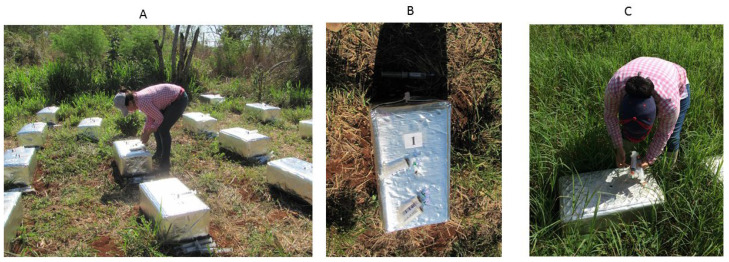
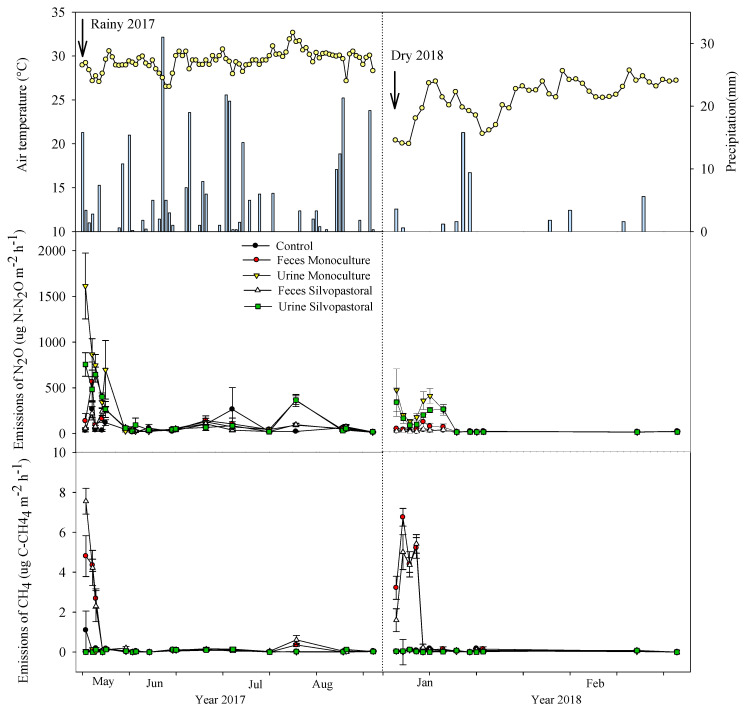
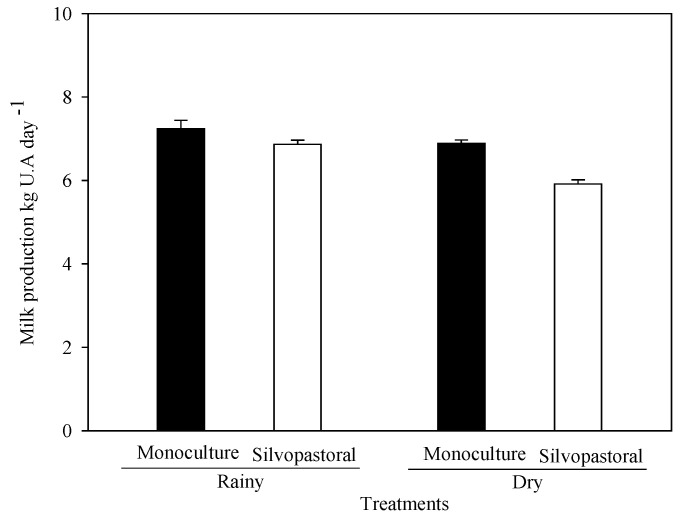
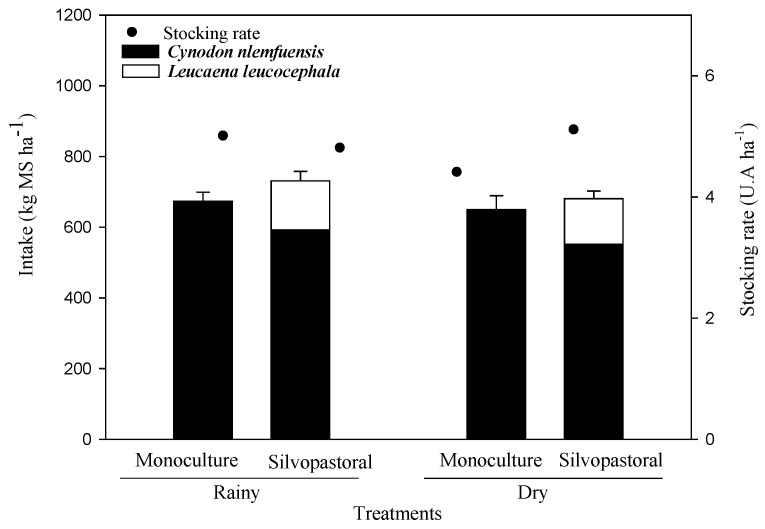
In Mexico, pasture degradation is associated with extensive pastures; additionally, under these conditions, livestock activities contribute considerably to greenhouse gas (GHG) emissions. Among the options to improve grazing systems and reduce GHG emissions, silvopastoral systems (SPS) have been recommended. The objectives of this work were to quantify the N outflow in a soil-plant-animal interface, as well as the CH emissions and milk production in an SPS with woody legumes () that is associated with stargrass (). This was then compared with stargrass in a monoculture system (MS) in the seasons (dry and rainy period) over a two-year period. Dung was collected from the animals of each of the grazing systems and applied fresh to the land plots. Fresh dung and urine were collected from the cows of each grazing system and were applied to the experimental plots. In addition, the soil CH and NO contents were measured to quantify the emissions. Average milk yield by seasons was similar: MS (7.1 kg per animal unit (AU)/day) and SPS (6.31 kg per AU/day). Cows in the MS had a mean N intake of 171.9 g/UA day without seasonal variation, while the SPS animals' mean N intake was 215.7 g/UA day for both seasons. For the urine applied to soil, the NO outflow was higher in the MS (peak value = 1623.9 μg N-NO m h). The peak value for the SPS was 755.9 μg of N-NO m h. The NO emissions were higher in the rainy season (which promotes denitrification). The values for the feces treatment were 0.05% (MS) and 0.01% (SPS). The urine treatment values were 0.52% (MS) and 0.17% (SPS). The emissions of CH showed that the feces of the SPS systems resulted in a higher accumulation of gas in the rainy season (29.8 g C ha), followed by the feces of the MS system in the dry season (26.0 g C ha). Legumes in the SPS helped to maintain milk production, and the NO emissions were lower than those produced by the MS (where the pastures were fertilized with N).
在墨西哥,牧场退化与粗放型牧场有关;此外,在这些条件下,畜牧活动对温室气体(GHG)排放有相当大的贡献。在改善放牧系统和减少温室气体排放的诸多选择中,林牧系统(SPS)被推荐采用。这项工作的目标是量化土壤 - 植物 - 动物界面中的氮流出量,以及与星草相关的含木本豆科植物()的林牧系统中的甲烷排放和牛奶产量。然后将其与两年期间不同季节(旱季和雨季)的单作系统(MS)中的星草进行比较。从每个放牧系统的动物身上收集粪便并新鲜施用于地块。从每个放牧系统的奶牛身上收集新鲜粪便和尿液并施用于试验地块。此外,测量土壤甲烷和一氧化氮含量以量化排放。各季节的平均牛奶产量相似:单作系统(每动物单位(AU)/天7.1千克)和林牧系统(每AU/天6.31千克)。单作系统中的奶牛平均氮摄入量为171.9克/UA天,无季节变化,而林牧系统动物在两个季节的平均氮摄入量均为215.7克/UA天。对于施用于土壤的尿液,单作系统中的一氧化氮流出量更高(峰值 = 1623.9微克N-NO/平方米·小时)。林牧系统的峰值为755.9微克N-NO/平方米·小时。一氧化氮排放在雨季更高(促进反硝化作用)。粪便处理的值分别为0.05%(单作系统)和0.01%(林牧系统)。尿液处理的值分别为0.52%(单作系统)和0.17%(林牧系统)。甲烷排放表明,林牧系统的粪便在雨季导致更高的气体积累(29.8克碳/公顷),其次是旱季单作系统的粪便(26.0克碳/公顷)。林牧系统中的豆科植物有助于维持牛奶产量,且一氧化氮排放低于单作系统(单作系统牧场施用氮肥)产生的排放。