Department of Ophthalmology, Charité-Universitätsmedizin Berlin, Corporate Member of Freie Universität Berlin and Humboldt-Universität zu Berlin, Hindenburgdamm 30, 12203 Berlin, Germany.
Alacris Theranostics, Max-Planck-Straße 3, 12489 Berlin, Germany.
Int J Mol Sci. 2023 Jun 19;24(12):10327. doi: 10.3390/ijms241210327.
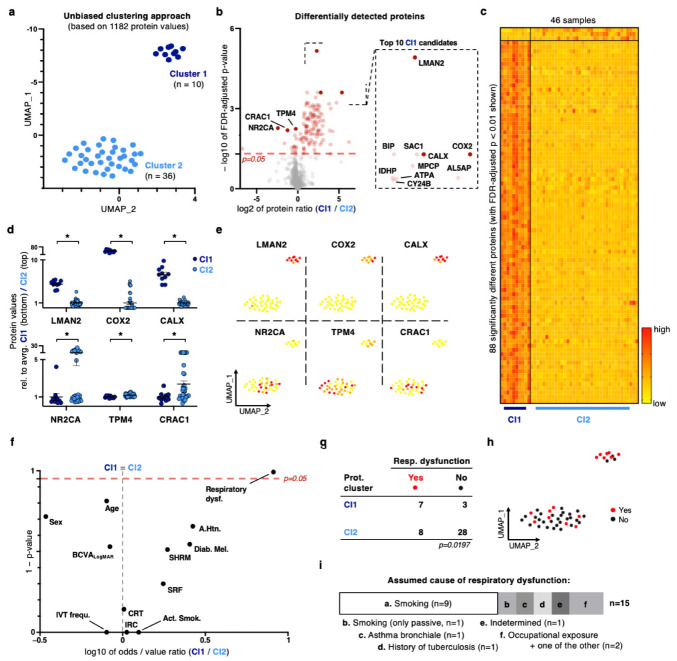
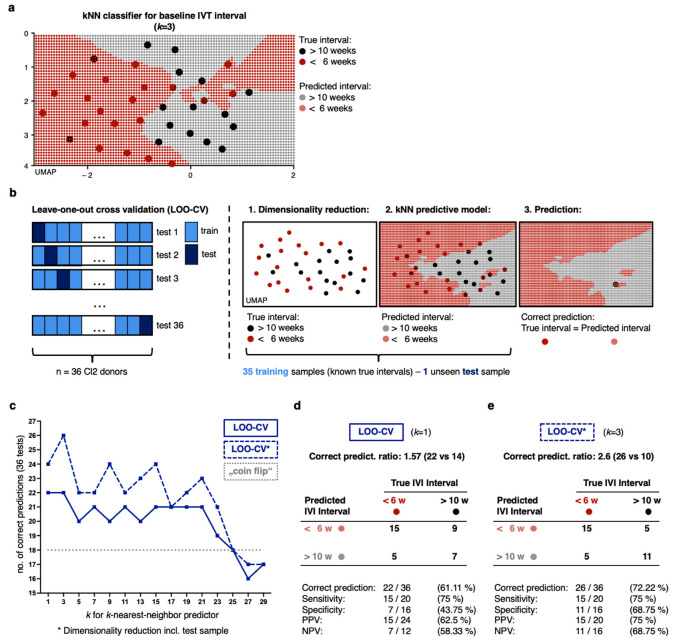
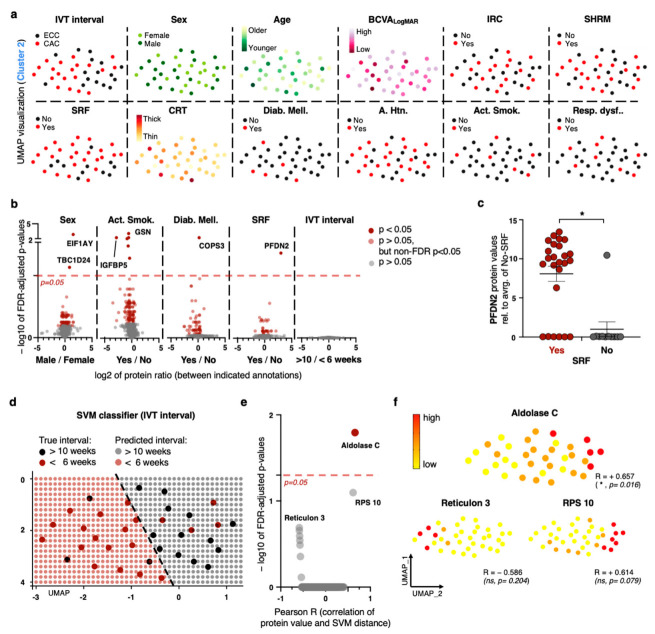
There is early evidence of extraocular systemic signals effecting function and morphology in neovascular age-related macular degeneration (nAMD). The prospective, cross-sectional BIOMAC study is an explorative investigation of peripheral blood proteome profiles and matched clinical features to uncover systemic determinacy in nAMD under anti-vascular endothelial growth factor intravitreal therapy (anti-VEGF IVT). It includes 46 nAMD patients stratified by the level of disease control under ongoing anti-VEGF treatment. Proteomic profiles in peripheral blood samples of every patient were detected with LC-MS/MS mass spectrometry. The patients underwent extensive clinical examination with a focus on macular function and morphology. In silico analysis includes unbiased dimensionality reduction and clustering, a subsequent annotation of clinical features, and non-linear models for recognition of underlying patterns. The model assessment was performed using leave-one-out cross validation. The findings provide an exploratory demonstration of the link between systemic proteomic signals and macular disease pattern using and validating non-linear classification models. Three main results were obtained: (1) Proteome-based clustering identifies two distinct patient subclusters with the smaller one ( = 10) exhibiting a strong signature for oxidative stress response. Matching the relevant meta-features on the individual patient's level identifies pulmonary dysfunction as an underlying health condition in these patients. (2) We identify biomarkers for nAMD disease features with Aldolase C as a putative factor associated with superior disease control under ongoing anti-VEGF treatment. (3) Apart from this, isolated protein markers are only weakly correlated with nAMD disease expression. In contrast, applying a non-linear classification model identifies complex molecular patterns hidden in a high number of proteomic dimensions determining macular disease expression. In conclusion, so far unconsidered systemic signals in the peripheral blood proteome contribute to the clinically observed phenotype of nAMD, which should be examined in future translational research on AMD.
有早期证据表明,眼外全身信号会影响新生血管性年龄相关性黄斑变性(nAMD)的功能和形态。前瞻性、横断面 BIOMAC 研究是一项探索性研究,旨在研究外周血蛋白质组谱和匹配的临床特征,以揭示接受抗血管内皮生长因子玻璃体内治疗(抗-VEGF IVT)的 nAMD 患者的全身决定因素。该研究纳入了 46 名 nAMD 患者,这些患者根据正在进行的抗-VEGF 治疗下疾病控制水平进行分层。每位患者的外周血样本的蛋白质组谱均采用 LC-MS/MS 质谱法进行检测。患者接受了广泛的临床检查,重点是黄斑功能和形态。计算分析包括无偏维数缩减和聚类、随后对临床特征进行注释,以及用于识别潜在模式的非线性模型。使用留一法交叉验证进行模型评估。研究结果提供了一个探索性的证据,表明使用和验证非线性分类模型可以将全身蛋白质组信号与黄斑疾病模式联系起来。主要有三个发现:(1)基于蛋白质组的聚类可识别出两种不同的患者亚群,其中较小的一个(= 10)表现出强烈的氧化应激反应特征。在个体患者水平上匹配相关元特征,可确定这些患者存在肺部功能障碍的潜在健康状况。(2)我们确定了与 nAMD 疾病特征相关的生物标志物,醛缩酶 C 是在持续接受抗-VEGF 治疗下疾病控制良好的潜在因素。(3)除此之外,孤立的蛋白质标记物与 nAMD 疾病表达相关性较弱。相比之下,应用非线性分类模型可以识别出隐藏在大量蛋白质组维度中的复杂分子模式,这些模式决定了黄斑疾病的表达。总之,目前在周围血液蛋白质组中尚未考虑到的全身信号会影响 nAMD 的临床表现,这在 AMD 的未来转化研究中应该进行进一步的研究。