Gaita Fiorenzo, Ferraris Federico, Anselmino Matteo, Calò Leonardo
Department of Medical Sciences, University of Torino, Turin, Italy.
Maria Pia Hospital, GVM Care & Research, Torino, Italy.
Eur Heart J Suppl. 2023 Apr 26;25(Suppl C):C7-C11. doi: 10.1093/eurheartjsupp/suad003. eCollection 2023 May.
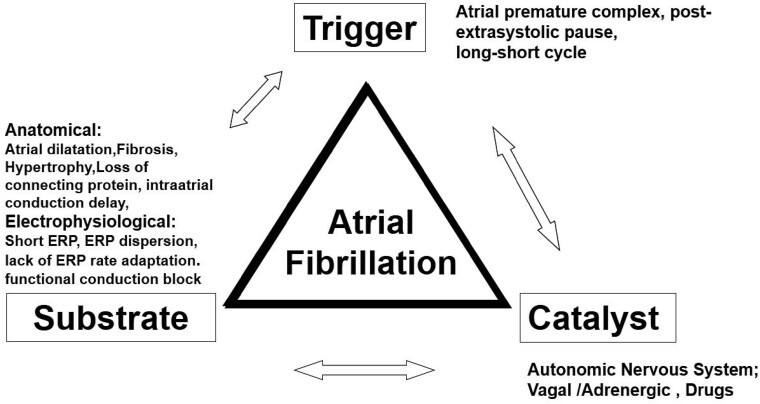
Atrial fibrillation (AF) is a common and harmful arrhythmia. Its complex pathogenesis can be outlined using Coumel's Triangle, that considers at the base of AF three different factors: substrate, trigger, and catalyst factor. The triangle can serve as a guide to understand the mechanism of action of the different possible treatments. Anti-arrhythmic drug therapies have a modest efficacy and no proven benefit on prognosis. Interventional therapy is more effective, especially if employed in the first stages of the disease, and can reduce mortality in selected populations. Ablative schemes must be different depending on the type of AF (paroxysmal, persistent) and the presence or absence of atrial dilation.
心房颤动(AF)是一种常见且有害的心律失常。其复杂的发病机制可用库梅尔三角来概述,该三角在房颤的基础上考虑三个不同因素:基质、触发因素和催化因素。这个三角可作为理解不同可能治疗方法作用机制的指南。抗心律失常药物治疗疗效一般,且对预后无已证实的益处。介入治疗更有效,尤其是在疾病的早期阶段应用时,并且可以降低特定人群的死亡率。消融方案必须根据房颤的类型(阵发性、持续性)以及是否存在心房扩张而有所不同。