Toubon Gaël, Butel Marie-José, Rozé Jean-Christophe, Nicolis Ioannis, Delannoy Johanne, Zaros Cécile, Ancel Pierre-Yves, Aires Julio, Charles Marie-Aline
Centre de Recherche en Épidémiologie et StatistiqueS (CRESS), Inserm, INRAE, Université Paris Cité et Université Sorbonne Paris Nord, 75004 Paris, France.
Physiopathologie et Pharmacotoxicologie Placentaire Humaine Microbiote Pré & Postnatal (3PHM), Inserm, UMR-S 1139, Université Paris Cité, 75006 Paris, France.
Microorganisms. 2023 May 25;11(6):1390. doi: 10.3390/microorganisms11061390.
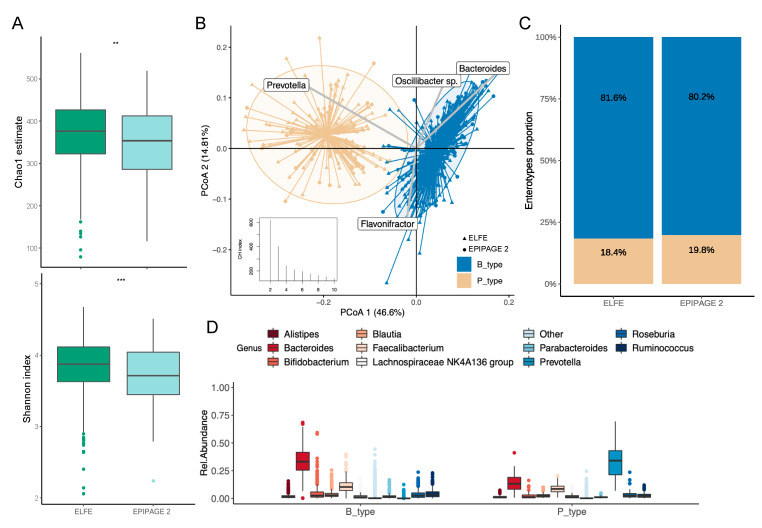
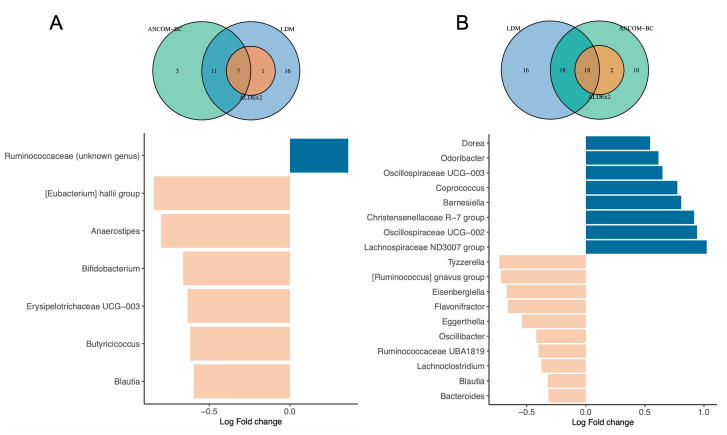
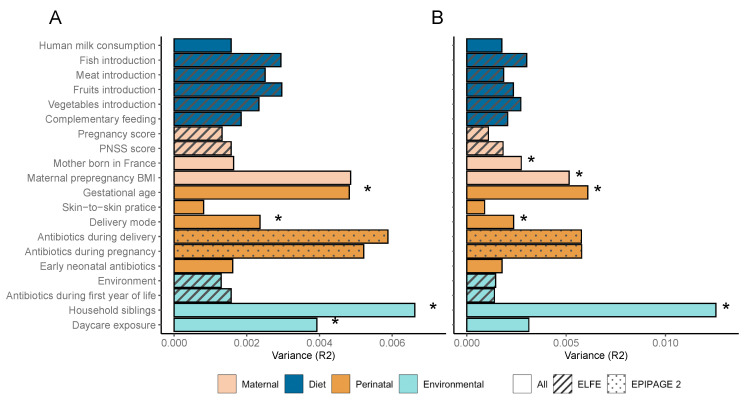
Early life gut microbiota-influencing factors may play an important role in programming individuals long-term health and substantial efforts have been devoted into studying the development of the gut microbiota in relation to early life events. This study aimed to examine in a single study, the persistence of associations between 20 factors occurring in the early life and the gut microbiota at 3.5 years of 798 children from two French nationwide birth cohorts, EPIPAGE 2 (very preterm children) and ELFE (late preterm and full-term children). Gut microbiota profiling was assessed using 16S rRNA gene sequencing-based method. Upon thorough adjustment of confounding factors, we demonstrated that gestational age was one of the factors most associated with gut microbiota differences with a noticeable imprint of prematurity at 3.5 years of age. Children born by cesarean section harbored lower richness and diversity and a different overall gut microbiota composition independently of preterm status. Children who had ever received human milk were associated with a -driven enterotype (P_type) compared to those who had never received human milk. Living with a sibling was associated with higher diversity. Children with siblings and those attending daycare centers were associated with a P_type enterotype. Maternal factors including the country of birth and preconception maternal body mass index were associated with some microbiota characteristics: children born to overweight or obese mothers showed increased gut microbiota richness. This study reveals that multiple exposures operating from early life imprint the gut microbiota at 3.5 years that is a pivotal age when the gut microbiota acquires many of its adult characteristics.
早期生活中影响肠道微生物群的因素可能在塑造个体长期健康方面发挥重要作用,并且人们已经投入了大量精力来研究与早期生活事件相关的肠道微生物群的发育。本研究旨在在一项单一研究中,考察来自法国两个全国性出生队列(EPIPAGE 2,极早产儿;ELFE,晚期早产儿和足月儿)的798名儿童在3.5岁时,早期生活中出现的20个因素与肠道微生物群之间关联的持续性。使用基于16S rRNA基因测序的方法评估肠道微生物群谱。在对混杂因素进行全面调整后,我们证明胎龄是与肠道微生物群差异最相关的因素之一,在3.5岁时存在明显的早产印记。剖宫产出生的儿童肠道微生物群的丰富度和多样性较低,且总体肠道微生物群组成不同,与早产状态无关。与从未接受过母乳的儿童相比,曾经接受过母乳的儿童与一种由母乳驱动的肠型(P型)相关。与兄弟姐妹一起生活与更高的多样性相关。有兄弟姐妹和上日托中心的儿童与P型肠型相关。包括出生国家和孕前母亲体重指数在内的母亲因素与一些微生物群特征相关:超重或肥胖母亲所生的儿童肠道微生物群丰富度增加。这项研究表明,从生命早期开始的多种暴露会在3.5岁时印记肠道微生物群,3.5岁是肠道微生物群获得许多成人特征的关键年龄。