Guidi Fabrizia, Centorotola Gabriella, Chiaverini Alexandra, Iannetti Luigi, Schirone Maria, Visciano Pierina, Cornacchia Alessandra, Scattolini Silvia, Pomilio Francesco, D'Alterio Nicola, Torresi Marina
Istituto Zooprofilattico Sperimentale Dell'abruzzo e del Molise "G. Caporale", Via Campo Boario, 64100 Teramo, Italy.
Faculty of Bioscience and Technology for Food, Agriculture and Environment, University of Teramo, Via R. Balzarini, 1, 64100 Teramo, Italy.
Microorganisms. 2023 Jun 9;11(6):1543. doi: 10.3390/microorganisms11061543.
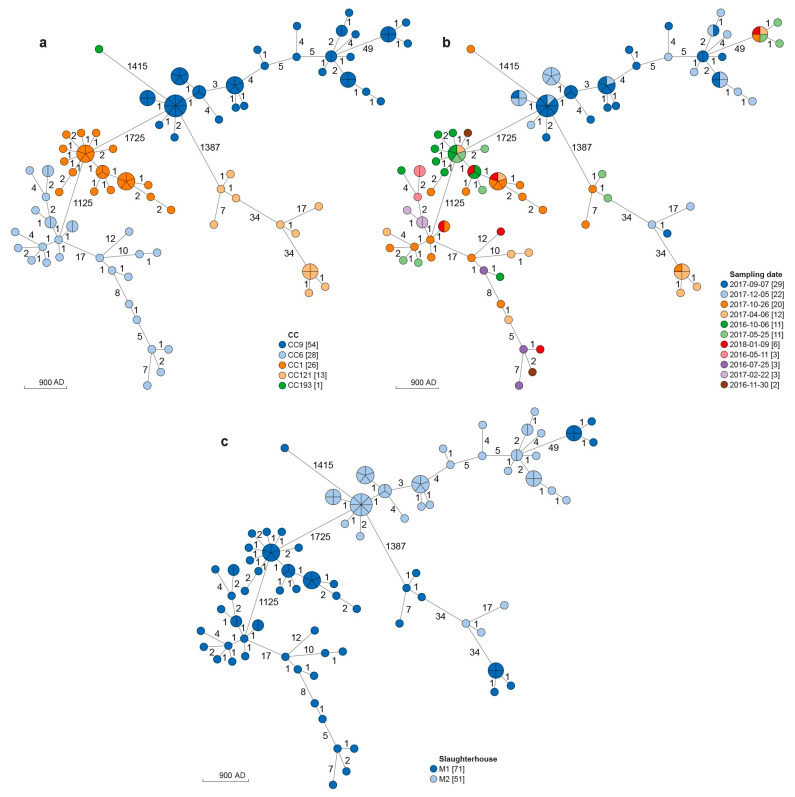
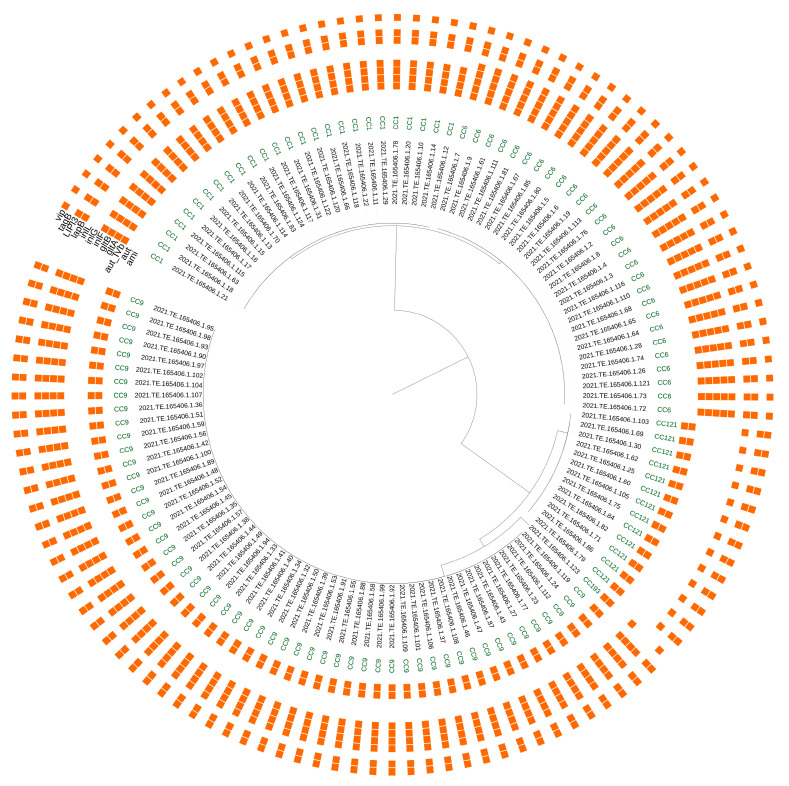
In Europe, very few studies are available regarding the diversity of clonal complexes (CCs) and sequence types (ST) in poultry and on the related typing of isolates using whole genome sequencing (WGS). In this study, we used a WGS approach to type 122 strains isolated from chicken neck skin samples collected in two different slaughterhouses of an integrated Italian poultry company. The studied strains were classified into five CCs: CC1-ST1 (21.3%), CC6-ST6 (22.9%), CC9-ST9 (44.2%), CC121-ST121 (10.6%) and CC193-ST193 (0.8%). CC1 and CC6 strains presented a virulence gene profile composed of 60 virulence genes and including the Listeria Pathogenicity Island 3, , and . According to cgMLST and SNPs analysis, long-term persistent clusters belonging to CC1 and CC6 were found in one of the two slaughterhouses. The reasons mediating the persistence of these CCs (up to 20 months) remain to be elucidated, and may involve the presence and the expression of stress response and environmental adaptation genes including heavy metals resistance genes (), multidrug efflux pumps (), cold-shock tolerance () and biofilm-formation determinants (). These findings indicated a serious risk of poultry finished products contamination with hypervirulent clones and raised concern for the consumer health. In addition to the AMR genes and , ubiquitous in strains, we also identified for quinolones, for macrolides and for tetracyclines. Although the phenotypical expression of these AMR genes was not tested, none of them is known to confer resistance to the primary antibiotics used to treat listeriosis The obtained results increase the data on the clones circulating in Italy and in particular in the poultry chain.
在欧洲,关于家禽中克隆复合体(CCs)和序列类型(ST)的多样性以及使用全基因组测序(WGS)对分离株进行相关分型的研究非常少。在本研究中,我们采用WGS方法对从一家意大利综合家禽公司的两个不同屠宰场采集的鸡颈部皮肤样本中分离出的122株菌株进行分型。所研究的菌株被分为五个CCs:CC1-ST1(21.3%)、CC6-ST6(22.9%)、CC9-ST9(44.2%)、CC121-ST121(10.6%)和CC193-ST193(0.8%)。CC1和CC6菌株呈现出由60个毒力基因组成的毒力基因谱,包括李斯特菌致病岛3、 、 和 。根据核心基因组多位点序列分型(cgMLST)和单核苷酸多态性(SNPs)分析,在两个屠宰场之一中发现了属于CC1和CC6的长期持续存在的聚类。介导这些CCs持续存在(长达20个月)的原因仍有待阐明,可能涉及应激反应和环境适应基因的存在和表达,包括重金属抗性基因( )、多药外排泵( )、耐冷休克( )和生物膜形成决定因素( )。这些发现表明家禽成品被高毒力克隆污染的严重风险,并引起了对消费者健康的关注。除了在 菌株中普遍存在的抗生素抗性(AMR)基因 和 外,我们还鉴定出了喹诺酮类的 、大环内酯类的 和四环素类的 。尽管这些AMR基因的表型表达未进行测试,但它们均未被认为赋予对用于治疗李斯特菌病的主要抗生素的抗性。所获得的结果增加了关于在意大利特别是在家禽链中传播的 克隆的数据。