Centorotola Gabriella, Ziba Maureen Wakwamba, Cornacchia Alessandra, Chiaverini Alexandra, Torresi Marina, Guidi Fabrizia, Cammà Cesare, Bowa Benson, Mtonga Samson, Magambwa Phelly, D'Alterio Nicola, Scacchia Massimo, Pomilio Francesco, Muuka Geoffrey
Istituto Zooprofilattico Sperimentale dell'Abruzzo e del Molise "G. Caporale", Teramo, Italy.
Central Veterinary Research Institute, Ministry of Fisheries and Livestock, Lusaka, Zambia.
Front Microbiol. 2023 Aug 30;14:1228726. doi: 10.3389/fmicb.2023.1228726. eCollection 2023.
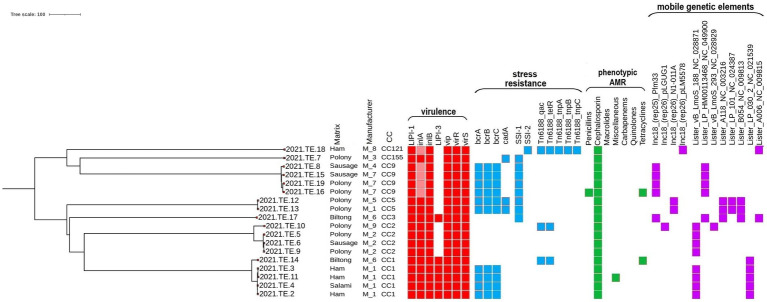
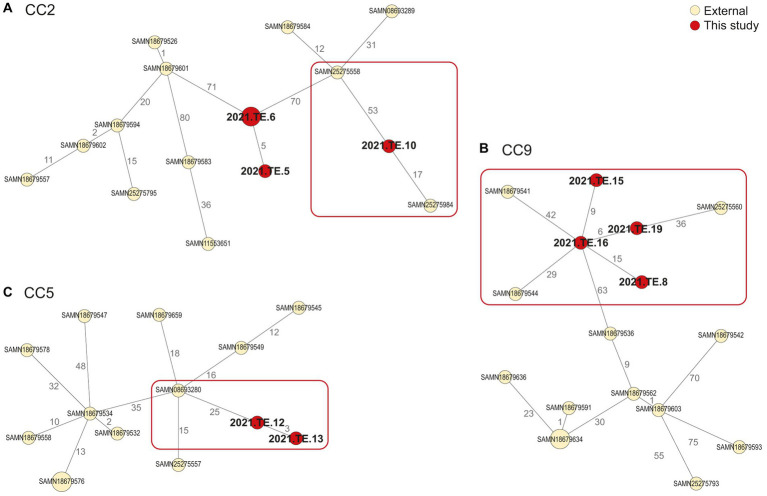
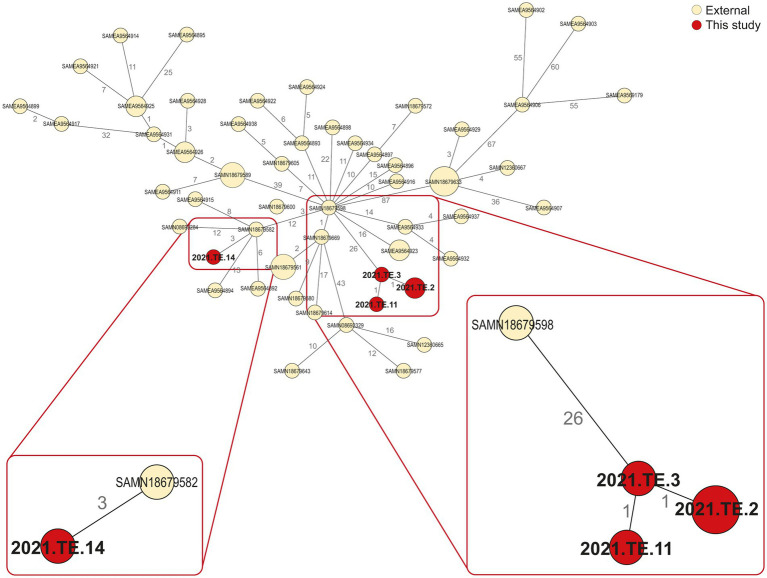
The contamination of ready to eat foods (RTE) products due to could compromise the products safety becoming a great risk for the consumers. The high presence of in RTE products has been described worldwide, but few data are available about these products from African countries. The aims of this study were to report the presence of in Zambian RTE products, providing genomic characterization and data on similarity with African circulating strains using whole genome sequencing (WGS). A total of 304 RTE products, produced by different Zambian manufacturers, were purchased at retail, from major supermarkets located in Lusaka, Zambia, comprising 130 dairy and 174 meat products. was detected only in 18 (10.3%) RTE meat products of the 174 samples tested. The MLST analysis grouped the 18 isolates in 7 clonal complexes (CCs): CC1 ( = 5), CC2 ( = 4), CC9 ( = 4), CC5 ( = 2), CC121 ( = 1), CC155 ( = 1), and CC3 ( = 1). According to the cgMLST results, several clusters were detected, in particular belonging to hyper-virulent clones CC1 and CC2. Regarding the virulence factors, a complete Pathogenicity Island 3 (LIPI-3) was present both in the CC1 and CC3, in addition to LIPI-1. Several resistance genes and mobile genetic elements were detected, including Stress Islands, the cassette and _qac transposon, plasmids and intact prophages. Despite being a first preliminary work with a limited number of samples and isolates, this study helped to increase existing knowledge on contaminated RTE products in Zambia, confirming the presence of hyper-virulent CCs, which could play an important role in human diseases, posing a public health concern for consumers.
即食食品(RTE)因[未提及具体污染因素]而受到污染,可能会危及产品安全,给消费者带来巨大风险。全球范围内都有报道称即食产品中[未提及具体物质]含量很高,但关于非洲国家此类产品的数据却很少。本研究的目的是报告赞比亚即食产品中[未提及具体物质]的存在情况,利用全基因组测序(WGS)提供基因组特征以及与非洲流行菌株的相似性数据。从赞比亚卢萨卡的主要超市零售购买了304种由不同赞比亚制造商生产的即食产品,其中包括130种乳制品和174种肉类产品。在所检测的174个样本中,仅在18种(10.3%)即食肉类产品中检测到[未提及具体物质]。多位点序列分型(MLST)分析将这18株[未提及具体物质]分离株归为7个克隆复合体(CCs):CC1(=5)、CC2(=4)、CC9(=4)、CC5(=2)、CC121(=1)、CC155(=1)和CC3(=1)。根据核心多位点序列分型(cgMLST)结果,检测到了几个簇,特别是属于高毒力克隆CC1和CC2的簇。关于毒力因子,除了致病岛1(LIPI - 1)外,CC1和CC3中均存在完整的致病岛3(LIPI - 3)。检测到了多个耐药基因和移动遗传元件,包括应激岛、[未提及具体盒式结构]盒和_qac转座子、质粒和完整的原噬菌体。尽管这是一项样本和分离株数量有限的初步工作,但本研究有助于增加对赞比亚受污染即食产品的现有认识,证实了高毒力[未提及具体物质]克隆复合体的存在,它们可能在人类疾病中起重要作用,对消费者构成公共卫生问题。