Department of Chemistry, Quaid-i-Azam University, Islamabad 45320, Pakistan.
National Centre of Excellence in Physical Chemistry, University of Peshawar, Peshawar 25120, Pakistan.
Molecules. 2023 Jun 7;28(12):4600. doi: 10.3390/molecules28124600.
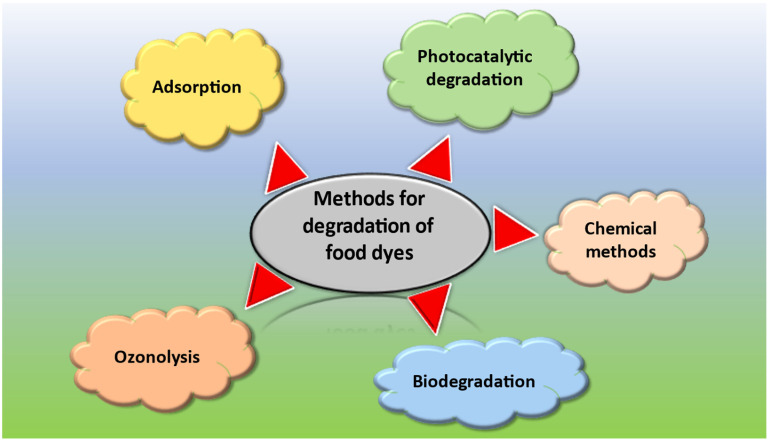
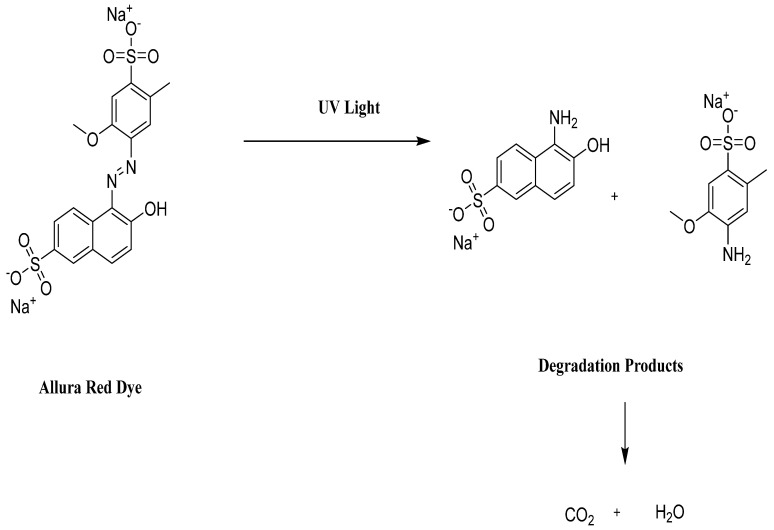
The unavailability of non-poisonous and hygienic food substances is the most challenging issue of the modern era. The uncontrolled usage of toxic colorant moieties in cosmetics and food manufacturing units leads to major threats to human life. The selection of environmentally benign approaches for the removal of these toxic dyes has gained the utmost attention from researchers in recent decades. This review article's main aim is the focus on the application of green-synthesized nanoparticles (NPs) for the photocatalytic degradation of toxic food dyes. The use of synthetic dyes in the food industry is a growing concern due to their harmful effects on human health and the environment. In recent years, photocatalytic degradation has emerged as an effective and eco-friendly method for the removal of these dyes from wastewater. This review discusses the various types of green-synthesized NPs that have been used for photocatalytic degradation (without the production of any secondary pollutant), including metal and metal oxide NPs. It also highlights the synthesis methods, characterization techniques, and photocatalytic efficiency of these NPs. Furthermore, the review explores the mechanisms involved in the photocatalytic degradation of toxic food dyes using green-synthesized NPs. Different factors that responsible for the photodegradation, are also highlighted. Advantages and disadvantages, as well as economic cost, are also discussed briefly. This review will be advantageous for the readers because it covers all aspects of dyes photodegradation. The future feature and limitations are also part of this review article. Overall, this review provides valuable insights into the potential of green-synthesized NPs as a promising alternative for the removal of toxic food dyes from wastewater.
无法获得无毒且卫生的食物物质是现代社会最具挑战性的问题。在化妆品和食品制造单位中,有毒着色剂的不受控制使用会对人类生命造成重大威胁。近几十年来,研究人员最关注的是选择环境友好的方法来去除这些有毒染料。本文的主要目的是关注绿色合成纳米粒子(NPs)在光催化降解有毒食品染料中的应用。由于合成染料对人类健康和环境的有害影响,其在食品工业中的使用引起了越来越多的关注。近年来,光催化降解已成为一种有效且环保的方法,可从废水中去除这些染料。本文讨论了各种已用于光催化降解(不产生任何二次污染物)的绿色合成 NPs,包括金属和金属氧化物 NPs。它还强调了这些 NPs 的合成方法、表征技术和光催化效率。此外,该综述探讨了使用绿色合成 NPs 进行光催化降解有毒食品染料的机制。还强调了负责光降解的不同因素。简要讨论了优点和缺点以及经济成本。由于涵盖了染料光降解的所有方面,因此本综述将对读者有益。未来的特点和局限性也是这篇综述文章的一部分。总的来说,本综述提供了有关绿色合成 NPs 作为去除废水中有毒食品染料的有前途的替代物的有价值的见解。