Martínez-Flórez Icíar, Guerrero Maria Jose, Dalmau Annabel, Cabré Maria, Alcover Maria Magdalena, Berenguer Diana, Good Liam, Fisa Roser, Riera Cristina, Ordeix Laura, Solano-Gallego Laia
Departament de Medicina i Cirurgia Animals, Universitat Autònoma de Barcelona, 08193 Cerdanyola del Vallès, Spain.
Hospital Veterinario Alhaurín el Grande, 29120 Alhaurín el Grande, Spain.
Pathogens. 2023 Jun 10;12(6):821. doi: 10.3390/pathogens12060821.
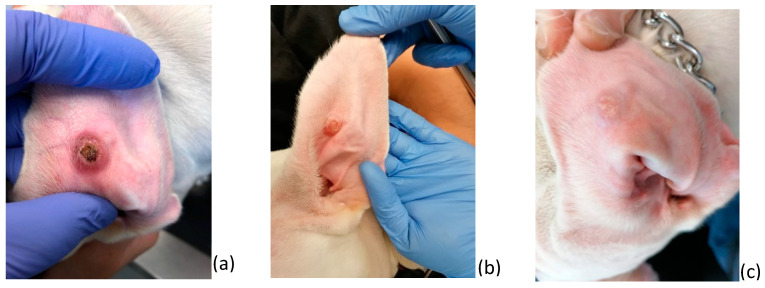
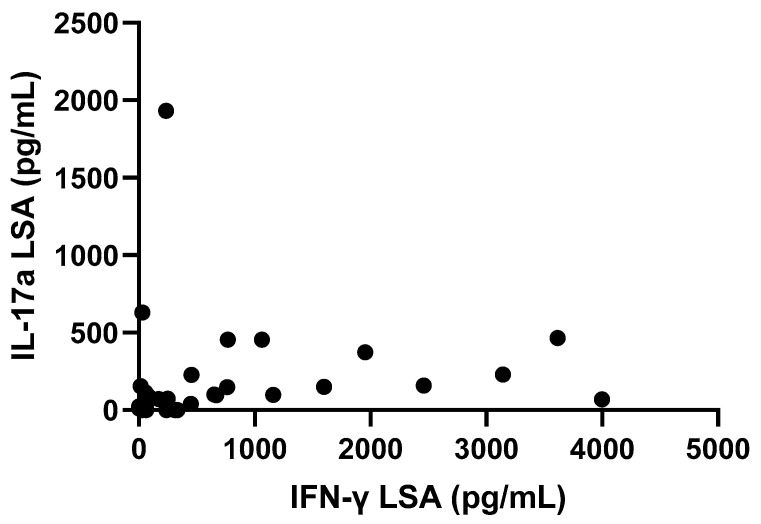
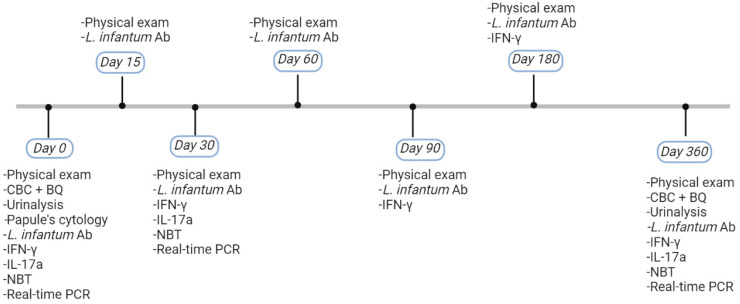
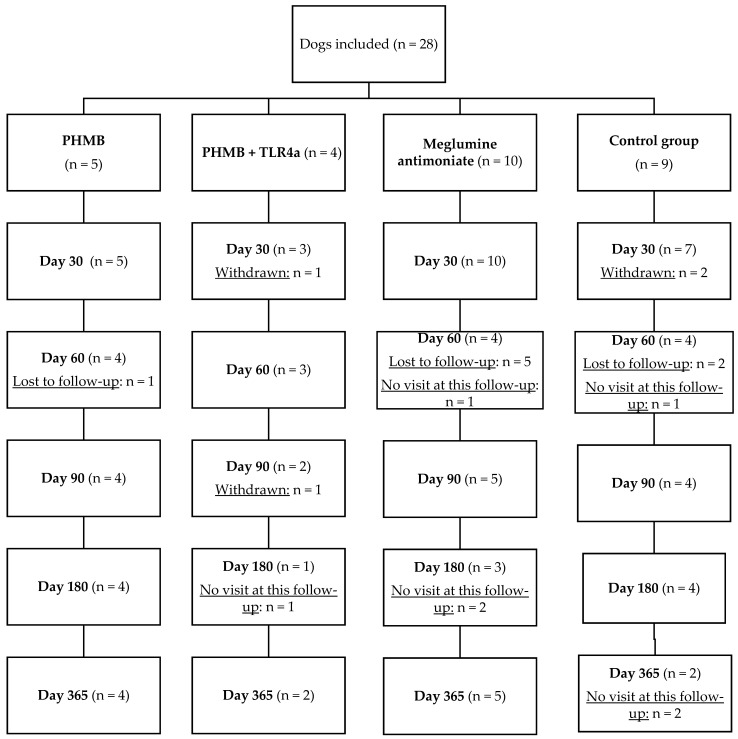
Papular dermatitis is a cutaneous manifestation of canine infection associated with mild disease. Although it is a typical presentation, nowadays, there is still no established treatment. This study evaluated the safety and clinical efficacy of local meglumine antimoniate, locally administered polyhexamethylene biguanide (PHMB) alone or PHMB in combination with a Toll-like receptor 4 agonist (TLR4a) for the treatment of papular dermatitis due to and assessed parasitological and immunological markers in this disease. Twenty-eight dogs with papular dermatitis were divided randomly into four different groups; three of them were considered treatment groups: PHMB (n = 5), PHMB + TLR4a (n = 4), and meglumine antimoniate (n = 10)), and the remaining were considered the placebo group (n = 9), which was further subdivided into two sub-groups: diluent (n = 5) and TLR4a (n = 4). Dogs were treated locally every 12 h for four weeks. Compared to placebo, local administration of PHMB (alone or with TLR4a) showed a higher tendency towards resolution of papular dermatitis due to infection at day 15 (χ = 5.78; df = 2, = 0.06) and day 30 (χ = 4.; df = 2, = 0.12), while local meglumine antimoniate administration demonstrated the fastest clinical resolution after 15 (χ = 12.58; df = 2, = 0.002) and 30 days post-treatment (χ = 9.47; df = 2, = 0.009). Meglumine antimoniate showed a higher tendency towards resolution at day 30 when compared with PHMB (alone or with TLR4a) (χ = 4.74; df = 2, = 0.09). In conclusion, the local administration of meglumine antimoniate appears to be safe and clinically efficient for the treatment of canine papular dermatitis due to infection.
丘疹性皮炎是犬感染相关轻度疾病的一种皮肤表现。尽管它是一种典型表现,但目前仍没有既定的治疗方法。本研究评估了局部应用葡甲胺锑酸盐、单独局部应用聚六亚甲基双胍(PHMB)或PHMB与Toll样受体4激动剂(TLR4a)联合用于治疗由[具体病因未提及]引起的丘疹性皮炎的安全性和临床疗效,并评估了该疾病的寄生虫学和免疫学标志物。28只患有丘疹性皮炎的犬被随机分为四个不同组;其中三组被视为治疗组:PHMB组(n = 5)、PHMB + TLR4a组(n = 4)和葡甲胺锑酸盐组(n = 10),其余的被视为安慰剂组(n = 9),安慰剂组又进一步细分为两个亚组:稀释剂亚组(n = 5)和TLR4a亚组(n = 4)。犬每12小时局部治疗一次,持续四周。与安慰剂相比,局部应用PHMB(单独或与TLR4a联合)在第15天(χ = 5.78;自由度 = 2,P = 0.06)和第30天(χ = 4.;自由度 = 2,P = 0.12)时,对于由[具体病因未提及]感染引起的丘疹性皮炎的消退显示出更高的趋势,而局部应用葡甲胺锑酸盐在治疗后15天(χ = 12.58;自由度 = 2,P = 0.002)和30天(χ = 9.47;自由度 = 2,P = 0.009)时显示出最快的临床消退。与PHMB(单独或与TLR4a联合)相比,葡甲胺锑酸盐在第30天时显示出更高的消退趋势(χ = 4.74;自由度 = 2,P = 0.09)。总之,局部应用葡甲胺锑酸盐对于治疗由[具体病因未提及]感染引起的犬丘疹性皮炎似乎是安全且临床有效的。