Laboratório de Nutrição, Faculdade de Medicina, Universidade de Lisboa, Avenida Professor Egas Moniz, 1649-028 Lisboa, Portugal.
Unidade de Reumatologia Pediátrica do Centro Hospitalar Universitário Lisboa Norte, Avenida Professor Egas Moniz, 1649-028 Lisboa, Portugal.
Nutrients. 2023 Jun 20;15(12):2812. doi: 10.3390/nu15122812.
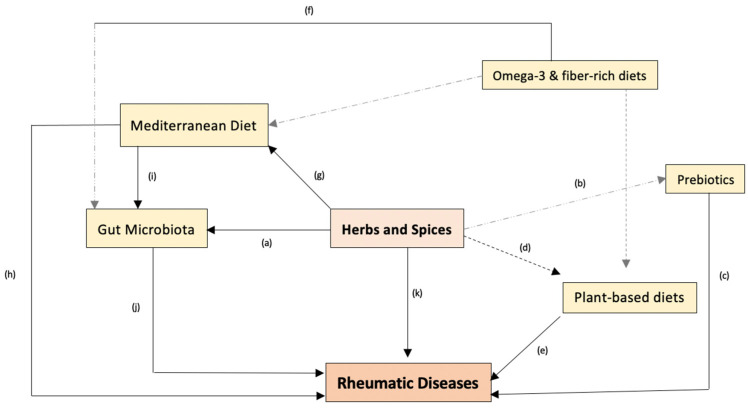
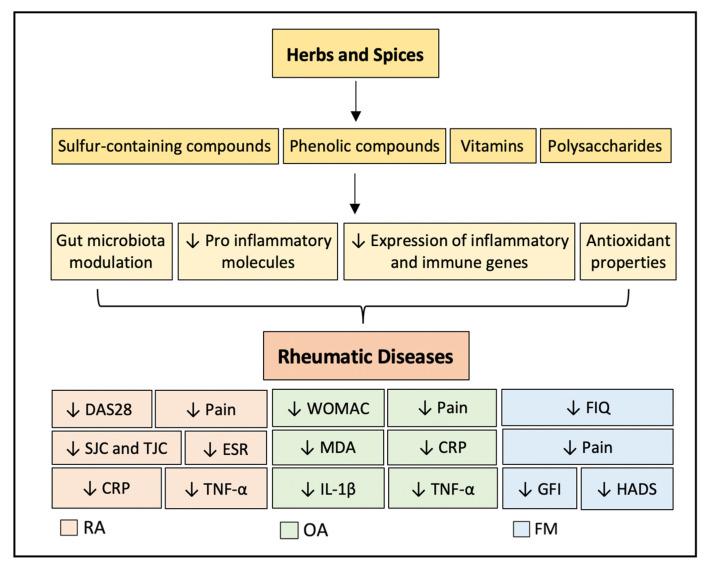
Although we have witnessed remarkable progress in understanding the biological mechanisms that lead to the development of rheumatic diseases (RDs), remission is still not achieved in a substantial proportion of patients with the available pharmacological treatment. As a consequence, patients are increasingly looking for complementary adjuvant therapies, including dietary interventions. Herbs and spices have a long historical use, across various cultures worldwide, for both culinary and medicinal purposes. The interest in herbs and spices, beyond their seasoning properties, has dramatically grown in many immune-mediated diseases, including in RDs. Increasing evidence highlights their richness in bioactive molecules, such as sulfur-containing compounds, tannins, alkaloids, phenolic diterpenes, and vitamins, as well as their antioxidant, anti-inflammatory, antitumorigenic, and anticarcinogenic properties. Cinnamon, garlic, ginger, turmeric, and saffron are the most popular spices used in RDs and will be explored throughout this manuscript. With this paper, we intend to provide an updated review of the mechanisms whereby herbs and spices may be of interest in RDs, including through gut microbiota modulation, as well as summarize human studies investigating their effects in Rheumatoid Arthritis, Osteoarthritis, and Fibromyalgia.
尽管我们已经见证了在理解导致风湿性疾病 (RDs) 发展的生物学机制方面的显著进展,但在可用的药物治疗中,仍有相当一部分患者无法达到缓解。因此,患者越来越多地寻求补充辅助疗法,包括饮食干预。草药和香料在世界各地的各种文化中都有悠久的历史用途,既用于烹饪,也用于药用。除了调味作用之外,人们对草药和香料的兴趣在许多免疫介导的疾病中急剧增加,包括 RD 在内。越来越多的证据强调了它们富含生物活性分子,如含硫化合物、单宁、生物碱、酚类二萜和维生素,以及它们的抗氧化、抗炎、抗肿瘤和抗癌特性。肉桂、大蒜、生姜、姜黄和藏红花是 RD 中最常用的香料,本文将对它们进行探讨。通过本文,我们旨在提供关于草药和香料如何在 RD 中引起关注的机制的最新综述,包括通过调节肠道微生物群,以及总结人类研究它们在类风湿关节炎、骨关节炎和纤维肌痛中的影响。