Gan Wei Chong, Ng Hien Fuh, Ngeow Yun Fong
Dr. Wu Lien-Teh Centre for Research in Communicable Diseases, M. Kandiah Faculty of Medicine and Health Sciences, Universiti Tunku Abdul Rahman, Jalan Sungai Long, Bandar Sungai Long, Kajang 43000, Selangor, Malaysia.
Pharmaceuticals (Basel). 2023 May 24;16(6):784. doi: 10.3390/ph16060784.
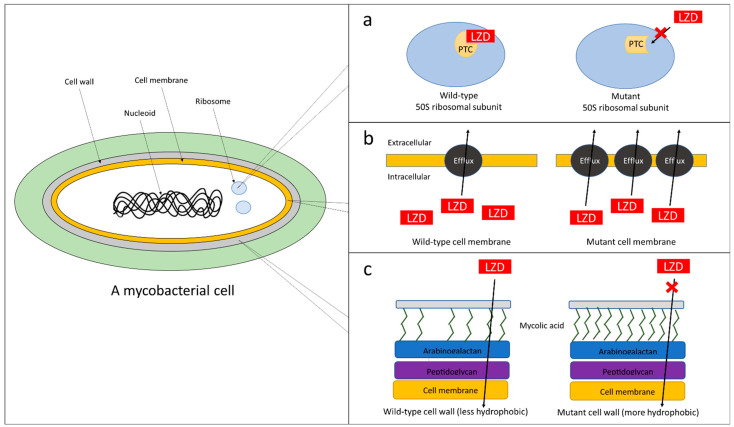
Mycobacteria form some of the most notorious and difficult-to-treat bacterial pathogens. As a group, they are intrinsically resistant to many commonly used antibiotics, such as tetracyclines and beta-lactams. In addition to intrinsic resistances, acquired multidrug resistance has also been observed and documented in (MTB) and non-tuberculous mycobacteria (NTM). To combat multidrug resistant infections by these pathogens, innovative antimicrobials and treatment regimens are required. In this regard, linezolid, an oxazolidinone introduced for clinical use just two decades ago, was added to the therapeutic armamentarium for drug-resistant mycobacteria. It exhibits antibacterial activity by binding to the 50S ribosomal subunit and inhibiting protein synthesis. Unfortunately, linezolid resistance has now been documented in MTB and NTM, in many parts of the world. Most linezolid-resistant mycobacterial strains show mutations in the ribosome or related genes, such as in the and genes. Non-ribosomal mechanisms appear to be rare. One such mechanism was associated with a mutation in , which encodes a protein that plays an important role in mycolic acid synthesis. Mycobacterial efflux proteins have also been implicated in linezolid resistance. This review summarises current knowledge of genetic determinants of linezolid resistance in mycobacteria, with the aim of contributing information that could facilitate the discovery of new therapeutic approaches to overcome, delay or avoid further developments of drug resistance among these important pathogens.
分枝杆菌构成了一些最臭名昭著且难以治疗的细菌病原体。作为一个群体,它们对许多常用抗生素具有内在抗性,如四环素类和β-内酰胺类。除了内在抗性外,在结核分枝杆菌(MTB)和非结核分枝杆菌(NTM)中也观察到并记录了获得性多药耐药性。为了对抗这些病原体引起的耐多药感染,需要创新的抗菌药物和治疗方案。在这方面,利奈唑胺,一种二十年前才引入临床使用的恶唑烷酮,被添加到耐药分枝杆菌的治疗药物库中。它通过与50S核糖体亚基结合并抑制蛋白质合成来发挥抗菌活性。不幸的是,现在在世界许多地区的MTB和NTM中都记录到了利奈唑胺耐药性。大多数耐利奈唑胺的分枝杆菌菌株在核糖体或相关基因中显示出突变,如在[具体基因名称1]和[具体基因名称2]基因中。非核糖体机制似乎很少见。一种这样的机制与[具体基因名称3]的突变有关,该基因编码一种在分枝菌酸合成中起重要作用的蛋白质。分枝杆菌外排蛋白也与利奈唑胺耐药性有关。本综述总结了分枝杆菌中利奈唑胺耐药性遗传决定因素的当前知识,旨在提供有助于发现新治疗方法的信息,以克服、延缓或避免这些重要病原体中耐药性的进一步发展。