School of Dentistry and Medical Sciences, Charles Sturt University, Wagga Wagga, NSW 2678, Australia.
Department of Microbiology, Icahn School of Medicine at Mount Sinai, New York, NY 10029, USA.
Viruses. 2023 May 31;15(6):1302. doi: 10.3390/v15061302.
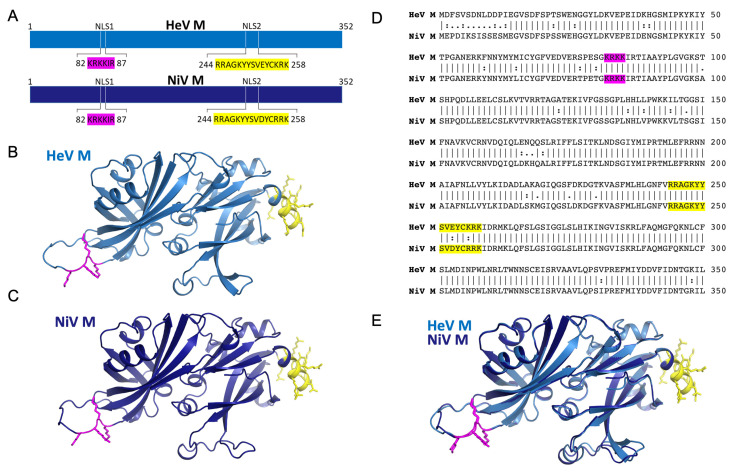
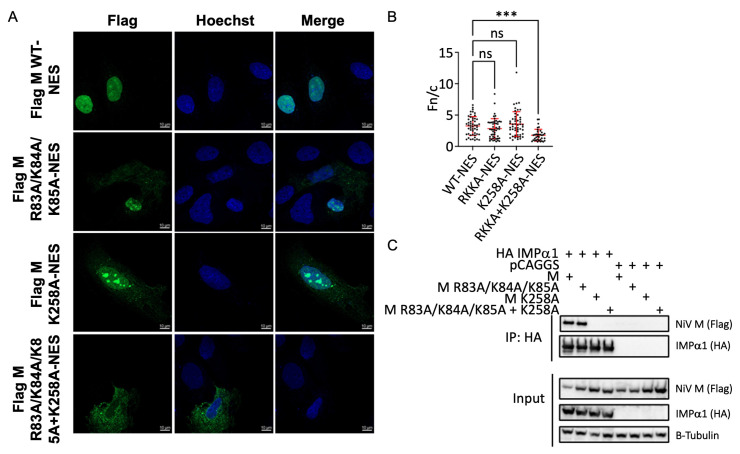
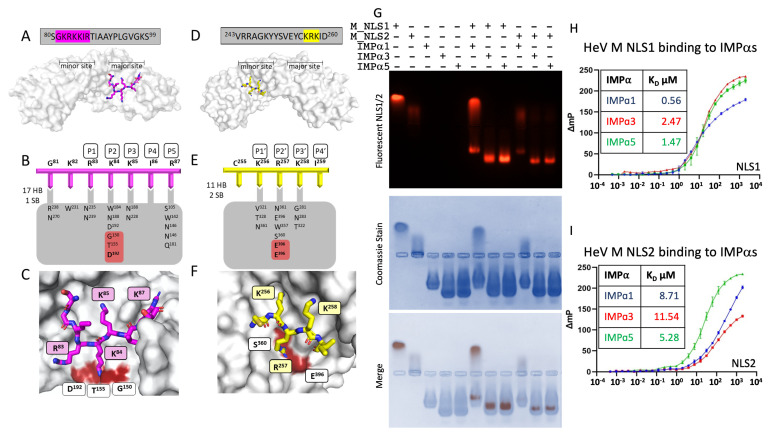
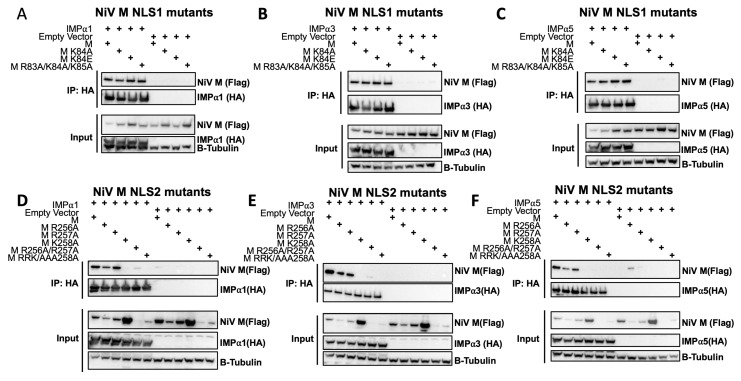
Nipah virus (NiV) and Hendra virus (HeV) are highly pathogenic species from the genus within the paramyxovirus family and are harbored by Flying Fox species. Henipaviruses cause severe respiratory disease, neural symptoms, and encephalitis in various animals and humans, with human mortality rates exceeding 70% in some NiV outbreaks. The henipavirus matrix protein (M), which drives viral assembly and budding of the virion, also performs non-structural functions as a type I interferon antagonist. Interestingly, M also undergoes nuclear trafficking that mediates critical monoubiquitination for downstream cell sorting, membrane association, and budding processes. Based on the NiV and HeV M X-ray crystal structures and cell-based assays, M possesses a putative monopartite nuclear localization signal (NLS) (residues KRKKIR; NLS1 HeV), positioned on an exposed flexible loop and typical of how many NLSs bind importin alpha (IMPα), and a putative bipartite NLS (RR-10X-KRK; NLS2 HeV), positioned within an α-helix that is far less typical. Here, we employed X-ray crystallography to determine the binding interface of these M NLSs and IMPα. The interaction of both NLS peptides with IMPα was established, with NLS1 binding the IMPα major binding site, and NLS2 binding as a non-classical NLS to the minor site. Co-immunoprecipitation (co-IP) and immunofluorescence assays (IFA) confirm the critical role of NLS2, and specifically K258. Additionally, localization studies demonstrated a supportive role for NLS1 in M nuclear localization. These studies provide additional insight into the critical mechanisms of M nucleocytoplasmic transport, the study of which can provide a greater understanding of viral pathogenesis and uncover a potential target for novel therapeutics for henipaviral diseases.
尼帕病毒(NiV)和亨德拉病毒(HeV)是副黏病毒科中的属中的高致病性物种,由飞狐物种携带。亨尼帕病毒会导致各种动物和人类发生严重的呼吸道疾病、神经症状和脑炎,在一些尼帕病毒爆发中,人类死亡率超过 70%。亨尼帕病毒的基质蛋白(M)驱动病毒的组装和病毒的出芽,同时作为 I 型干扰素拮抗剂发挥非结构功能。有趣的是,M 还经历核易位,介导关键的单泛素化,用于下游细胞分选、膜结合和出芽过程。基于 NiV 和 HeV M 的 X 射线晶体结构和基于细胞的测定,M 具有一个假定的单部分核定位信号(NLS)(残基 KRKKIR;NLS1 HeV),位于暴露的柔性环上,这是许多 NLS 与导入蛋白α(IMPα)结合的典型方式,以及一个假定的双部分 NLS(RR-10X-KRK;NLS2 HeV),位于一个 α-螺旋内,远不那么典型。在这里,我们利用 X 射线晶体学来确定这些 M NLS 和 IMPα 的结合界面。这两种 NLS 肽与 IMPα 的相互作用得到了确立,NLS1 结合 IMPα 的主要结合位点,NLS2 作为非经典 NLS 结合次要位点。共免疫沉淀(co-IP)和免疫荧光分析(IFA)证实了 NLS2 的关键作用,特别是 K258。此外,定位研究表明 NLS1 在 M 核定位中起辅助作用。这些研究为 M 的核质转运的关键机制提供了更多的见解,对其研究可以更深入地了解病毒发病机制,并发现针对亨尼帕病毒病的新型治疗方法的潜在靶点。