Sogari Giovanni, Amato Mario, Palmieri Rossella, Hadj Saadoun Jasmine, Formici Giulia, Verneau Fabio, Mancini Simone
Department of Food and Drug, University of Parma, Parco Area delle Scienze 49/a, 43124, Parma, Italy.
Department of Political Science, University of Naples Federico II, Via Rodinò 22/A, 80138, Naples, Italy.
Curr Res Food Sci. 2023 Apr 12;6:100504. doi: 10.1016/j.crfs.2023.100504. eCollection 2023.
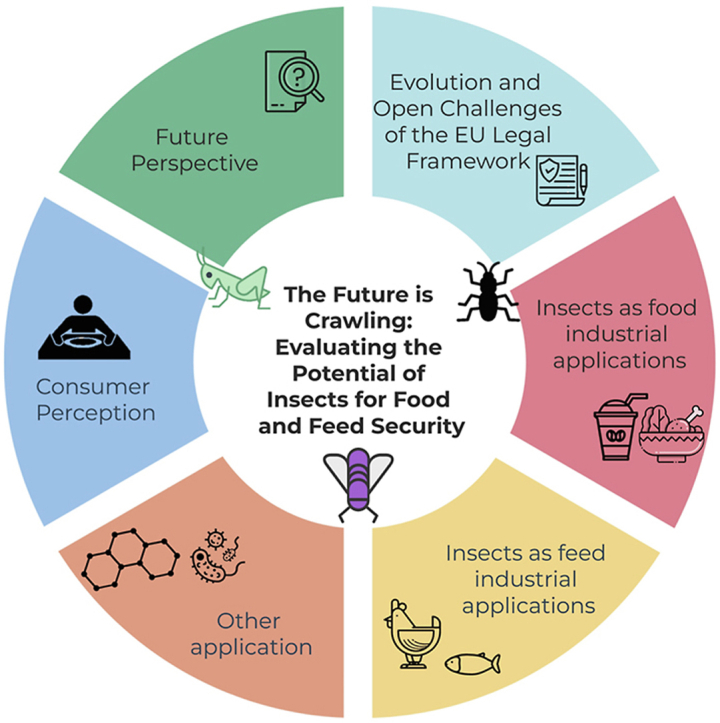
Current estimations showed that the number of people affected by hunger doubled in the last two years, reaching 9.8% of the global population. According to FAO, in order to satisfy the demand for food in the next few years, it will be necessary to double food production. Moreover, the call for a change in dietary patterns has been raised, showing how the food sector is responsible of 1/3 of climate change where meat-based diets or overconsumption of meat play an important role in the negative environmental impact. Consequently, there is a growing concern in how to achieve the goal of increasing food productions without exploiting environmental resources and to explore the production and use of alternative resources, such as insects. Insects are gaining interests both as food and feed not only to reduce the environmental costs in feed production for common livestock, but also to reduce farmers' dependence on traditional protein sources. In this work we aimed to provide an overview of the state-of-the-art upon insect studies, highlighting the most important results obtained from both an industrial and market perspective. The legislative framework concerning edible insects as food and feed is also analyzed, with the final purpose to highlight recent reforms, relevant case-law as well as unsolved regulatory challenges. From a normative perspective, regulatory efforts are still required to fully take advantage of the potentialities of insects-industry. From a consumer point of view, consumers' willingness to pay a premium is going to be a key issue for economic sustainability of the insect farming chain. To meet the food and feed security challenges, insects will have to be considered all-around, including applications in the food, feed, and other sectors. We believe that this review is an important contribution to the field of food science and will be of interest to researchers, food industry professionals, and policymakers in order to prioritize research questions and help communicate scientific knowledge to a broader audience.
目前的估计显示,受饥饿影响的人数在过去两年中翻了一番,达到全球人口的9.8%。根据联合国粮食及农业组织(FAO)的数据,为了满足未来几年的粮食需求,粮食产量将有必要翻番。此外,人们还呼吁改变饮食模式,这表明食品行业对三分之一的气候变化负有责任,其中以肉类为主的饮食或肉类的过度消费在负面环境影响中起着重要作用。因此,人们越来越关注如何在不开发环境资源的情况下实现增加粮食产量的目标,并探索替代资源(如昆虫)的生产和利用。昆虫作为食物和饲料正越来越受到关注,这不仅是为了降低普通牲畜饲料生产中的环境成本,也是为了减少农民对传统蛋白质来源的依赖。在这项工作中,我们旨在概述昆虫研究的最新进展,从工业和市场角度突出最重要的成果。我们还分析了关于食用昆虫作为食物和饲料的立法框架,最终目的是突出近期的改革、相关判例法以及尚未解决的监管挑战。从规范的角度来看,仍需要做出监管努力,以充分利用昆虫产业的潜力。从消费者的角度来看,消费者愿意支付溢价将是昆虫养殖产业链经济可持续性的一个关键问题。为了应对粮食和饲料安全挑战,必须全面考虑昆虫,包括其在食品、饲料和其他领域的应用。我们相信,这篇综述对食品科学领域做出了重要贡献,对于研究人员、食品行业专业人士和政策制定者来说将具有参考价值,有助于他们确定研究问题的优先级,并将科学知识传播给更广泛的受众。