Thomas Merlin, Raza Tasleem, Hameed Mansoor, Sharma Rohit, Rajagopal Rajalekshmi Maheswari, Hussain O Al Adab Aisha, Ahmad Mushtaq, George Saibu, Hussein Mousa, Akram Jaweria, Mohamed Ibrahim Mohamed Izham, Ait Hssain Ali, Yousaf Muhammad, Yahya Khatib Mohamad
Department of Chest, Hamad General Hospital, Doha, Qatar.
Department of Clinical Medicine, Weill Cornell Medicine, Doha, Qatar.
Int J Gen Med. 2023 Jun 22;16:2633-2642. doi: 10.2147/IJGM.S404834. eCollection 2023.
COVID-19 pandemic resulted in a significant number of critical care admissions secondary to severe pneumonia and acute respiratory distress syndrome. We evaluated the short-, medium- and long-term outcomes of lung function and quality of life in this prospective cohort study and reported the outcomes at 7 weeks and 3 months from discharge from intensive care unit.
A prospective cohort study of ICU survivors with COVID-19 was conducted from August 2020 to May 2021 to evaluate baseline demographic and clinical variables as well as determine lung function, exercise capacity, and health-related quality of life (HRQOL) using spirometry and 6-minute walk test (6MWT) conducted in accordance with American Thoracic Society standards, and SF-36 (Rand), respectively. SF-36 is a generic 36 question standardized health survey. Descriptive and inferential statistics (alpha = 0.05) were used to analyse the data.
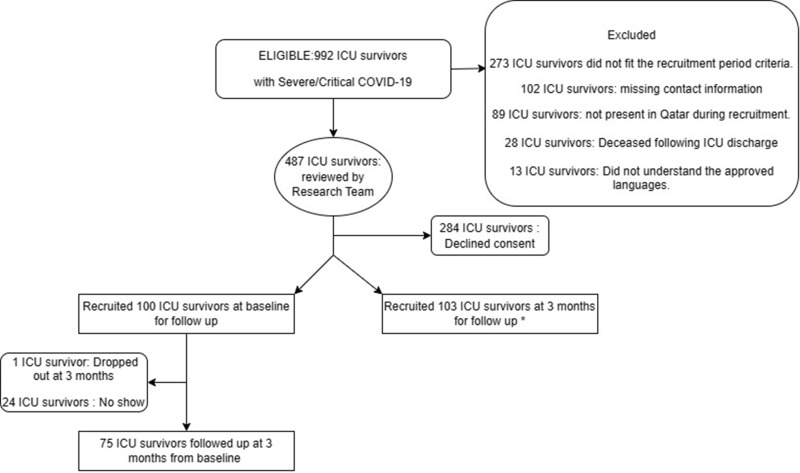
At baseline, 100 participants were enrolled in the study of whom 76 followed up at 3 months. Majority of the patients were male (83%), Asians (84%) and less than 60 years of age (91%). HRQOL showed significant improvement in all domains of SF-36, except in emotional wellbeing. Spirometry variables also showed significant improvement in all variables over time with greatest improvement in percentage predicted Forced expiratory volume 1 (79% vs 88% < 0.001). 6MWT showed significant improvement in variables of walk distance, dyspnea, and fatigue with greatest improvement in change in oxygen saturation (3% vs 1.44% < 0.001). Intubation status did not impact the changes in SF-36, spirometry or 6MWT variables.
Our findings suggest that ICU survivors of COVID-19 have significant improvement in their lung function, exercise capacity and HRQOL within 3 months of ICU discharge regardless of intubation status.
新冠疫情导致大量因重症肺炎和急性呼吸窘迫综合征而入住重症监护病房的病例。在这项前瞻性队列研究中,我们评估了肺功能和生活质量的短期、中期和长期结果,并报告了重症监护病房出院7周和3个月时的结果。
2020年8月至2021年5月对新冠疫情后重症监护病房的幸存者进行了一项前瞻性队列研究,以评估基线人口统计学和临床变量,并分别根据美国胸科学会标准进行肺活量测定以及6分钟步行试验(6MWT)来测定肺功能、运动能力和健康相关生活质量(HRQOL),同时使用SF-36(兰德)进行评估。SF-36是一项包含36个问题的通用标准化健康调查。使用描述性和推断性统计(α = 0.05)对数据进行分析。
基线时,100名参与者纳入研究,其中76人在3个月时进行了随访。大多数患者为男性(83%)、亚洲人(84%)且年龄小于60岁(91%)。HRQOL在SF-36的所有领域均有显著改善,但情感健康领域除外。肺活量测定变量随时间推移在所有变量中也显示出显著改善,其中预计第1秒用力呼气量百分比改善最大(79%对88%,<0.001)。6MWT在步行距离、呼吸困难和疲劳变量方面有显著改善,其中氧饱和度变化改善最大(3%对1.44%,<0.001)。插管状态并未影响SF-36、肺活量测定或6MWT变量的变化。
我们的研究结果表明,新冠疫情后重症监护病房的幸存者在重症监护病房出院3个月内,无论插管状态如何,其肺功能、运动能力和HRQOL均有显著改善。