Lila Alexander M, Alekseeva Lyudmila I, Baranov Andrey A, Taskina Elena A, Kashevarova Natalya G, Lapkina Natalia A, Trofimov Evgeny A
Director, Research Institute of Rheumatology Named after VA Nasonova, Moscow 115522, Moscow, Russia.
Bone and Joints Metabolic Diseases Laboratory, Research Institute of Rheumatology Named after VA Nasonova, Moscow 115522, Moscow, Russia.
World J Orthop. 2023 Jun 18;14(6):443-457. doi: 10.5312/wjo.v14.i6.443.
Oral treatment of glucosamine (GA) combined with chondroitin sulfate (CS) was reportedly effective for pain relief and function improvement in osteoarthritis patients with moderate to severe knee pain in clinical trials. While the effectiveness of GA and CS on both clinical and radiological findings has been demonstrated, only a few high-quality trials exist. Therefore, controversy regarding their effectiveness in real-world clinical practice remains.
To investigate the impact of GA + CS on clinical outcomes of patients with knee and hip osteoarthritis in routine clinical practice.
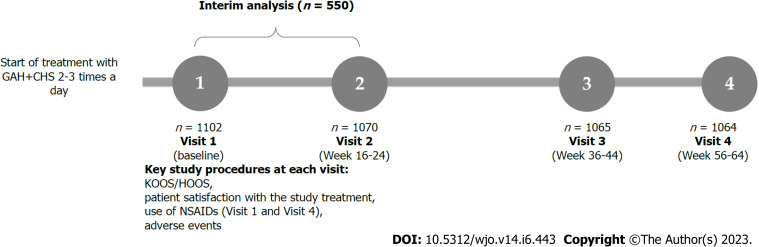
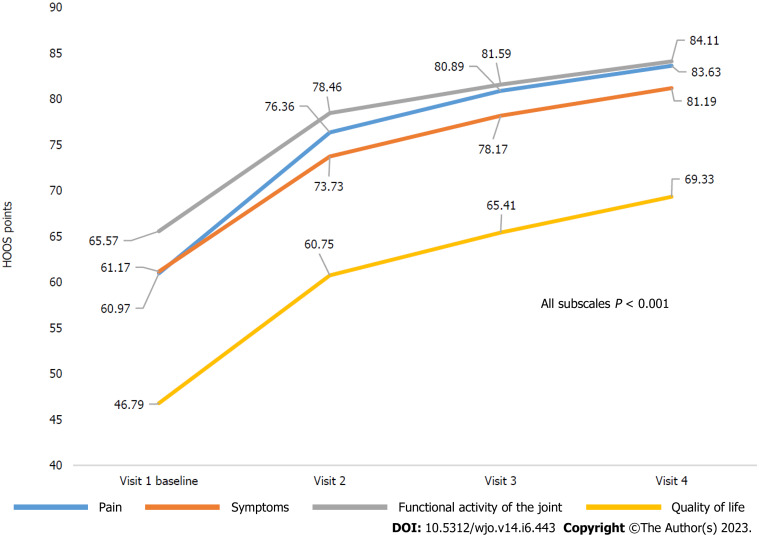
A multicenter prospective observational cohort study included 1102 patients of both genders with knee or hip osteoarthritis (Kellgren & Lawrence grades I-III) in 51 clinical centers in the Russian Federation from November 20, 2017, to March 20, 2020, who had started to receive oral capsules of glucosamine hydrochloride 500 mg and CS 400 mg according to the approved patient information leaflet starting from 3 capsules daily for 3 wk, followed by a reduced dosage of 2 capsules daily before study inclusion (minimal recommended treatment duration is 3-6 mo). Changes in subscale scores [Pain, Symptoms, Function, and Quality of Life (QOL)] of the Knee Injury and Osteoarthritis Outcome Score (KOOS)/Hip Disability and Osteoarthritis Outcome Score (HOOS) questionnaires during the observational period (up to 54-64 wk with a total of 4 visits). Patients' treatment satisfaction, data on the combined oral use of glucosamine hydrochloride and CS, concomitant use of non-steroidal anti-inflammatory drugs (NSAIDs), and adverse events (AEs) were also evaluated.
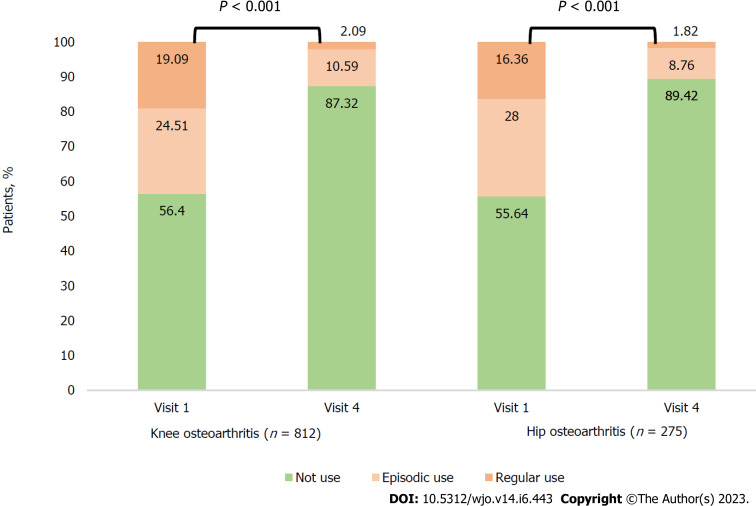
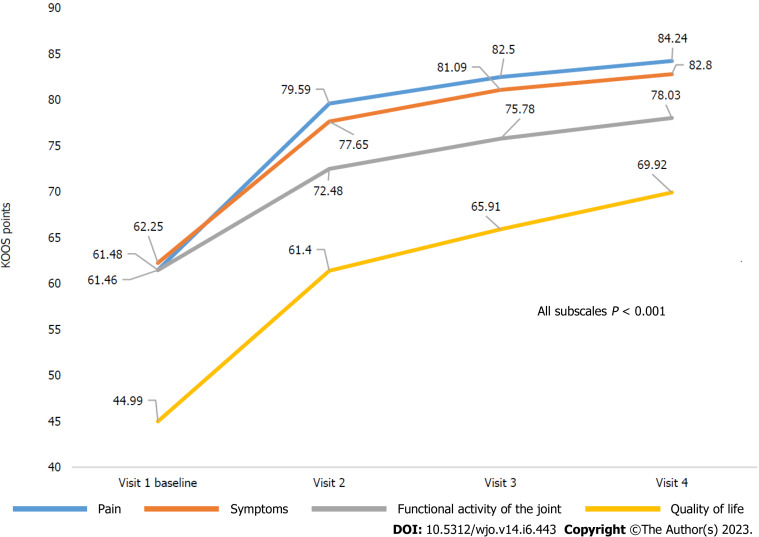
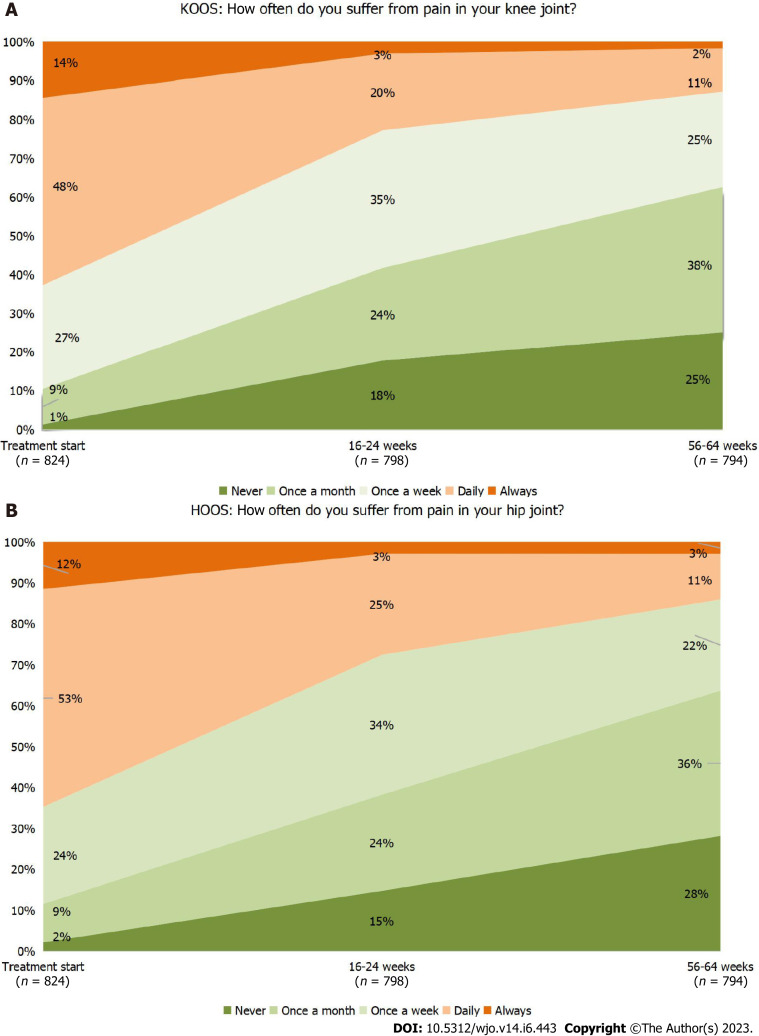
A total of 1102 patients with knee and hip osteoarthritis were included in the study. The mean patient age was 60.4 years, most patients were women (87.8%), and their average body mass index was 29.49 kg/m. All subscale scores (Pain, Symptoms, Function, and QOL) of the KOOS and HOOS demonstrated clinically and statistically significant improvements. In patients with knee osteoarthritis, the mean score increases from baseline to the end of Week 64 were 22.87, 20.78, 16.60, and 24.87 on Pain, Symptoms, Physical Function (KOOS-PS), and QOL subscales ( < 0.001 for all), respectively. In patients with hip osteoarthritis, the mean score increases were 22.81, 19.93, 18.77, and 22.71 on Pain, Symptoms, Physical Function (HOOS-PS), and QOL subscales ( < 0.001 for all), respectively. The number of patients using any NSAIDs decreased from 43.1% to 13.5% ( < 0.001) at the end of the observation period. Treatment-related AEs occurred in 2.8% of the patients and mainly included gastrointestinal disorders [25 AEs in 24 (2.2%) patients]. Most patients (78.1%) were satisfied with the treatment.
Long-term oral GA + CS was associated with decreased pain, reduced concomitant NSAID therapy, improved joint function and QOL in patients with knee and hip osteoarthritis in routine clinical practice.
在临床试验中,据报道口服氨基葡萄糖(GA)联合硫酸软骨素(CS)对中度至重度膝关节疼痛的骨关节炎患者缓解疼痛和改善功能有效。虽然GA和CS对临床和影像学结果的有效性已得到证实,但高质量试验较少。因此,关于它们在实际临床实践中的有效性仍存在争议。
在常规临床实践中,研究GA + CS对膝关节和髋关节骨关节炎患者临床结局的影响。
一项多中心前瞻性观察队列研究纳入了2017年11月20日至2020年3月20日期间俄罗斯联邦51个临床中心的1102例膝关节或髋关节骨关节炎(凯尔格伦和劳伦斯分级I - III级)患者,这些患者根据批准的患者信息说明书开始服用500毫克盐酸氨基葡萄糖和400毫克CS的口服胶囊,开始时每日3粒,持续3周,然后在纳入研究前减至每日2粒(推荐的最短治疗持续时间为3 - 6个月)。观察期(长达54 - 64周,共4次就诊)内膝关节损伤和骨关节炎结局评分(KOOS)/髋关节残疾和骨关节炎结局评分(HOOS)问卷各子量表评分[疼痛、症状、功能和生活质量(QOL)]的变化。还评估了患者的治疗满意度、盐酸氨基葡萄糖和CS联合口服使用的数据、非甾体抗炎药(NSAIDs)的联合使用情况以及不良事件(AE)。
本研究共纳入1102例膝关节和髋关节骨关节炎患者。患者平均年龄为60.4岁,大多数患者为女性(87.8%),平均体重指数为29.49kg/m。KOOS和HOOS的所有子量表评分(疼痛、症状、功能和QOL)均显示出临床和统计学上的显著改善。在膝关节骨关节炎患者中,从基线到第64周结束时,疼痛、症状、身体功能(KOOS - PS)和QOL子量表的平均评分增加分别为22.87、20.78、16.60和24.87(均P < 0.001)。在髋关节骨关节炎患者中,疼痛、症状、身体功能(HOOS - PS)和QOL子量表的平均评分增加分别为22.81、19.93、18.77和22.71(均P < 0.001)。在观察期结束时,使用任何NSAIDs的患者数量从43.1%降至13.5%(P < 0.001)。2.8%的患者发生了与治疗相关的AE,主要包括胃肠道疾病[24例(2.2%)患者发生25次AE]。大多数患者(78.1%)对治疗满意。
在常规临床实践中,长期口服GA + CS与膝关节和髋关节骨关节炎患者疼痛减轻、NSAID联合治疗减少、关节功能和QOL改善相关。