Dolan Carrie B, Malik Ammar A, Zhang Sheng, Mao Wenhui, McDade Kaci Kennedy, Svoboda Eli, Odhiambo Julius N
Department of Health Sciences, William & Mary, Williamsburg, Virginia, United States of America.
Ignite Global Health Research Lab, William & Mary, Williamsburg, Virginia, United States of America.
PLOS Glob Public Health. 2023 Jun 28;3(6):e0001637. doi: 10.1371/journal.pgph.0001637. eCollection 2023.
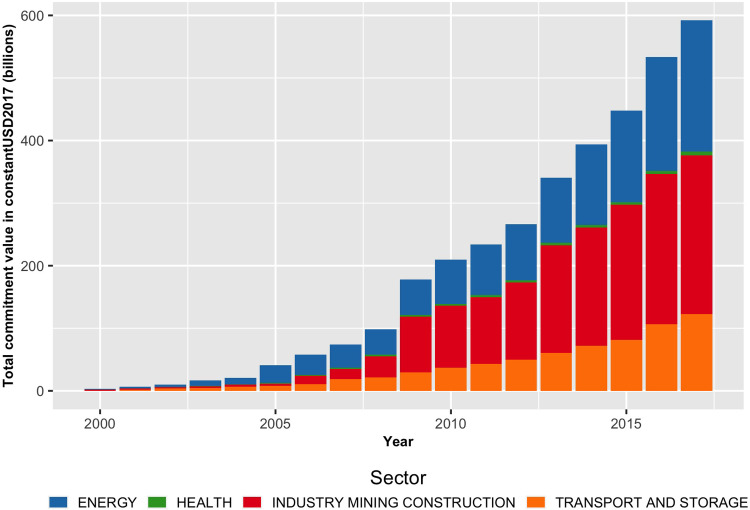
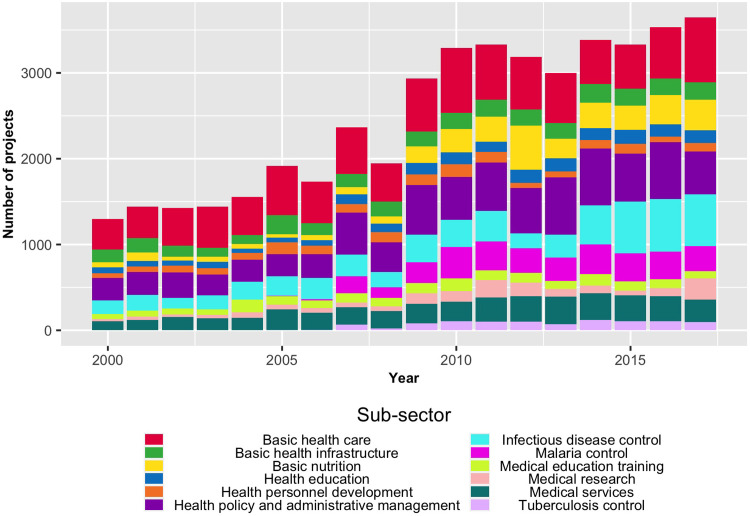
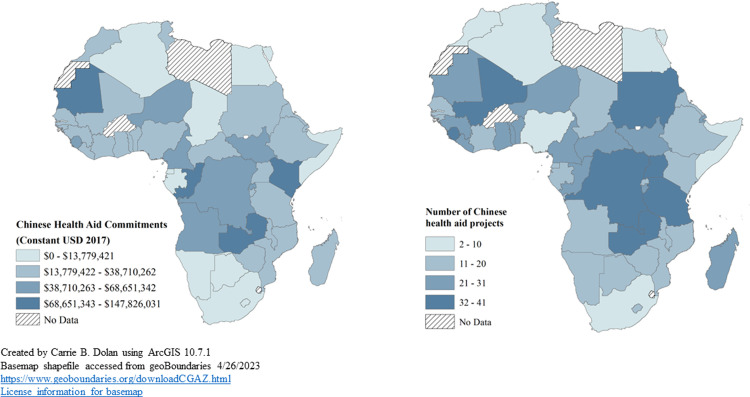
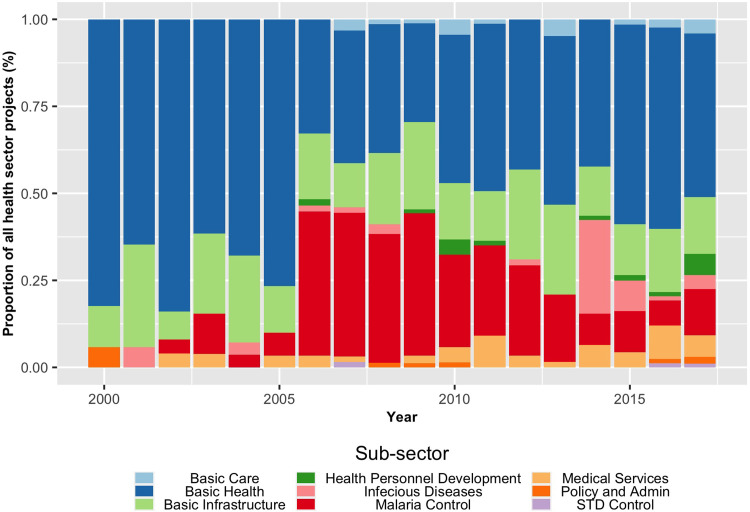
The motivations behind China's allocation of health aid to Africa remain complex due to limited information on the details of health aid project activities. Insufficient knowledge about the purpose of China's health aid hinders our understanding of China's comprehensive role in supporting Africa's healthcare system. To address this gap, our study aimed to gain better insights into China's health aid priorities and the factors driving these priorities across Africa. To achieve this, we utilized AidData's Chinese Official Finance Dataset and adhered to the Organisation for Economic Co-operation and Development (OECD) guidelines. We reclassified all 1,026 health projects in Africa, originally categorized under broad 3-digit OECD-DAC sector codes, into more specific 5-digit CRS codes. By analyzing the project count and financial value, we assessed the shifting priorities over time. Our analysis revealed that China's priorities in health aid have evolved between 2000 and 2017. In the early 2000s, China primarily allocated aid to basic health personnel and lacked diversity in sub-sectors. However, after 2004, China shifted its focus more toward basic infrastructure and reduced emphasis on clinical-level staff. Furthermore, China's interest in addressing malaria expanded both in scale and depth between 2006 and 2009. This trend continued in 2012 and 2014 when China responded to the Ebola outbreak by shifting its focus from basic infrastructure to infectious diseases. In summary, our findings demonstrate the changes in China's health aid strategy, starting with addressing diseases already eliminated in China and gradually transitioning towards global health security, health system strengthening, and shaping the governance mechanisms.
由于关于卫生援助项目活动细节的信息有限,中国向非洲提供卫生援助背后的动机仍然复杂。对中国卫生援助目的的了解不足阻碍了我们对中国在支持非洲医疗体系方面全面作用的理解。为了填补这一空白,我们的研究旨在更深入地了解中国在非洲的卫生援助重点以及推动这些重点的因素。为实现这一目标,我们利用了援助数据中心(AidData)的中国官方金融数据集,并遵循经济合作与发展组织(OECD)的指导方针。我们将非洲最初按照经合组织发展援助委员会(OECD-DAC)宽泛的三位数部门代码分类的所有1026个卫生项目重新分类为更具体的五位数中央产品分类(CRS)代码。通过分析项目数量和资金价值,我们评估了随时间推移的重点变化。我们的分析表明,2000年至2017年期间,中国的卫生援助重点发生了演变。在21世纪初,中国主要向基础卫生人员提供援助,且子部门缺乏多样性。然而,2004年之后,中国将重点更多地转向基础基础设施,并减少了对临床层面工作人员的重视。此外,2006年至2009年期间,中国在应对疟疾方面的兴趣在规模和深度上都有所扩大。2012年和2014年,当中国应对埃博拉疫情时,这种趋势仍在继续,重点从基础基础设施转向了传染病。总之,我们的研究结果表明了中国卫生援助战略的变化,从解决中国已消除的疾病开始,逐步向全球卫生安全、卫生系统加强以及塑造治理机制转变。