Liu Jiuling, Wang Junhong
Department of Neurology, Nanjing BenQ Medical Center, The Affiliated BenQ Hospital of Nanjing Medical University, Nanjing, China.
Department of Neurosurgery, Tongji Hospital, Tongji Medical College, Huazhong University of Science and Technology, Wuhan, Hubei, China.
Front Neurol. 2023 Jun 14;14:1180912. doi: 10.3389/fneur.2023.1180912. eCollection 2023.
In patients with ischemic stroke, low hemoglobin-to-red blood cell distribution width ratio (HRR) was associated with an increased risk of mortality. However, it was unknown in the non-traumatic subarachnoid hemorrhage (SAH) population. The purpose of this study was to examine the association between baseline HRR and in-hospital mortality in patients with non-traumatic SAH.
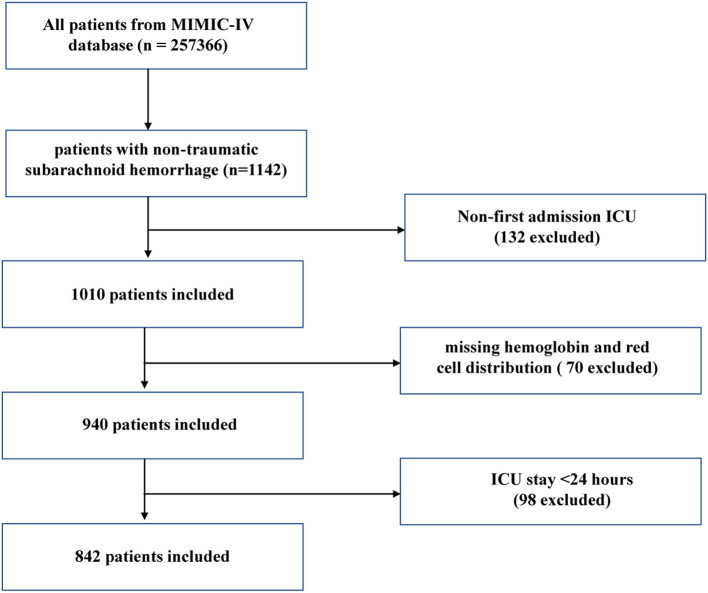
Non-traumatic SAH patients were screened out of the Medical Information Mart for Intensive IV (MIMIC-IV) database between 2008 and 2019. The Cox proportional hazard regression models were utilized to analyze the association between baseline HRR and in-hospital mortality. Restricted cubic splines (RCS) analysis was utilized to determine the relationship curve between hospital mortality and the HRR level and examine the threshold saturation effect. We further applied Kaplan-Meier survival curve analysis to examine the consistency of these correlations. The interaction test was used to identify subgroups with differences.
A total of 842 patients were included in this retrospective cohort study. Compared with individuals with lower HRR Q1 ( ≤ 7.85), the adjusted HR values in Q2 (7.86-9.15), Q3 (9.16-10.16), and Q4 (≥10.17) were 0.574 (95% CI: 0.368-0.896, = 0.015), 0.555 (95% CI: 0.346-0.890, = 0.016), and 0.625 (95% CI: 0.394-0.991, = 0.045), respectively. The association between the HRR level and in-hospital mortality exhibited a non-linear relationship ( < 0.05). The threshold inflection point value of 9.50 was calculated using RCS analysis. When the HHR level was lower than 9.50, the risk of in-hospital mortality rate decreased with an adjusted HR of 0.79 (95% CI: 0.70-0.90, = 0.0003). When the HRR level was higher than 9.50, the risk of in-hospital mortality almost hardly increased with the increase in the HRR level (adjusted HR = 1.18, 95% CI: 0.91-1.53, = 0.2158). K-M analysis showed that patients with low HRR levels had significantly higher in-hospital mortality ( < 0.001).
There was a non-linear connection between the baseline HRR level and in-hospital mortality. A low level of HRR could increase the risk of death in participants with non-traumatic SAH.
在缺血性中风患者中,低血红蛋白与红细胞分布宽度比值(HRR)与死亡风险增加相关。然而,在非创伤性蛛网膜下腔出血(SAH)人群中情况尚不清楚。本研究旨在探讨非创伤性SAH患者基线HRR与院内死亡率之间的关联。
从2008年至2019年的重症监护医学信息数据库(MIMIC-IV)中筛选出非创伤性SAH患者。采用Cox比例风险回归模型分析基线HRR与院内死亡率之间的关联。利用限制立方样条(RCS)分析确定院内死亡率与HRR水平之间的关系曲线,并检验阈值饱和效应。我们进一步应用Kaplan-Meier生存曲线分析来检验这些相关性的一致性。使用交互检验来识别存在差异的亚组。
本回顾性队列研究共纳入842例患者。与HRR处于Q1(≤7.85)较低水平的个体相比,Q2(7.86 - 9.15)、Q3(9.16 - 10.16)和Q4(≥10.17)的校正HR值分别为0.574(95%CI:0.368 - 0.896,P = 0.015)、0.555(95%CI:0.346 - 0.890,P = 0.016)和0.625(95%CI:0.394 - 0.991,P = 0.045)。HRR水平与院内死亡率之间呈非线性关系(P < 0.05)。通过RCS分析计算出阈值拐点值为9.50。当HHR水平低于9.50时,院内死亡率风险随校正HR为0.79而降低(95%CI:0.70 - 0.90,P = 0.0003)。当HRR水平高于9.50时,院内死亡率风险几乎不随HRR水平升高而增加(校正HR = 1.18,95%CI:0.91 - 1.53,P = 0.2158)。K-M分析表明,HRR水平低的患者院内死亡率显著更高(P < 0.001)。
基线HRR水平与院内死亡率之间存在非线性关联。低水平的HRR会增加非创伤性SAH参与者的死亡风险。