Kang Yuna, Choi Changhyun, Kim Jae Yoon, Min Kyeong Do, Kim Changsoo
Department of Crop Science, Chungnam National University, Daejeon, Republic of Korea.
Wheat Research Team, National Institution Crop Sciences, Wanju-gun, Republic of Korea.
Front Plant Sci. 2023 Jun 14;14:1112297. doi: 10.3389/fpls.2023.1112297. eCollection 2023.
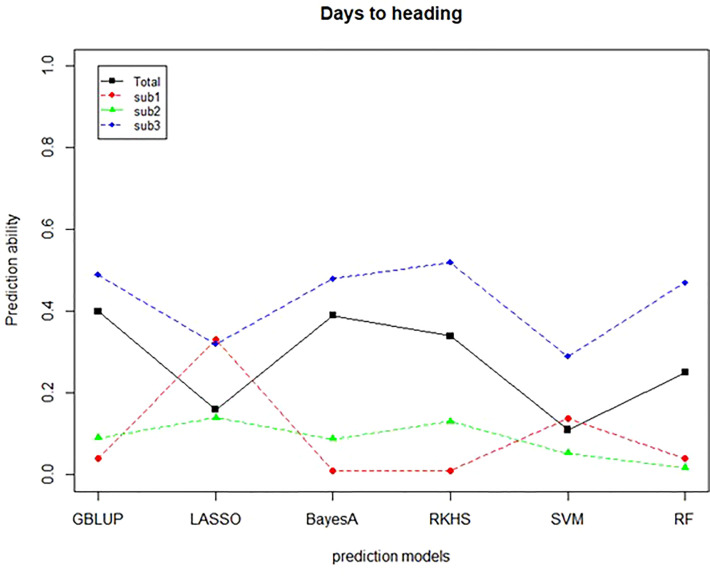
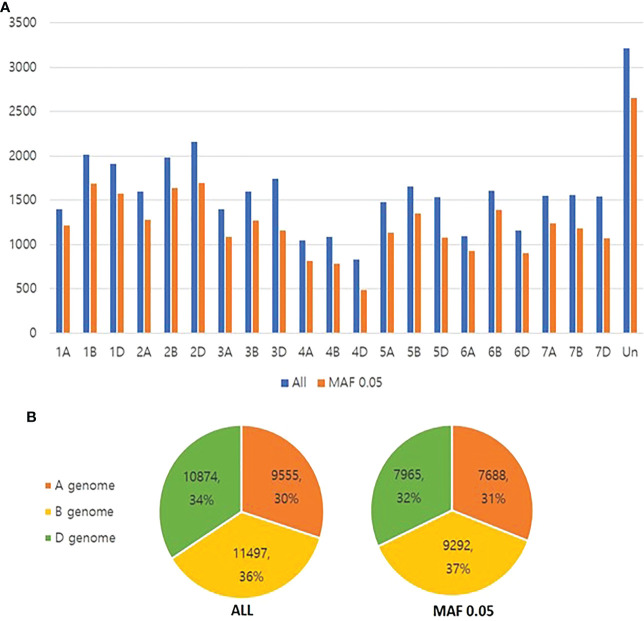
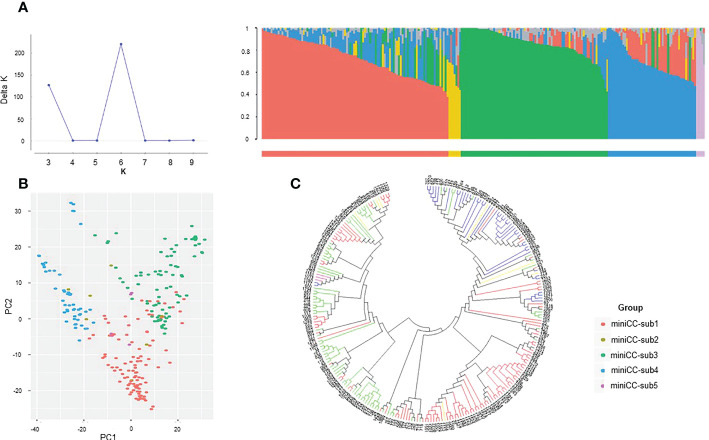
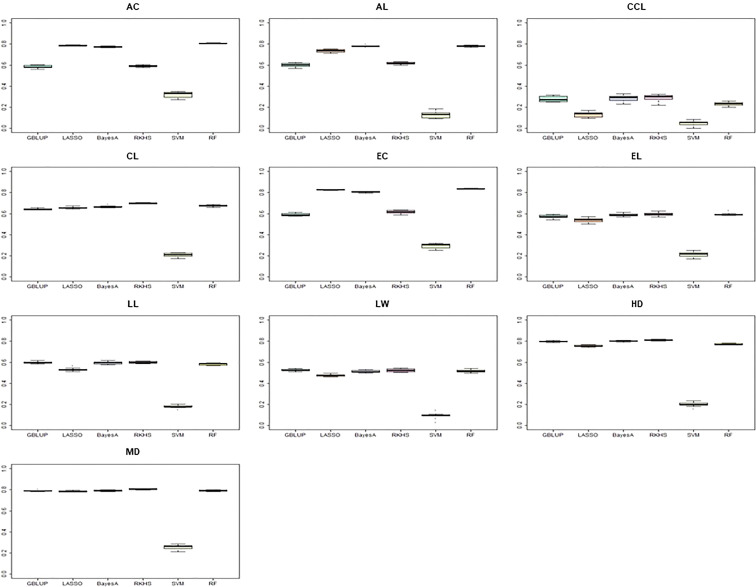
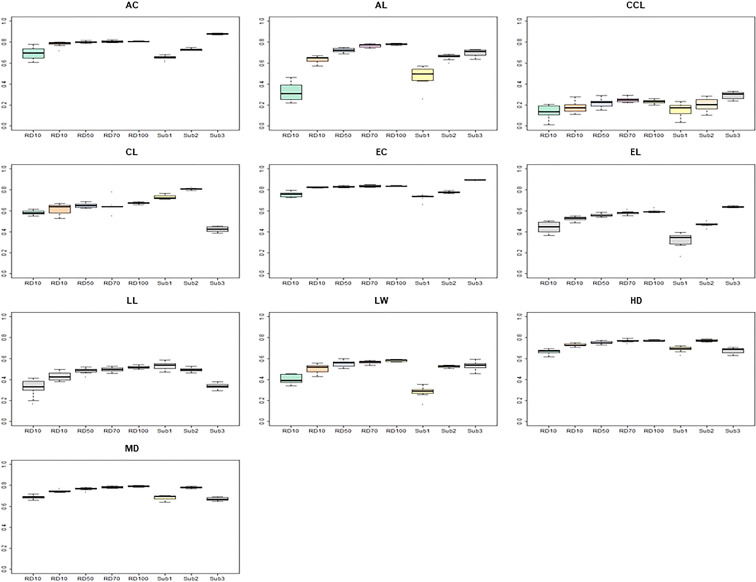
The agricultural traits that constitute basic plant breeding information are usually quantitative or complex in nature. This quantitative and complex combination of traits complicates the process of selection in breeding. This study examined the potential of genome-wide association studies (GWAS) and genomewide selection (GS) for breeding ten agricultural traits by using genome-wide SNPs. As a first step, a trait-associated candidate marker was identified by GWAS using a genetically diverse 567 Korean (K)-wheat core collection. The accessions were genotyped using an Axiom 35K wheat DNA chip, and ten agricultural traits were determined (awn color, awn length, culm color, culm length, ear color, ear length, days to heading, days to maturity, leaf length, and leaf width). It is essential to sustain global wheat production by utilizing accessions in wheat breeding. Among the traits associated with awn color and ear color that showed a high positive correlation, a SNP located on chr1B was significantly associated with both traits. Next, GS evaluated the prediction accuracy using six predictive models (G-BLUP, LASSO, BayseA, reproducing kernel Hilbert space, support vector machine (SVM), and random forest) and various training populations (TPs). With the exception of the SVM, all statistical models demonstrated a prediction accuracy of 0.4 or better. For the optimization of the TP, the number of TPs was randomly selected (10%, 30%, 50% and 70%) or divided into three subgroups (CC-sub 1, CC-sub 2 and CC-sub 3) based on the subpopulation structure. Based on subgroup-based TPs, better prediction accuracy was found for awn color, culm color, culm length, ear color, ear length, and leaf width. A variety of Korean wheat cultivars were used for validation to evaluate the prediction ability of populations. Seven out of ten cultivars showed phenotype-consistent results based on genomics-evaluated breeding values (GEBVs) calculated by the reproducing kernel Hilbert space (RKHS) predictive model. Our research provides a basis for improving complex traits in wheat breeding programs through genomics assisted breeding. The results of our research can be used as a basis for improving wheat breeding programs by using genomics-assisted breeding.
构成基本植物育种信息的农艺性状通常在本质上是数量性状或复杂性状。这种性状的数量化和复杂组合使育种选择过程变得复杂。本研究通过使用全基因组单核苷酸多态性(SNP)来检验全基因组关联研究(GWAS)和全基因组选择(GS)对十种农艺性状育种的潜力。第一步,利用遗传多样性丰富的567份韩国(K)小麦核心种质,通过GWAS鉴定出与性状相关的候选标记。使用Axiom 35K小麦DNA芯片对种质进行基因分型,并测定了十种农艺性状(芒颜色、芒长度、茎颜色、茎长度、穗颜色、穗长度、抽穗天数、成熟天数、叶长度和叶宽度)。通过在小麦育种中利用种质来维持全球小麦产量至关重要。在与芒颜色和穗颜色相关且显示出高度正相关的性状中,位于1B染色体上的一个SNP与这两个性状均显著相关。接下来,GS使用六种预测模型(G-BLUP、LASSO、BayseA、再生核希尔伯特空间、支持向量机(SVM)和随机森林)以及各种训练群体(TPs)评估预测准确性。除了SVM外,所有统计模型的预测准确性均达到0.4或更高。为了优化TP,随机选择TP的数量(10%、30%、50%和70%),或者根据亚群结构将其分为三个亚组(CC-sub 1、CC-sub 2和CC-sub 3)。基于基于亚组的TP,在芒颜色、茎颜色、茎长度、穗颜色、穗长度和叶宽度方面发现了更好的预测准确性。使用了多种韩国小麦品种进行验证,以评估群体的预测能力。十个品种中有七个基于由再生核希尔伯特空间(RKHS)预测模型计算的基因组评估育种值(GEBVs)显示出表型一致的结果。我们的研究为通过基因组辅助育种改善小麦育种计划中的复杂性状提供了依据。我们的研究结果可作为利用基因组辅助育种改善小麦育种计划的依据。