Sorbonne University, GRC 29, AP-HP, DMU DREAM, Department of Anaesthesiology and Critical Care, Pitié-Salpêtrière Hospital, Paris, France.
Department of Anesthesiology and Critical Care, Bicêtre Hospital, AP-HP, University Paris Saclay, Le Kremlin Bicêtre, France.
JAMA Netw Open. 2023 Jun 1;6(6):e2320960. doi: 10.1001/jamanetworkopen.2023.20960.
Electric scooter (e-scooter) use is increasing in France and in many urban environments worldwide. Yet little is known about injuries associated with use of e-scooters.
To describe characteristics and outcomes of major trauma involving e-scooters.
DESIGN, SETTING, AND PARTICIPANTS: A multicenter cohort study was conducted in France using the national major trauma registry between January 1, 2019, and December 20, 2022. All patients admitted to a participating major trauma center following a road traffic crash (RTC) involving an e-scooter, a bicycle, or a motorbike were included.
Included patients were compared according to the 3 mechanisms.
The primary outcome was trauma severity as defined by the Injury Severity Score (ISS). Secondary outcomes included the trends of the number of patients per year, a comparison of the RTC epidemiologic factors, injury severity, resources used, and in-hospital outcomes.
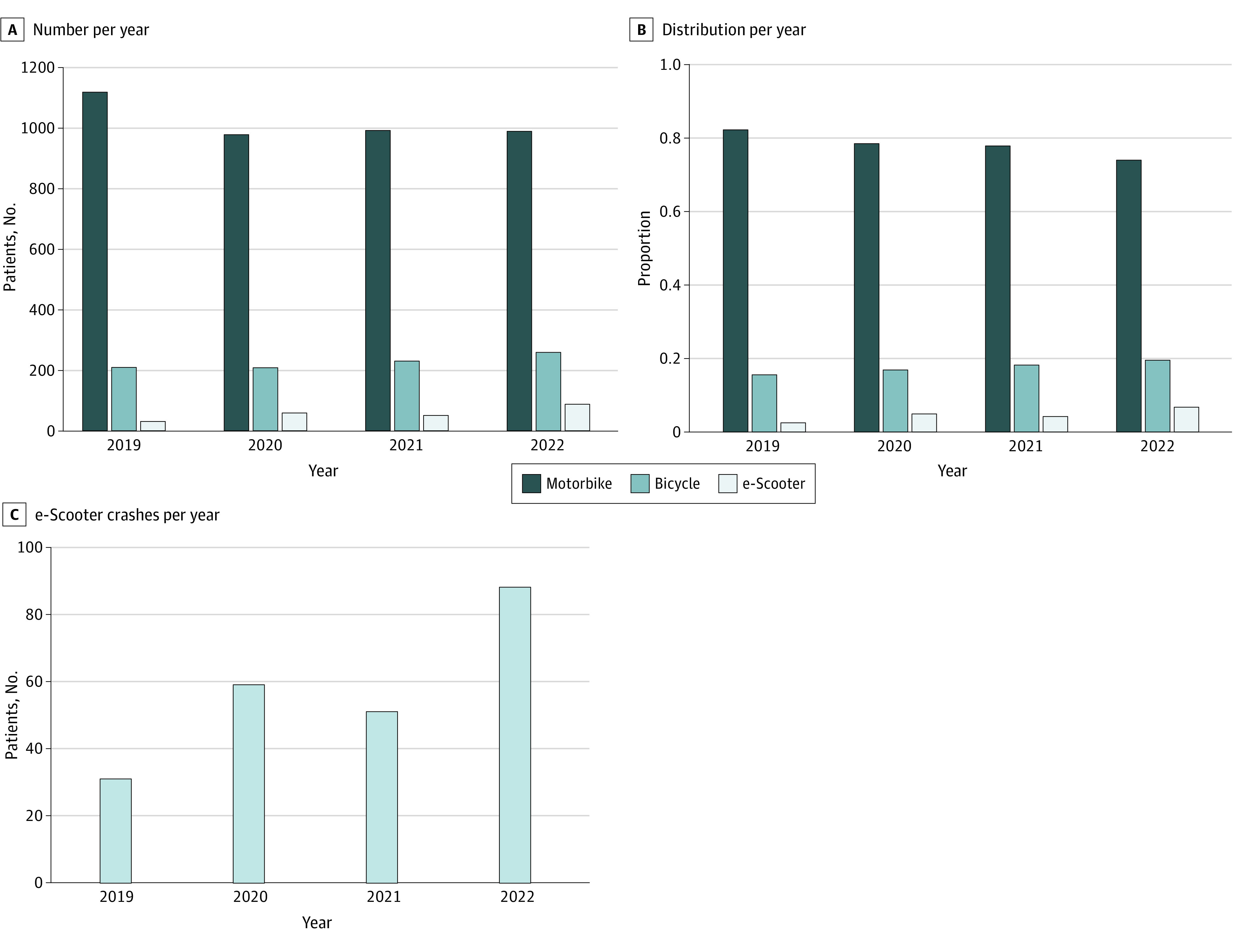
A total of 5233 patients involved in RTCs were admitted (median age, 33 [IQR, 24-48] years; 4629 [88.5%] men; median ISS, 13 [IQR, 8-22]). The population included 229 e-scooter RTCs (4.4%), 4094 motorbike RTCs (78.2%), and 910 bicycle RTCs (17.4%). The number of patients treated following e-scooter RTCs increased by 2.8-fold in 4 years (from 31 in 2019 to 88 in 2022), while bicycle RTCs increased by 1.2-fold and motorbike RTCs decreased by 0.9-fold. At admission, 36.7% of e-scooter users had a blood alcohol content higher than the legal threshold (n = 84) and 22.5% wore a protective helmet (n = 32). Among e-scooter RTCs, 102 patients (45.5%) had an ISS of 16 or higher. This proportion was similar for patients with motorbike RTCs (1557 [39.7%]; P = .10) and bicycle RTCs (411 [47.3%]; P = .69). With a proportion of 25.9% (n = 50), patients with e-scooter RTCs had twice as many severe traumatic brain injuries (Glasgow Coma Scale ≤8) as motorbike RTCs (445 [11.8%]) and a proportion comparable to bicycle RTCs (174 [22.1%]). The mortality of e-scooter RTCs was 9.2% (n = 20), compared with 5.2% (n = 196) (P = .02) for motorbikes and 10.0% (n = 84) (P = .82) for bicycles.
The findings of this study suggest that trauma involving e-scooters in France has significantly increased over the past 4 years. These patients presented with injury profiles as severe as those of individuals who experienced bicycle or motorbike RTCs, with a higher proportion of severe traumatic brain injury.
电动滑板车(e-scooter)在法国和许多城市环境中的使用正在增加。然而,人们对与使用 e-scooter 相关的伤害知之甚少。
描述与 e-scooter 相关的主要创伤的特征和结果。
设计、地点和参与者:本研究采用多中心队列研究方法,使用法国国家主要创伤登记处,时间范围为 2019 年 1 月 1 日至 2022 年 12 月 20 日。所有在涉及 e-scooter、自行车或摩托车的道路交通碰撞(RTC)后被送往参与的主要创伤中心的患者均被纳入研究。
根据三种机制,对纳入的患者进行了比较。
主要结局是损伤严重程度,定义为损伤严重程度评分(ISS)。次要结局包括每年患者数量的趋势、RTC 流行病学因素、损伤严重程度、资源使用和住院结果的比较。
共纳入 5233 名参与 RTC 的患者(中位数年龄为 33 岁[IQR,24-48];4629 名[88.5%]为男性;中位数 ISS 为 13 分[IQR,8-22])。该人群包括 229 例 e-scooter RTC(4.4%)、4094 例摩托车 RTC(78.2%)和 910 例自行车 RTC(17.4%)。在 4 年内,接受 e-scooter RTC 治疗的患者数量增加了 2.8 倍(从 2019 年的 31 例增加到 2022 年的 88 例),而自行车 RTC 增加了 1.2 倍,摩托车 RTC 减少了 0.9 倍。入院时,36.7%的 e-scooter 用户血液中的酒精含量高于法定阈值(n=84),22.5%的人佩戴了防护头盔(n=32)。在 e-scooter RTC 中,102 名患者(45.5%)的 ISS 为 16 或更高。在摩托车 RTC(1557 [39.7%];P=0.10)和自行车 RTC(411 [47.3%];P=0.69)患者中,这一比例相似。由于 e-scooter RTC 患者的严重创伤性脑损伤(格拉斯哥昏迷量表≤8)比例为 25.9%(n=50),是摩托车 RTC(445 [11.8%])的两倍,与自行车 RTC(174 [22.1%])的比例相当。e-scooter RTC 的死亡率为 9.2%(n=20),而摩托车 RTC 为 5.2%(n=196)(P=0.02),自行车 RTC 为 10.0%(n=84)(P=0.82)。
本研究结果表明,法国涉及 e-scooter 的创伤在过去 4 年中显著增加。这些患者的损伤情况与经历自行车或摩托车 RTC 的患者一样严重,伴有严重创伤性脑损伤的比例更高。