Department of Neuroscience, Yale University, New Haven, CT 06511, USA; Interdepartmental Neuroscience Program, Yale University, New Haven, CT 06511, USA.
Department of Neuroscience, Yale University, New Haven, CT 06511, USA.
Cell Rep. 2023 Jul 25;42(7):112720. doi: 10.1016/j.celrep.2023.112720. Epub 2023 Jun 30.
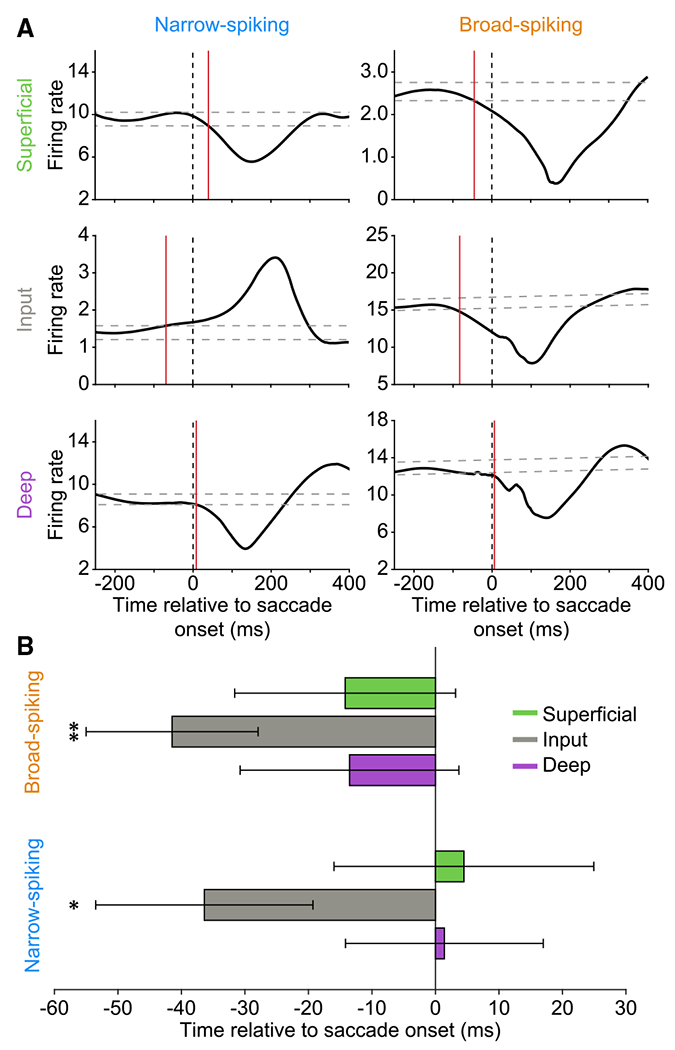
Saccadic eye movements are known to cause saccadic suppression, a temporary reduction in visual sensitivity and visual cortical firing rates. While saccadic suppression has been well characterized at the level of perception and single neurons, relatively little is known about the visual cortical networks governing this phenomenon. Here we examine the effects of saccadic suppression on distinct neural subpopulations within visual area V4. We find subpopulation-specific differences in the magnitude and timing of peri-saccadic modulation. Input-layer neurons show changes in firing rate and inter-neuronal correlations prior to saccade onset, and putative inhibitory interneurons in the input layer elevate their firing rate during saccades. A computational model of this circuit recapitulates our empirical observations and demonstrates that an input-layer-targeting pathway can initiate saccadic suppression by enhancing local inhibitory activity. Collectively, our results provide a mechanistic understanding of how eye movement signaling interacts with cortical circuitry to enforce visual stability.
扫视眼动众所周知会引起扫视抑制,即视觉敏感性和视觉皮层发放率的暂时降低。虽然在感知和单个神经元水平上已经很好地描述了扫视抑制,但对于控制这种现象的视觉皮层网络却知之甚少。在这里,我们研究了扫视抑制对视 V4 内不同神经亚群的影响。我们发现,在扫视期间,在幅度和定时上存在亚群特异性差异。输入层神经元在扫视开始前显示出放电率和神经元间相关性的变化,而输入层中的假定抑制性中间神经元在扫视期间增加其放电率。该电路的计算模型再现了我们的经验观察结果,并表明输入层靶向通路可以通过增强局部抑制活性来引发扫视抑制。总的来说,我们的结果提供了一种机制性的理解,即眼球运动信号如何与皮层回路相互作用以维持视觉稳定性。