Solomon Marjorie, Cho Billy, Iosif Ana-Maria, Heath Brianna, Srivastav Apurv, Nordahl Christine, Ferrer Emilio, Amaral David G
Department of Psychiatry & Behavioral Sciences, University of California-Davis, Sacramento, CA, 2230 Stockton Blvd., Sacramento, CA 95817.
Imaging Research Center, 4701 X Street, Sacramento, CA 95817.
JCPP Adv. 2023 Mar;3(1). doi: 10.1002/jcv2.12127. Epub 2023 Jan 31.
We extended our study of trajectories of intellectual development of autistic individuals in early (mean age 3 years; T1), and middle childhood (mean age 5 years, 7 months; T2) into later middle childhood/preadolescence (mean age 11 years, 6 months; T3) in the longitudinal Autism Phenome Project cohort. Participants included 373 autistic children (115 females).
Multivariate latent class growth analysis was used to identify distinct IQ trajectory subgroups. Baseline and developmental course group differences and predictors of trajectory membership were assessed using linear mixed effects models with repeated measures with pairwise testing, multinomial logistic regression models, and sensitivity analyses.
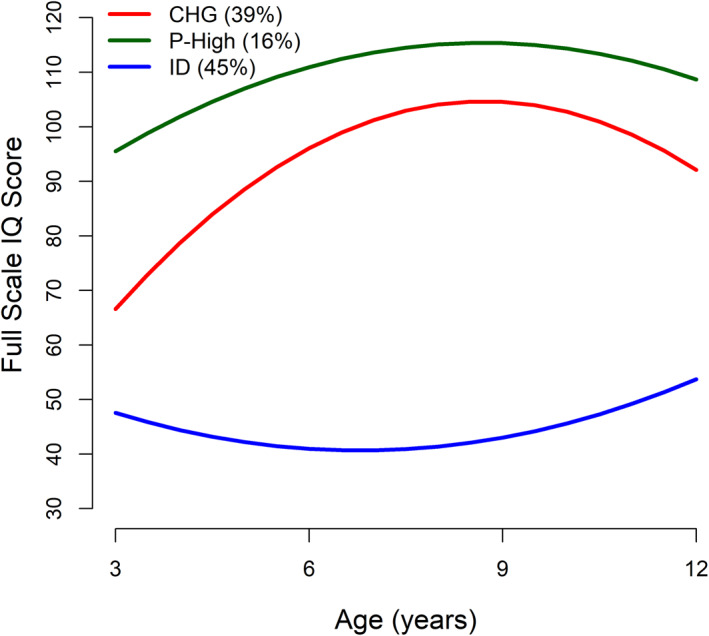
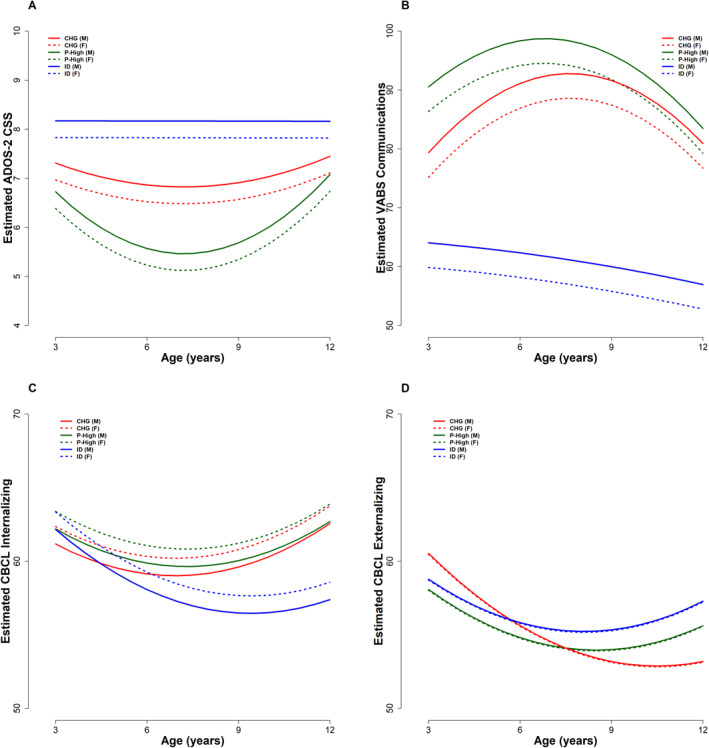
We isolated three IQ trajectories between T1 and T3 for autistic youth that were similar to those found in our prior work. These included a group with persistent intellectual disability (ID; 45%), a group with substantial increases in IQ (CHG; 39%), and a group with persistently average or above IQs (P-High; 16%). By T3, the groups did not differ in ADOS-2 calibrated severity scores (CSS), and there were no group differences between Vineland (VABS) communication scores in CHG and P-High. T1-T3 externalizing behaviors declined significantly for CHG, however, there were no significant T3 group differences between internalizing or externalizing symptoms. T1 correlates for CHG and P-High versus ID group membership included higher VABS communication and lower ADOS-2 CSS. A T1 to T2 increase in VABS communication scores and a decline in externalizing predicted CHG versus ID group membership at T3, while T1 to T2 improvement in VABS communication and reduction in ADOS-2 CSS predicted P-High versus ID group membership.
Autistic youth exhibit consistent IQ developmental trajectories from early childhood through preadolescence. Factors associated with trajectory group membership may provide clues about prognosis, and the need for treatments that improve adaptive communication and externalizing symptoms.
在纵向开展的自闭症表型项目队列研究中,我们将对自闭症个体在幼儿期(平均年龄3岁;T1)和童年中期(平均年龄5岁7个月;T2)智力发展轨迹的研究扩展至童年中后期/青春期前期(平均年龄11岁6个月;T3)。参与者包括373名自闭症儿童(115名女性)。
采用多变量潜在类别增长分析来识别不同的智商轨迹亚组。使用具有重复测量和成对检验的线性混合效应模型、多项逻辑回归模型以及敏感性分析,评估基线和发育过程中的组间差异以及轨迹成员的预测因素。
我们在T1和T3之间为自闭症青少年分离出了三条智商轨迹,与我们之前研究中发现的轨迹相似。其中包括一组存在持续性智力残疾(ID;45%)的个体,一组智商大幅提高(CHG;39%)的个体,以及一组智商持续处于平均水平或以上(P-High;16%)的个体。到T3时,各组在ADOS-2校准严重程度评分(CSS)上没有差异,并且在CHG组和P-High组的文兰(VABS)沟通得分上也没有组间差异。然而,CHG组的T1-T3外化行为显著下降,不过在内化或外化症状方面,T3时各组之间没有显著差异。CHG组和P-High组与ID组成员的T1相关性包括较高的VABS沟通得分和较低的ADOS-2 CSS。T3时,VABS沟通得分从T1到T2的增加以及外化行为的下降预测了CHG组与ID组的成员关系,而VABS沟通从T1到T2的改善以及ADOS-2 CSS的降低预测了P-High组与ID组的成员关系。
自闭症青少年从幼儿期到青春期前期呈现出一致的智商发展轨迹。与轨迹组成员相关的因素可能为预后以及改善适应性沟通和外化症状的治疗需求提供线索。