Division of Cancer Epidemiology and Genetics, National Cancer Institute, National Institutes of Health, Rockville, Maryland.
Division of Genetics and Epidemiology, The Institute of Cancer Research, London, United Kingdom.
JAMA Intern Med. 2023 Aug 1;183(8):849-856. doi: 10.1001/jamainternmed.2023.2509.
Although deaths due to external causes are a leading cause of mortality in the US, trends over time by intent and demographic characteristics remain poorly understood.
To examine national trends in mortality rates due to external causes from 1999 to 2020 by intent (homicide, suicide, unintentional, and undetermined) and demographic characteristics. External causes were defined as poisonings (eg, drug overdose), firearms, and all other injuries, including motor vehicle injuries and falls. Given the repercussions of the COVID-19 pandemic, US death rates for 2019 and 2020 were also compared.
DESIGN, SETTING, AND PARTICIPANTS: Serial cross-sectional study using national death certificate data obtained from the National Center for Health Statistics and including all external causes of 3 813 894 deaths among individuals aged 20 years or older from January 1, 1999, to December 31, 2020. Data analysis was conducted from January 20, 2022, to February 5, 2023.
Age, sex, and race and ethnicity.
Trends in age-standardized mortality rates and average annual percentage change (AAPC) in rates calculated by intent (suicide, homicide, unintentional, and undetermined), age, sex, and race and ethnicity for each external cause.
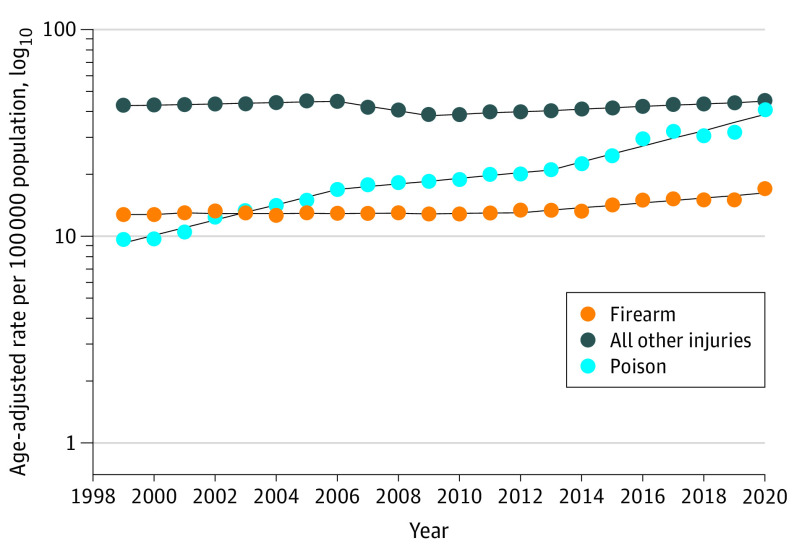
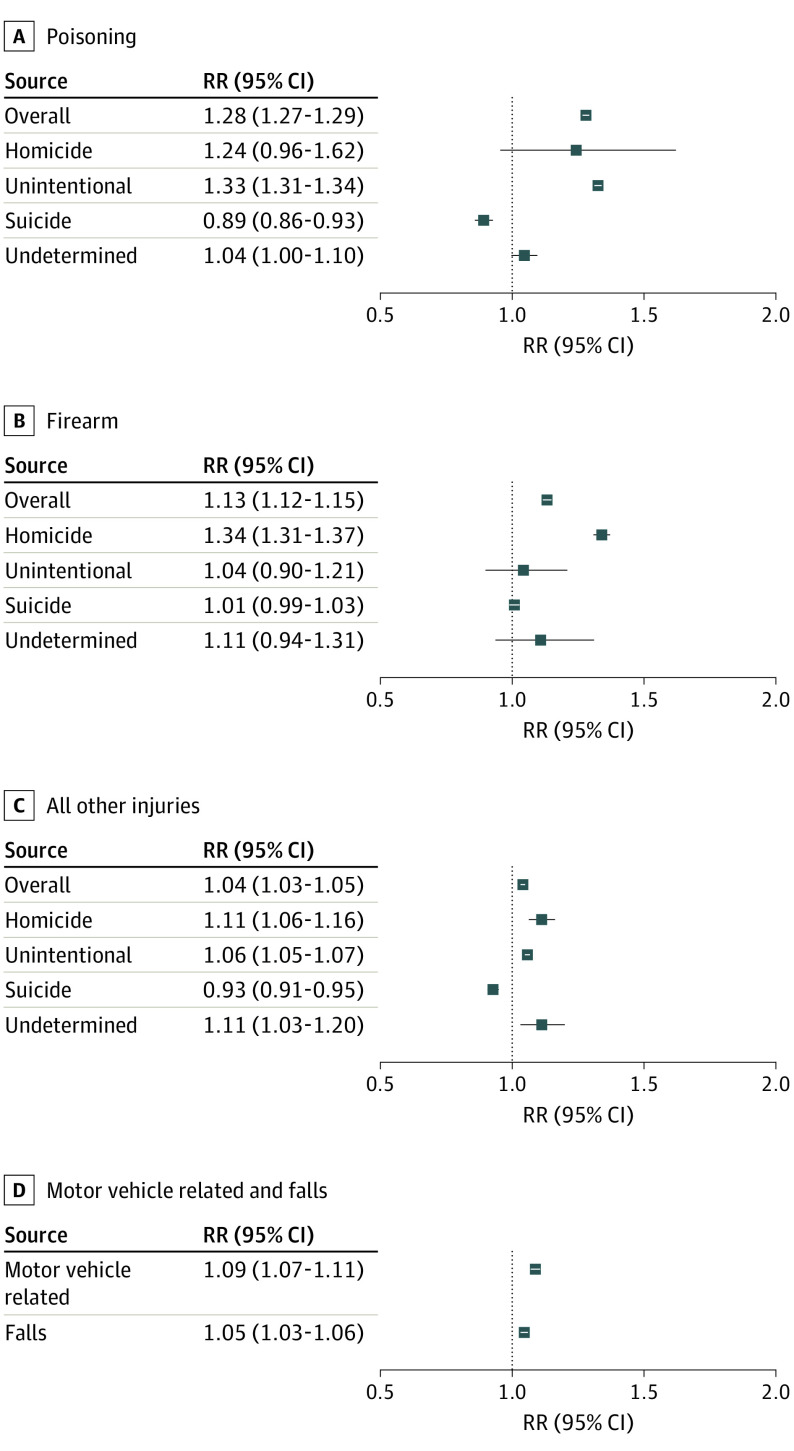
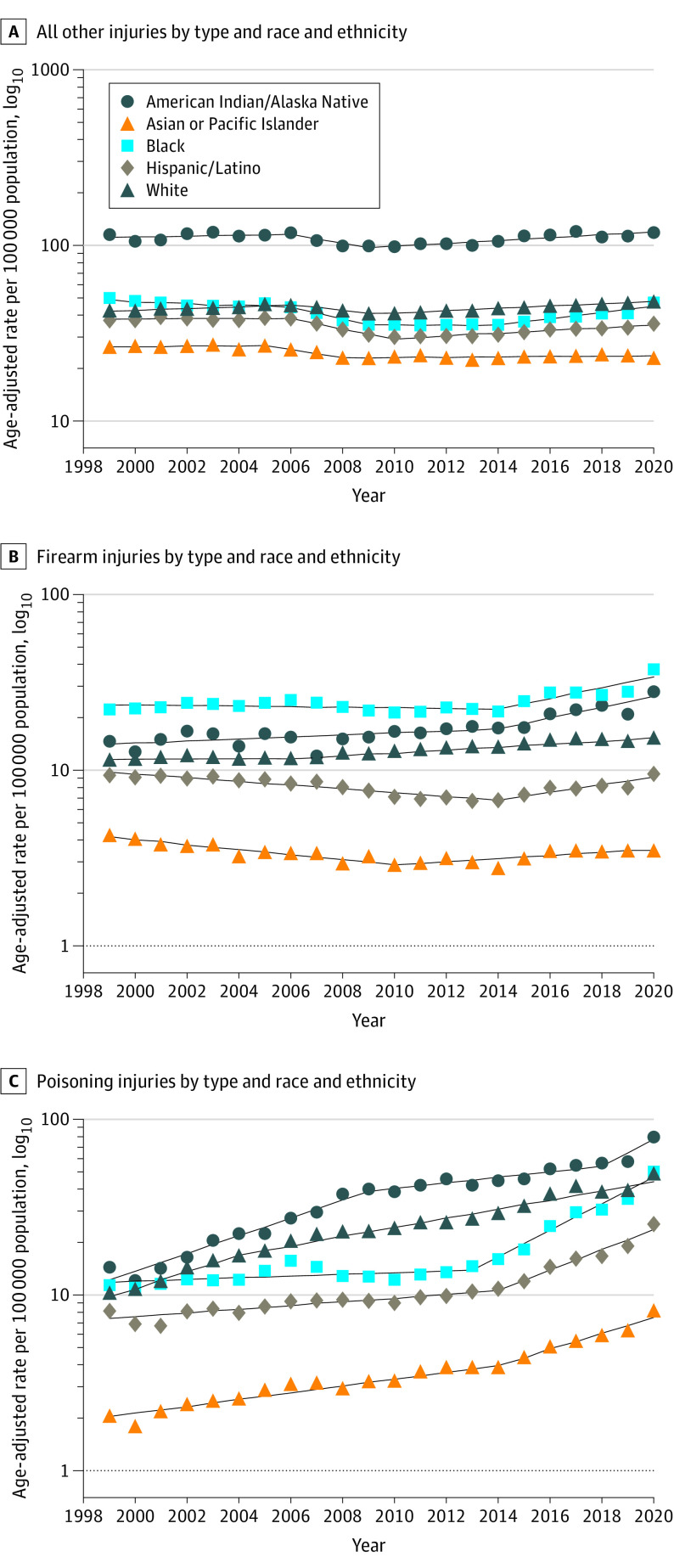
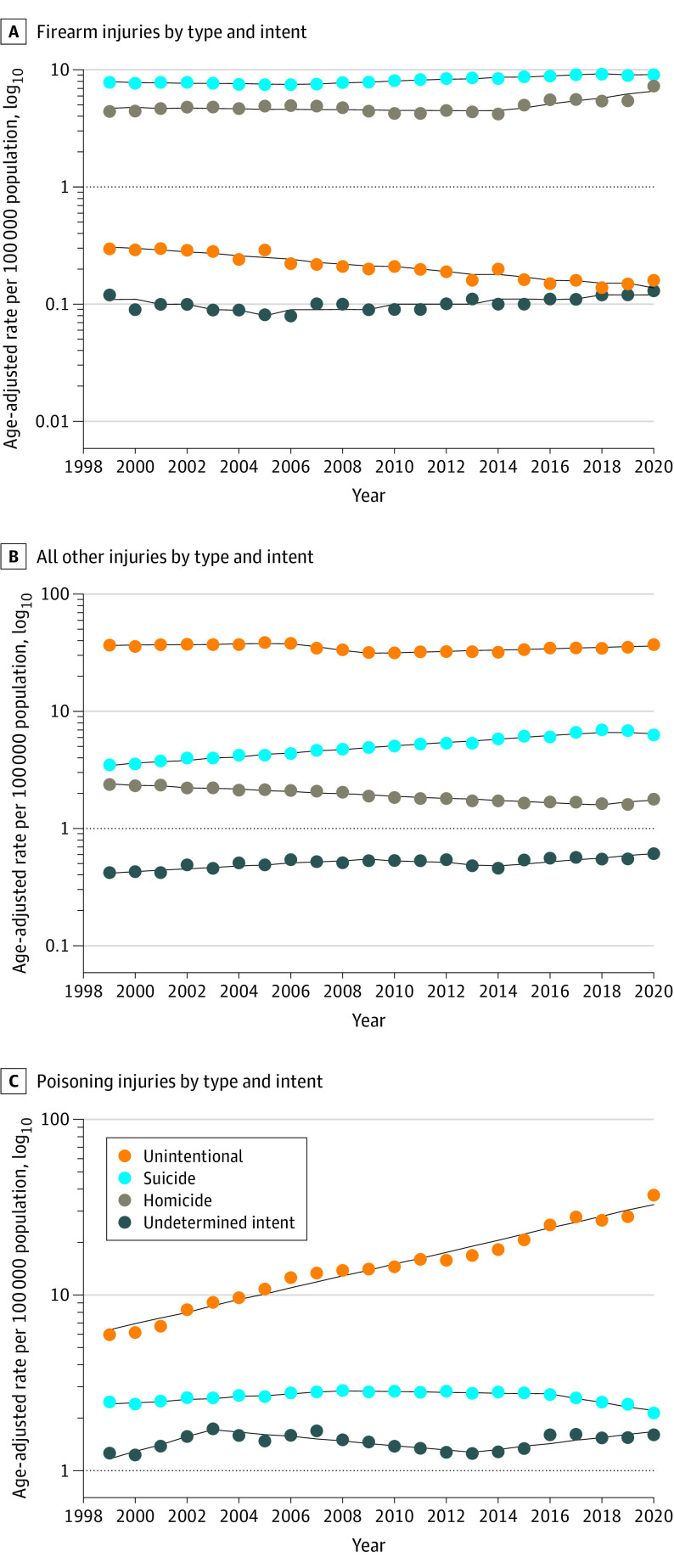
Between 1999 and 2020, there were 3 813 894 deaths due to external causes in the US. From 1999 to 2020, poisoning death rates increased annually (AAPC, 7.0%; 95% CI, 5.4%-8.7%). From 2014 to 2020, poisoning death rates increased the most among men (APC, 10.8%; 95% CI, 7.7%-14.0%). During the study period, poisoning death rates increased in all the racial and ethnic groups examined; the most rapid increase was among American Indian and Alaska Native individuals (AAPC, 9.2%; 95% CI, 7.4%-10.9%). During the study period, death rates for unintentional poisoning had the most rapid rate of increase (AAPC, 8.1%; 95% CI, 7.4%-8.9%). From 1999 to 2020, firearm death rates increased (AAPC, 1.1%; 95% CI, 0.7%-1.5%). From 2013 to 2020, firearm mortality increased by an average of 4.7% annually (95% CI, 2.9%-6.5%) among individuals aged 20 to 39 years. From 2014 to 2020, mortality from firearm homicides increased by an average of 6.9% annually (95% CI, 3.5%-10.4%). From 2019 to 2020, mortality rates from external causes accelerated further, largely from increases in unintentional poisoning, and homicide due to firearms and all other injuries.
Results of this cross-sectional study suggest that from 1999 to 2020, death rates due to poisonings, firearms, and all other injuries increased substantially in the US. The rapid increase in deaths due to unintentional poisonings and firearm homicides is a national emergency that requires urgent public health interventions at the local and national levels.
尽管美国因外部原因导致的死亡是导致死亡的主要原因,但随着时间的推移,按意图和人口特征划分的趋势仍了解甚少。
通过意图(凶杀、自杀、意外和未确定)和人口特征,研究 1999 年至 2020 年美国因外部原因导致的死亡率趋势。外部原因定义为中毒(例如,药物过量)、枪支和所有其他伤害,包括机动车事故和跌倒。鉴于 COVID-19 大流行的影响,还比较了 2019 年和 2020 年的美国死亡率。
设计、地点和参与者:这是一项使用国家卫生统计中心获得的国家死亡证明数据的连续横断面研究,包括 1999 年 1 月 1 日至 2020 年 12 月 31 日期间 20 岁或以上个体的所有外部原因导致的 3813894 例死亡。数据分析于 2023 年 2 月 5 日从 2023 年 2 月 5 日进行。
年龄、性别和种族和民族。
按意图(自杀、凶杀、意外和未确定)、年龄、性别和种族和民族计算的每一种外部原因的年龄标准化死亡率趋势和平均年百分比变化(AAPC)。
1999 年至 2020 年期间,美国有 3813894 人因外部原因死亡。从 1999 年到 2020 年,中毒死亡率每年都在增加(AAPC,7.0%;95%CI,5.4%-8.7%)。从 2014 年到 2020 年,中毒死亡率在男性中增加最多(APC,10.8%;95%CI,7.7%-14.0%)。在研究期间,所有检查的种族和族裔群体的中毒死亡率都有所增加;增幅最大的是美洲印第安人和阿拉斯加原住民(AAPC,9.2%;95%CI,7.4%-10.9%)。在研究期间,意外中毒的死亡率增长最快(AAPC,8.1%;95%CI,7.4%-8.9%)。从 1999 年到 2020 年,枪支死亡率增加(AAPC,1.1%;95%CI,0.7%-1.5%)。从 2013 年到 2020 年,20 至 39 岁人群的枪支死亡率平均每年增加 4.7%(95%CI,2.9%-6.5%)。从 2014 年到 2020 年,枪支凶杀死亡率平均每年增加 6.9%(95%CI,3.5%-10.4%)。从 2019 年到 2020 年,外部原因死亡率进一步加速,主要是由于意外中毒和枪支以及所有其他伤害导致的凶杀案增加。
这项横断面研究的结果表明,从 1999 年到 2020 年,美国因中毒、枪支和所有其他伤害导致的死亡率大幅上升。意外中毒和枪支凶杀导致的死亡率迅速增加是全国性的紧急情况,需要在地方和国家层面采取紧急公共卫生干预措施。