Department of Molecular Bioscience, College of Biomedical Science, Kangwon National University, Chuncheon 24341, Korea.
Department of Molecular Bioscience, College of Biomedical Science, Kangwon National University, Chuncheon 24341; Kangwon Institute of Inclusive Technology, Kangwon National University, Chuncheon 24341, Korea.
BMB Rep. 2023 Nov;56(11):600-605. doi: 10.5483/BMBRep.2023-0029.
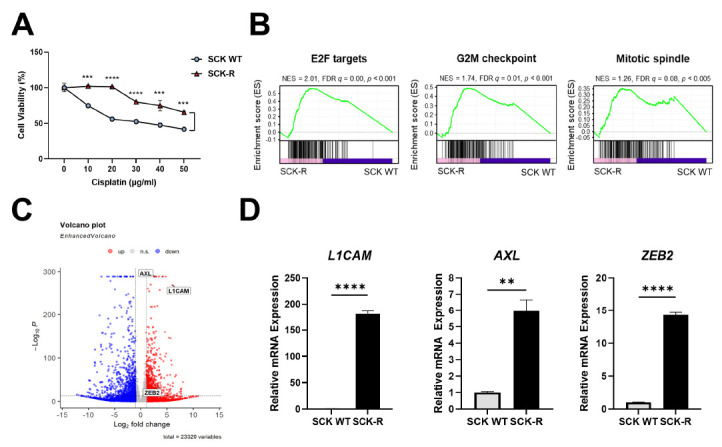
Intrahepatic cholangiocarcinoma (ICC) is a bile duct cancer and a rare malignant tumor with a poor prognosis owing to the lack of an early diagnosis and resistance to conventional chemotherapy. A combination of gemcitabine and cisplatin is the typically attempted first-line treatment approach. However, the underlying mechanism of resistance to chemotherapy is poorly understood. We addressed this by studying dynamics in the human ICC SCK cell line. Here, we report that the regulation of glucose and glutamine metabolism was a key factor in overcoming cisplatin resistance in SCK cells. RNA sequencing analysis revealed a high enrichment cell cycle-related gene set score in cisplatin-resistant SCK (SCK-R) cells compared to parental SCK (SCK WT) cells. Cell cycle progression correlates with increased nutrient requirement and cancer proliferation or metastasis. Commonly, cancer cells are dependent upon glucose and glutamine availability for survival and proliferation. Indeed, we observed the increased expression of GLUT (glucose transporter), ASCT2 (glutamine transporter), and cancer progression markers in SCK-R cells. Thus, we inhibited enhanced metabolic reprogramming in SCK-R cells through nutrient starvation. SCK-R cells were sensitized to cisplatin, especially under glucose starvation. Glutaminase-1 (GLS1), which is a mitochondrial enzyme involved in tumorigenesis and progression in cancer cells, was upregulated in SCK-R cells. Targeting GLS1 with the GLS1 inhibitor CB-839 (telaglenastat) effectively reduced the expression of cancer progression markers. Taken together, our study results suggest that a combination of GLUT inhibition, which mimics glucose starvation, and GLS1 inhibition could be a therapeutic strategy to increase the chemosensitivity of ICC. [BMB Reports 2023; 56(11): 600-605].
肝内胆管癌(ICC)是一种胆管癌,是一种罕见的恶性肿瘤,由于缺乏早期诊断和对常规化疗的耐药性,预后较差。吉西他滨和顺铂联合治疗是常用的一线治疗方法。然而,对化疗耐药的潜在机制仍不清楚。我们通过研究人 ICC SCK 细胞系来解决这个问题。在这里,我们报告说,葡萄糖和谷氨酰胺代谢的调节是克服 SCK 细胞中顺铂耐药的关键因素。RNA 测序分析显示,与亲本 SCK(SCK WT)细胞相比,耐顺铂的 SCK(SCK-R)细胞中细胞周期相关基因集评分高度富集。细胞周期进展与增加的营养需求以及癌症增殖或转移相关。通常情况下,癌细胞依赖葡萄糖和谷氨酰胺的可用性来生存和增殖。事实上,我们观察到 SCK-R 细胞中 GLUT(葡萄糖转运蛋白)、ASCT2(谷氨酰胺转运蛋白)和癌症进展标志物的表达增加。因此,我们通过营养饥饿抑制 SCK-R 细胞中增强的代谢重编程。SCK-R 细胞对顺铂更敏感,特别是在葡萄糖饥饿的情况下。谷氨酰胺酶-1(GLS1)是一种参与癌细胞发生和进展的线粒体酶,在 SCK-R 细胞中上调。用 GLS1 抑制剂 CB-839(telaglenastat)靶向 GLS1 可有效降低癌症进展标志物的表达。总之,我们的研究结果表明,GLUT 抑制(模拟葡萄糖饥饿)和 GLS1 抑制的联合治疗可能是提高 ICC 化疗敏感性的一种治疗策略。[BMB 报告 2023;56(11):600-605]。