Beijing Municipal Key Laboratory of Clinical Epidemiology, School of Public Health, Capital Medical University, No.10 Xitoutiao, Youanmen Street, Beijing, 100069, China.
Centre for Precision Health, School of Medical and Health Sciences, Edith Cowan University, 270 Joondalup Drive, Joondalup, WA, 6027, Australia.
J Transl Med. 2023 Jul 5;21(1):436. doi: 10.1186/s12967-023-04276-3.
Impaired sensitivity to thyroid hormones is a newly proposed clinical entity associated with hyperuricemia in the subclinical hypothyroid population. However, it is unknown whether the association exists in the euthyroid population. This study aimed to explore the association of impaired sensitivity to thyroid hormones (assessed by the thyroid feedback quantile-based index [TFQI], parametric thyroid feedback quantile-based index [PTFQI], thyrotrophic thyroxine resistance index [TT4RI] and thyroid-stimulating hormone index [TSHI]) with hyperuricemia and quantify the mediating effect of body mass index BMI in the euthyroid population.
This cross-sectional study enrolled Chinese adults aged ≥ 20 years who participated in the Beijing Health Management Cohort (2008-2019). Adjusted logistic regression models were used to explore the association between indices of sensitivity to thyroid hormones and hyperuricemia. Odds ratios [OR] and absolute risk differences [ARD] were calculated. Mediation analyses were performed to estimate direct and indirect effects through BMI.
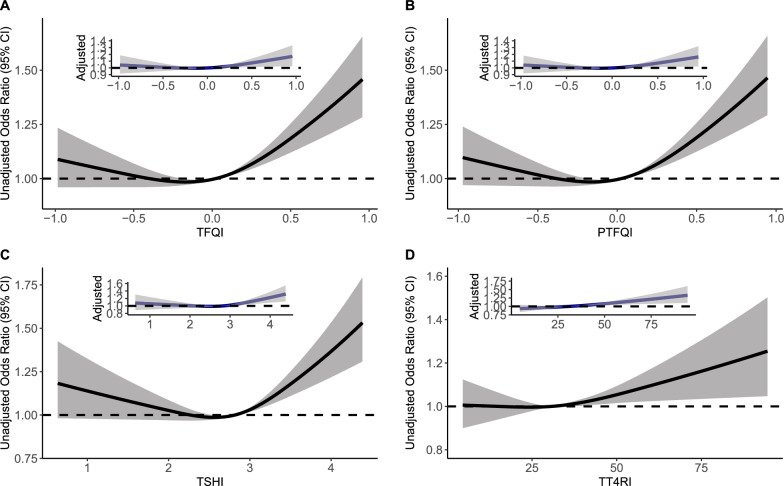
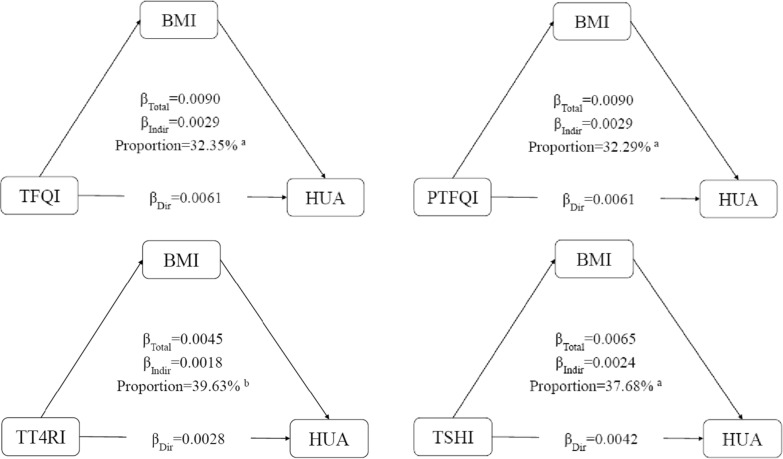
Of 30,857 participants, 19,031 (61.7%) were male; the mean (SD) age was 47.3 (13.3) years; and 6,515 (21.1%) had hyperuricemia. After adjusting for confounders, individuals in the highest group of thyroid hormone sensitivity indices were associated with an increased prevalence of hyperuricemia compared with the lowest group (TFQI: OR = 1.18, 95% CI 1.04-1.35; PTFQI: OR = 1.20, 95% CI 1.05-1.36; TT4RI: OR = 1.17, 95% CI 1.08-1.27; TSHI: OR = 1.12, 95% CI 1.04-1.21). BMI significantly mediated 32.35%, 32.29%, 39.63%, and 37.68% of the associations of TFQI, PTFQI, TT4RI and TSHI with hyperuricemia, respectively.
Our research revealed that BMI mediated the association between impaired sensitivity to thyroid hormones and hyperuricemia in the euthyroid population. These findings could provide useful evidence for understanding the interaction between impaired sensitivity to thyroid hormone and hyperuricemia in euthyroid individuals and suggest the clinical implications of weight control in terms of impaired thyroid hormones sensitivity.
甲状腺激素敏感性受损是一种新提出的临床实体,与亚临床甲状腺功能减退人群中的高尿酸血症有关。然而,在甲状腺功能正常人群中是否存在这种关联尚不清楚。本研究旨在探讨甲状腺激素敏感性受损(通过甲状腺反馈分位数指数[TFQI]、参数甲状腺反馈分位数指数[PTFQI]、促甲状腺素甲状腺素抵抗指数[TT4RI]和促甲状腺激素指数[TSHI]评估)与高尿酸血症的相关性,并量化甲状腺功能正常人群中体重指数(BMI)的中介作用。
本横断面研究纳入了参加北京健康管理队列(2008-2019 年)的年龄≥20 岁的中国成年人。采用调整后的逻辑回归模型探讨甲状腺激素敏感性指数与高尿酸血症的关系。计算比值比[OR]和绝对风险差异[ARD]。通过 BMI 进行中介分析,以估计直接和间接效应。
在 30857 名参与者中,19031 名(61.7%)为男性;平均(SD)年龄为 47.3(13.3)岁;6515 名(21.1%)患有高尿酸血症。调整混杂因素后,与最低组相比,甲状腺激素敏感性指数最高组的高尿酸血症患病率增加(TFQI:OR=1.18,95%CI 1.04-1.35;PTFQI:OR=1.20,95%CI 1.05-1.36;TT4RI:OR=1.17,95%CI 1.08-1.27;TSHI:OR=1.12,95%CI 1.04-1.21)。BMI 显著介导了 TFQI、PTFQI、TT4RI 和 TSHI 与高尿酸血症之间关联的 32.35%、32.29%、39.63%和 37.68%。
本研究表明,BMI 介导了甲状腺激素敏感性受损与甲状腺功能正常人群高尿酸血症之间的关联。这些发现为理解甲状腺激素敏感性受损与甲状腺功能正常个体高尿酸血症之间的相互作用提供了有用的证据,并提示在控制体重方面具有临床意义,以改善甲状腺激素敏感性。