Zhang Yueyue, Han Shichao, Duan Zhizhou, Tian Xu, Li Xueyi, Hou Guangdong, Gao Xuelin, Tian Chunjuan, Li Xiangyu, Yu Wenyuan, Zhou Qin, Niu Zhiping, Wang Fuli
Department of Urology, Xijing Hospital, Air Force Medical University, Xi'an, China.
Preventive Health Service, Jiangxi Provincial People's Hospital, The First Affiliated Hospital of Nanchang Medical College, Nanchang, Jiangxi, China.
Front Endocrinol (Lausanne). 2024 Dec 9;15:1469637. doi: 10.3389/fendo.2024.1469637. eCollection 2024.
With the development of lifestyle, elevated uric acid and hyperuricemia have become important factors affecting human health, but the biological mechanism and risk factors are still unclear.
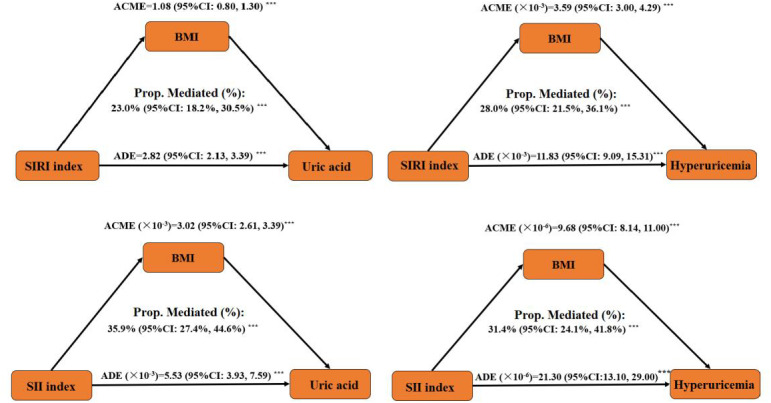
A multi-stage, cross-sectional study of 41,136 adults from the NHANES 2003-2018 was conducted. Serum uric acid concentrations, platelet, neutrophil, lymphocyte, and monocyte counts were measured. The systemic inflammation response (SIRI) index and systemic immune-inflammatory (SII) index were calculated to reflect systemic inflammation and systemic immune inflammation. The height and weight data were obtained to assess body mass index (BMI). Generalized linear models were used to examine the relationships of SIRI and SII with uric acid and hyperuricemia risk, as well as the associations of SIRI and SII with BMI, and BMI with uric acid and hyperuricemia risk. Causal mediation effect model was used to assess the mediating effect of BMI in the relationships of SIRI, and SII with uric acid concentration and hyperuricemia risk.
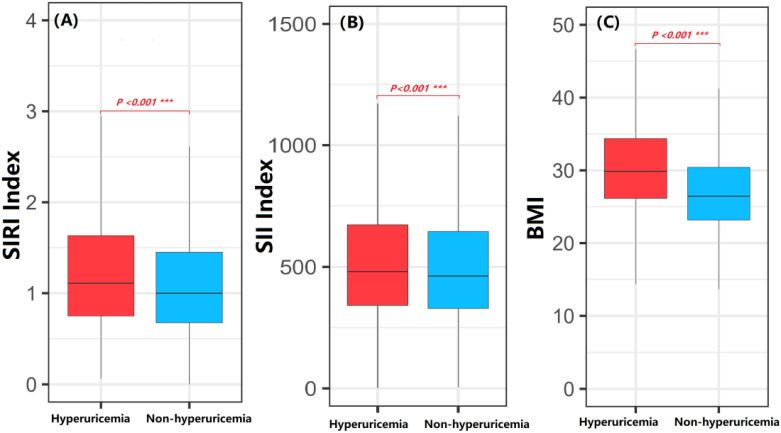
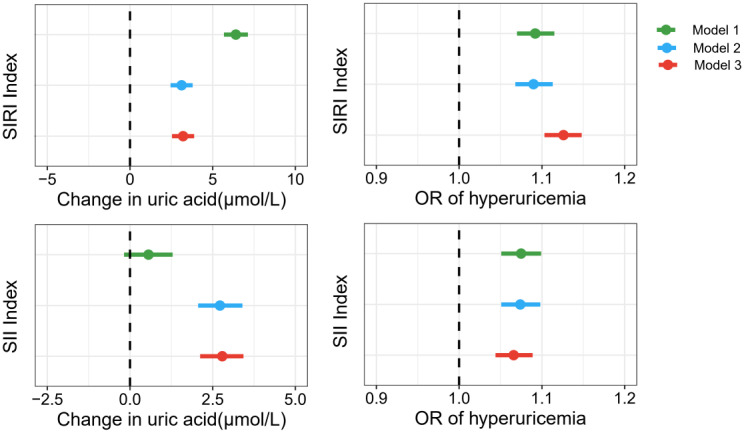
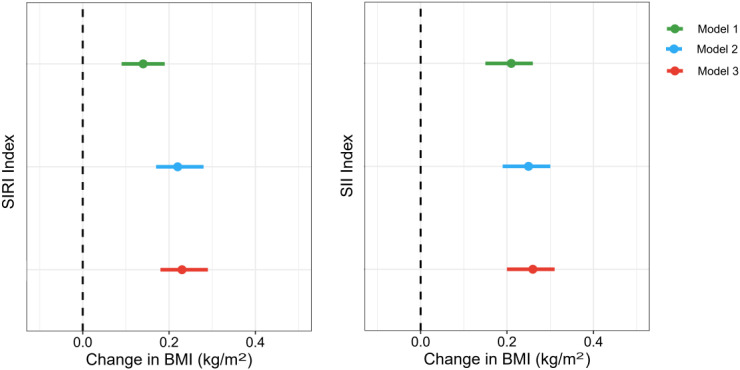
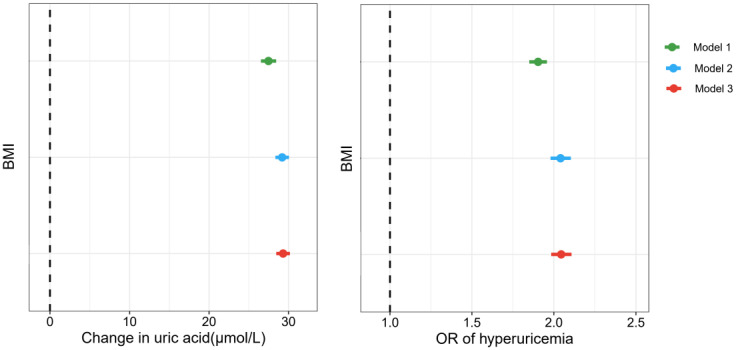
The prevalence of hyperuricemia in US adults is 19.78%. Positive associations were found in the relationships of SIRI and SII with uric acid level, hyperuricemia risk, and BMI, as well as the relationships of BMI with uric acid and hyperuricemia risk. Causal mediation effect model showed that BMI played an important mediating role in the relationships of SIRI, and SII with uric acid concentration and hyperuricemia risk, with the proportion of mediating effect ranging from 23.0% to 35.9%.
Exposure to higher SIRI and SII is associated with increased uric acid concentration and hyperuricemia risk in adults, and BMI plays an important mediating effect. Reducing systemic inflammation and systemic immune inflammation and proper weight control could be effective ways to reduce hyperuricemia prevalence and related health problems.
随着生活方式的改变,尿酸升高和高尿酸血症已成为影响人类健康的重要因素,但其生物学机制和危险因素仍不清楚。
对2003 - 2018年美国国家健康与营养检查调查(NHANES)中的41136名成年人进行了多阶段横断面研究。测量了血清尿酸浓度、血小板、中性粒细胞、淋巴细胞和单核细胞计数。计算全身炎症反应(SIRI)指数和全身免疫炎症(SII)指数以反映全身炎症和全身免疫炎症。获取身高和体重数据以评估体重指数(BMI)。使用广义线性模型来检验SIRI和SII与尿酸及高尿酸血症风险的关系,以及SIRI和SII与BMI的关联,还有BMI与尿酸及高尿酸血症风险的关联。采用因果中介效应模型评估BMI在SIRI和SII与尿酸浓度及高尿酸血症风险关系中的中介作用。
美国成年人高尿酸血症的患病率为19.78%。发现SIRI和SII与尿酸水平、高尿酸血症风险及BMI之间存在正相关关系,以及BMI与尿酸和高尿酸血症风险之间也存在正相关关系。因果中介效应模型表明,BMI在SIRI和SII与尿酸浓度及高尿酸血症风险的关系中起重要中介作用,中介效应比例在23.0%至35.9%之间。
成年人暴露于较高的SIRI和SII与尿酸浓度升高及高尿酸血症风险增加相关,且BMI起重要中介作用。减轻全身炎症和全身免疫炎症以及适当控制体重可能是降低高尿酸血症患病率及相关健康问题的有效方法。