Tsinghua University School of Medicine, Beijing, China.
Department of Microbiology and Molecular Genetics, University of Pittsburgh School of Medicine, Pittsburgh, Pennsylvania, USA.
Appl Environ Microbiol. 2023 Jul 26;89(7):e0063323. doi: 10.1128/aem.00633-23. Epub 2023 Jul 5.
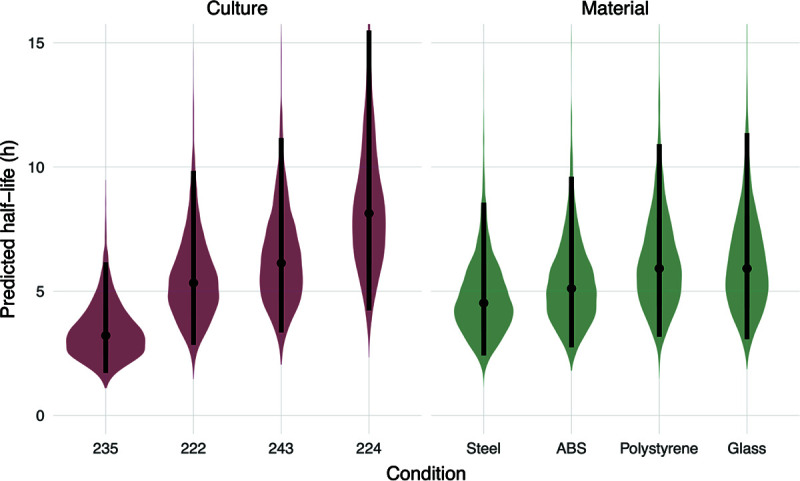
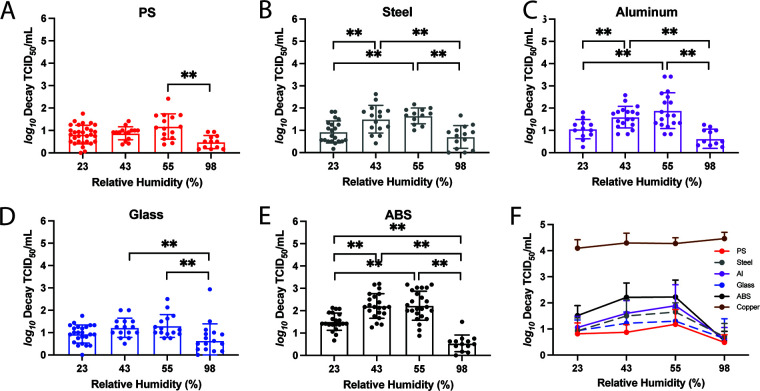
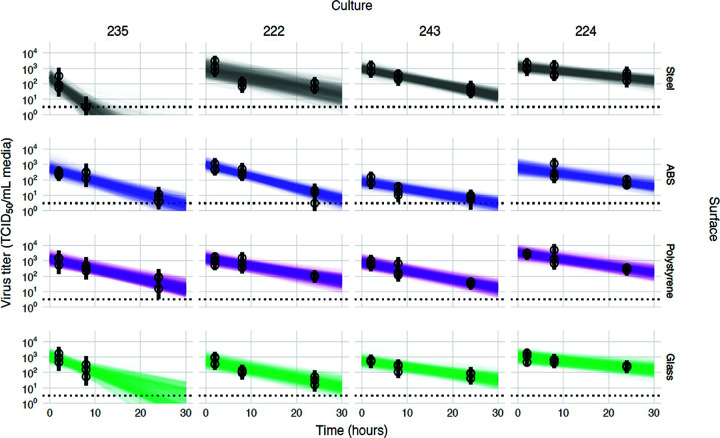
Respiratory viruses can be transmitted by multiple modes, including contaminated surfaces, commonly referred to as fomites. Efficient fomite transmission requires that a virus remain infectious on a given surface material over a wide range of environmental conditions, including different relative humidities. Prior work examining the stability of influenza viruses on surfaces has relied upon virus grown in media or eggs, which does not mimic the composition of virus-containing droplets expelled from the human respiratory tract. In this study, we examined the stability of the 2009 pandemic H1N1 (H1N1pdm09) virus on a variety of nonporous surface materials at four different humidities. Importantly, we used virus grown in primary human bronchial epithelial cell (HBE) cultures from different donors to recapitulate the physiological microenvironment of expelled viruses. We observed rapid inactivation of H1N1pdm09 on copper under all experimental conditions. In contrast to copper, viruses were stable on polystyrene plastic, stainless steel, aluminum, and glass, at multiple relative humidities, but greater decay on acrylonitrile butadiene styrene (ABS) plastic was observed at short time points. However, the half-lives of viruses at 23% relative humidity were similar among noncopper surfaces and ranged from 4.5 to 5.9 h. Assessment of H1N1pdm09 longevity on nonporous surfaces revealed that virus persistence was governed more by differences among HBE culture donors than by surface material. Our findings highlight the potential role of an individual's respiratory fluid on viral persistence and could help explain heterogeneity in transmission dynamics. Seasonal epidemics and sporadic pandemics of influenza cause a large public health burden. Although influenza viruses disseminate through the environment in respiratory secretions expelled from infected individuals, they can also be transmitted by contaminated surfaces where virus-laden expulsions can be deposited. Understanding virus stability on surfaces within the indoor environment is critical to assessing influenza transmission risk. We found that influenza virus stability is affected by the host respiratory secretion in which the virus is expelled, the surface material on which the droplet lands, and the ambient relative humidity of the environment. Influenza viruses can remain infectious on many common surfaces for prolonged periods, with half-lives of 4.5 to 5.9 h. These data imply that influenza viruses are persistent in indoor environments in biologically relevant matrices. Decontamination and engineering controls should be used to mitigate influenza virus transmission.
呼吸道病毒可以通过多种途径传播,包括被污染的表面,通常被称为污染物。有效的污染物传播需要病毒在广泛的环境条件下(包括不同的相对湿度),在给定的表面材料上保持传染性。先前研究流感病毒在表面稳定性的工作依赖于在培养基或鸡蛋中生长的病毒,这并不能模拟从人体呼吸道排出的含病毒飞沫的组成。在这项研究中,我们在四种不同的湿度下,研究了 2009 年大流行性 H1N1(H1N1pdm09)病毒在各种非多孔表面材料上的稳定性。重要的是,我们使用在不同供体的原代人支气管上皮细胞(HBE)培养物中生长的病毒来重现排出病毒的生理微环境。我们观察到在所有实验条件下,铜上的 H1N1pdm09 迅速失活。与铜不同,病毒在聚苯乙烯塑料、不锈钢、铝和玻璃上在多个相对湿度下稳定,但在丙烯腈丁二烯苯乙烯(ABS)塑料上在短时间点观察到更大的衰减。然而,在 23%相对湿度下,非铜表面上病毒的半衰期相似,范围为 4.5 至 5.9 小时。对非多孔表面上 H1N1pdm09 持久性的评估表明,病毒的持久性更多地受 HBE 培养物供体之间的差异控制,而不是表面材料。我们的研究结果突出了个体呼吸液对病毒持久性的潜在作用,并可能有助于解释传播动力学的异质性。季节性流感流行和偶发大流行给公共卫生带来了巨大负担。虽然流感病毒通过感染个体排出的呼吸道分泌物在环境中传播,但它们也可以通过污染的表面传播,病毒载量的飞沫可以沉积在这些表面上。了解室内环境中病毒在表面上的稳定性对于评估流感传播风险至关重要。我们发现,流感病毒的稳定性受病毒排出的宿主呼吸道分泌物、飞沫降落在其上的表面材料以及环境的环境相对湿度的影响。流感病毒可以在许多常见表面上长时间保持传染性,半衰期为 4.5 至 5.9 小时。这些数据意味着流感病毒在具有生物学相关性的室内环境中具有持久性。应使用去污和工程控制来减轻流感病毒的传播。