Public Health, Department of Social Medicine, Osaka University Graduate School of Medicine.
Osaka Maternal and Child Health Information Center, Osaka Women's and Children's Hospital.
Environ Health Prev Med. 2023;28:41. doi: 10.1265/ehpm.23-00008.
Unhealthy eating behaviors, including eating fast, eating after satiety, skipping breakfast, and eating out are common among men aged 20-39 years. In this cross-sectional study, we aimed to examine the association between self-reported eating habits and the prevalence of dyslipidemia.
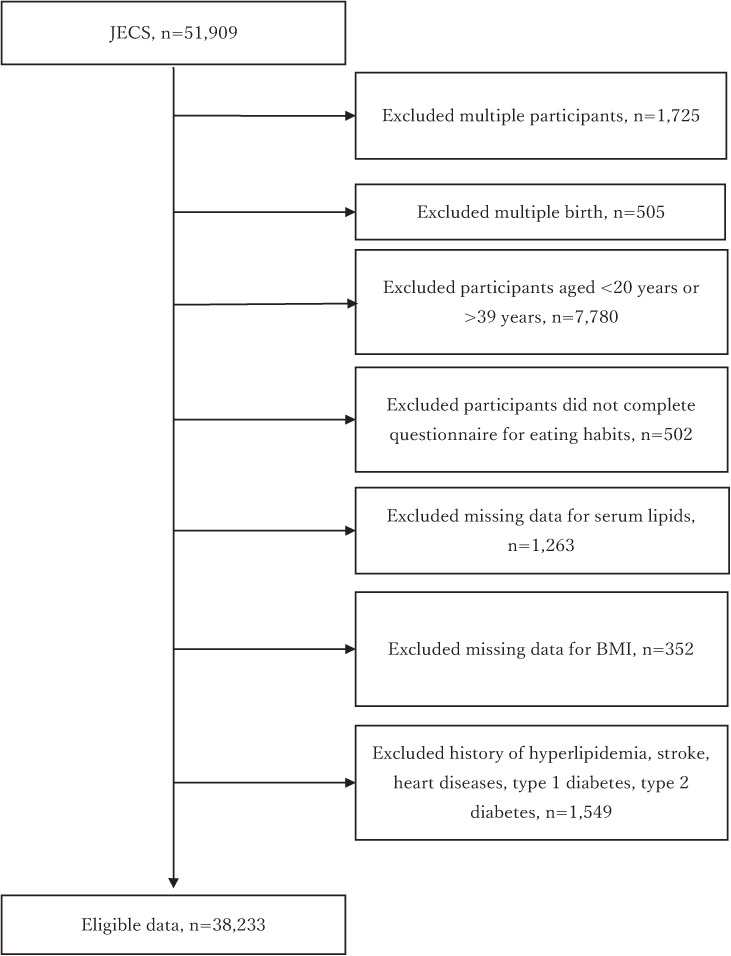
The participants of this study were 38,233 men aged 20-39 years, whose food consumption frequency related information was collected through a questionnaire. Dyslipidemia was defined as total cholesterol (TC) ≥190 mg/dL, fasting triglyceride (TG) ≥150 mg/dL and non-fasting TG ≥175 mg/dL, high-density lipoprotein cholesterol (HDL-C) <40 mg/dL, low-density lipoprotein cholesterol (LDL-C) ≥140 mg/dL. Odds ratios (ORs) and 95% confidence intervals were calculated relative to healthy eating habits using logistic regression, after adjustment for age, study unit, and other potential confounding factors.
Moderate and fast speeds were associated with a higher prevalence of reduced HDL-C (by 27% and 26%, respectively) compared to slow speeds. Eating after satiety was associated with a higher prevalence of elevated TC (by 16%) and elevated TG (by 11%), elevated LDL-C (by 21%). Breakfast eating of 1-4 times/week and <1 time/week were associated with a higher prevalence of elevated TC (by 11% and 16%, respectively) and elevated LDL-C (by 21% and 38%, respectively) compared to that of ≥5 times/week. Eating out of ≥5 times/week was associated with a 13% higher prevalence of elevated TG.
All of four unhealthy eating habits were associated with a higher prevalence of dyslipidemia in men aged 20-39 years.
20-39 岁男性中,常见的不健康饮食行为包括进食过快、过饱后进食、不吃早餐和外出就餐。在这项横断面研究中,我们旨在研究自我报告的饮食习惯与血脂异常患病率之间的关系。
本研究的参与者为 38233 名 20-39 岁的男性,通过问卷收集了他们的食物消费频率相关信息。血脂异常定义为总胆固醇(TC)≥190mg/dL、空腹甘油三酯(TG)≥150mg/dL 和非空腹 TG≥175mg/dL、高密度脂蛋白胆固醇(HDL-C)<40mg/dL、低密度脂蛋白胆固醇(LDL-C)≥140mg/dL。使用逻辑回归,在校正年龄、研究单位和其他潜在混杂因素后,计算相对于健康饮食习惯的比值比(OR)和 95%置信区间。
与缓慢进食相比,中速和快速进食与 HDL-C 降低的患病率升高(分别增加 27%和 26%)相关。过饱进食与 TC 升高(增加 16%)和 TG 升高(增加 11%)、LDL-C 升高(增加 21%)的患病率升高相关。每周 1-4 次和每周<1 次的早餐摄入与每周≥5 次相比,TC 升高(分别增加 11%和 16%)和 LDL-C 升高(分别增加 21%和 38%)的患病率升高相关。每周外出就餐≥5 次与 TG 升高的患病率增加 13%相关。
所有四种不健康的饮食习惯都与 20-39 岁男性血脂异常患病率升高有关。