Harvard T.H. Chan School of Public Health, Harvard University, Boston, Massachusetts, USA.
Department of Health Outcomes and Biomedical Informatics, College of Medicine, University of Florida, Gainesville, Florida, USA.
Obesity (Silver Spring). 2020 Jun;28(6):1098-1109. doi: 10.1002/oby.22791. Epub 2020 Apr 18.
The objective of this study was to evaluate the effect of skipping breakfast on body composition and cardiometabolic risk factors.
This study conducted a systematic review and meta-analysis of randomized controlled trials (RCTs) evaluating breakfast skipping compared with breakfast consumption. Inclusion criteria included age ≥ 18, intervention duration ≥ 4 weeks, ≥ 7 participants per group, and ≥ 1 body composition measure. Random-effects meta-analyses of the effect of breakfast skipping on body composition and cardiometabolic risk factors were performed.
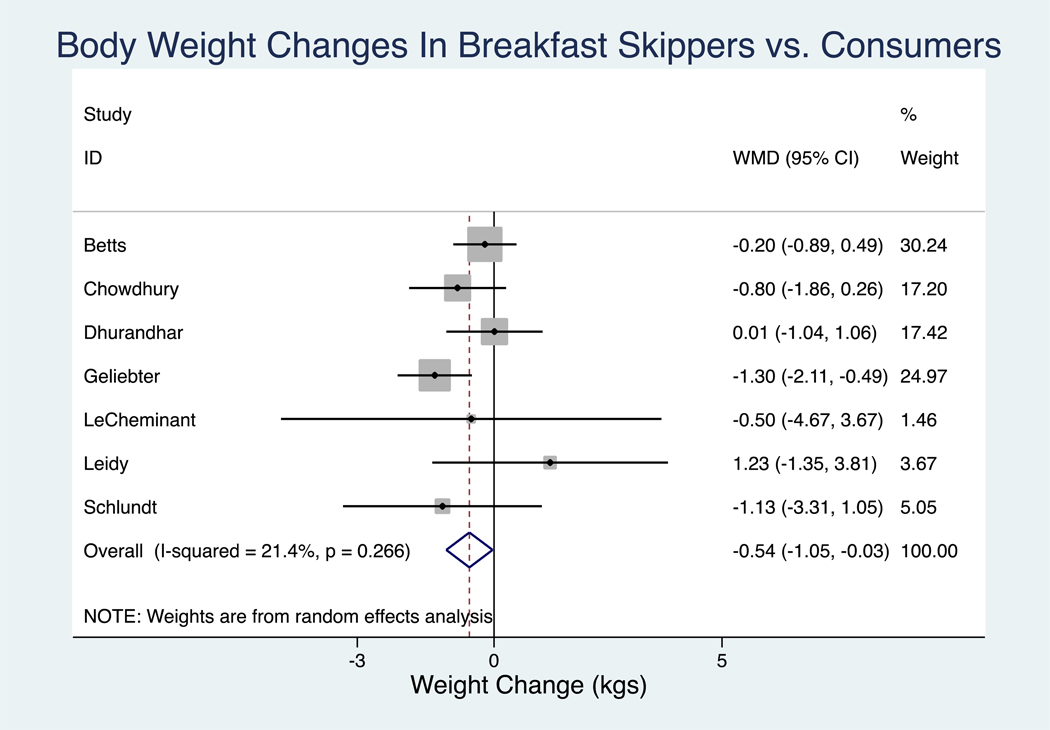
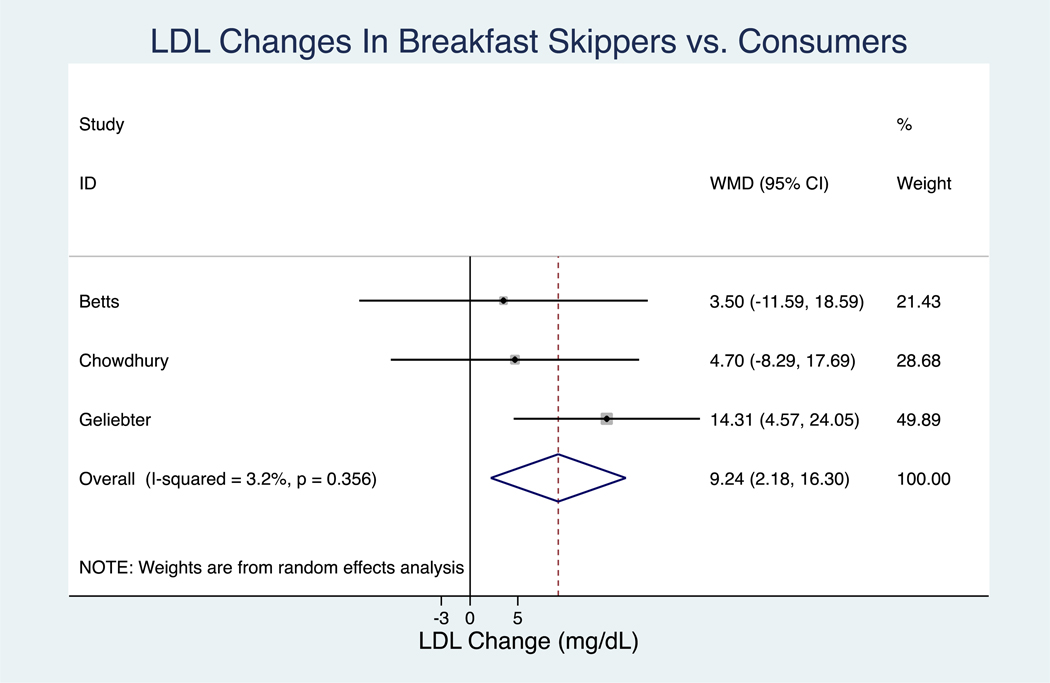
Seven RCTs (n = 425 participants) with an average duration of 8.6 weeks were included. Compared with breakfast consumption, breakfast skipping significantly reduced body weight (weighted mean difference [WMD] = -0.54 kg [95% CI: -1.05 to -0.03], P = 0.04, I = 21.4%). Percent body fat was reported in 5 studies and was not significantly different between breakfast skippers and consumers. Three studies reported on low-density lipoprotein cholesterol (LDL), which was increased in breakfast skippers as compared with breakfast consumers (WMD = 9.24 mg/dL [95% CI: 2.18 to 16.30], P = 0.01). Breakfast skipping did not lead to significant differences in blood pressure, total cholesterol, high-density lipoprotein (HDL) cholesterol, triglycerides, C-reactive protein, insulin, fasting glucose, leptin, homeostatic model assessment of insulin resistance, or ghrelin.
Breakfast skipping may have a modest impact on weight loss and may increase LDL in the short term. Further studies are needed to provide additional insight into the effects of breakfast skipping.
本研究旨在评估不吃早餐对身体成分和心血管代谢风险因素的影响。
本研究对评估不吃早餐与吃早餐相比的随机对照试验(RCT)进行了系统评价和荟萃分析。纳入标准包括年龄≥18 岁、干预持续时间≥4 周、每组≥7 名参与者以及≥1 项身体成分测量。对不吃早餐对身体成分和心血管代谢风险因素的影响进行了随机效应荟萃分析。
纳入了 7 项 RCT(n=425 名参与者),平均持续时间为 8.6 周。与吃早餐相比,不吃早餐显著降低了体重(加权均数差[WMD]=-0.54kg[95%CI:-1.05 至-0.03],P=0.04,I²=21.4%)。5 项研究报告了体脂百分比,但在不吃早餐者和吃早餐者之间没有显著差异。3 项研究报告了低密度脂蛋白胆固醇(LDL),与吃早餐者相比,不吃早餐者的 LDL 升高(WMD=9.24mg/dL[95%CI:2.18 至 16.30],P=0.01)。不吃早餐对血压、总胆固醇、高密度脂蛋白(HDL)胆固醇、甘油三酯、C 反应蛋白、胰岛素、空腹血糖、瘦素、胰岛素抵抗稳态模型评估、胃饥饿素无显著影响。
不吃早餐短期内可能对体重减轻有一定影响,并且可能增加 LDL。需要进一步研究来提供对不吃早餐影响的更多见解。