Filippi Massimo, Cividini Camilla, Basaia Silvia, Spinelli Edoardo G, Castelnovo Veronica, Leocadi Michela, Canu Elisa, Agosta Federica
Neuroimaging Research Unit, Division of Neuroscience, IRCCS San Raffaele Scientific Institute, Milan, Italy.
Neurology Unit, IRCCS San Raffaele Scientific Institute, Milan, Italy.
Mol Psychiatry. 2023 Dec;28(12):5350-5358. doi: 10.1038/s41380-023-02157-1. Epub 2023 Jul 6.
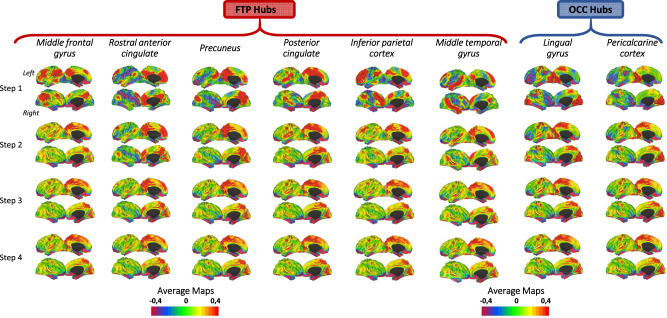
Multifactorial models integrating brain variables at multiple scales are warranted to investigate aging and its relationship with neurodegeneration. Our aim was to evaluate how aging affects functional connectivity of pivotal regions of the human brain connectome (i.e., hubs), which represent potential vulnerability 'stations' to aging, and whether such effects influence the functional and structural changes of the whole brain. We combined the information of the functional connectome vulnerability, studied through an innovative graph-analysis approach (stepwise functional connectivity), with brain cortical thinning in aging. Using data from 128 cognitively normal participants (aged 20-85 years), we firstly investigated the topological functional network organization in the optimal healthy condition (i.e., young adults) and observed that fronto-temporo-parietal hubs showed a highly direct functional connectivity with themselves and among each other, while occipital hubs showed a direct functional connectivity within occipital regions and sensorimotor areas. Subsequently, we modeled cortical thickness changes over lifespan, revealing that fronto-temporo-parietal hubs were among the brain regions that changed the most, whereas occipital hubs showed a quite spared cortical thickness across ages. Finally, we found that cortical regions highly functionally linked to the fronto-temporo-parietal hubs in healthy adults were characterized by the greatest cortical thinning along the lifespan, demonstrating that the topology and geometry of hub functional connectome govern the region-specific structural alterations of the brain regions.
有必要采用整合多尺度脑变量的多因素模型来研究衰老及其与神经退行性变的关系。我们的目的是评估衰老如何影响人类脑连接组关键区域(即枢纽)的功能连接,这些区域代表了衰老的潜在脆弱“站点”,以及这种影响是否会影响全脑的功能和结构变化。我们将通过创新的图形分析方法(逐步功能连接)研究的功能连接组脆弱性信息与衰老过程中的脑皮质变薄相结合。利用128名认知正常参与者(年龄在20 - 85岁之间)的数据,我们首先研究了最佳健康状态(即年轻人)下的拓扑功能网络组织,观察到额颞顶叶枢纽彼此之间以及与自身之间表现出高度直接的功能连接,而枕叶枢纽在枕叶区域和感觉运动区域内表现出直接的功能连接。随后,我们对整个生命周期内的皮质厚度变化进行建模,发现额颞顶叶枢纽是变化最大的脑区之一,而枕叶枢纽在不同年龄段的皮质厚度变化较小。最后,我们发现健康成年人中与额颞顶叶枢纽高度功能连接的皮质区域在整个生命周期中皮质变薄最为明显,这表明枢纽功能连接组的拓扑结构和几何形状决定了脑区特定区域的结构改变。