Department of Rehabilitation Sciences, The Hong Kong Polytechnic University, Hung Hom, Kowloon, Hong Kong SAR, China.
Queensland Brain Institute, The University of Queensland, St Lucia, QLD, 4072, Australia.
Sci Rep. 2023 Jul 6;13(1):10948. doi: 10.1038/s41598-023-37309-4.
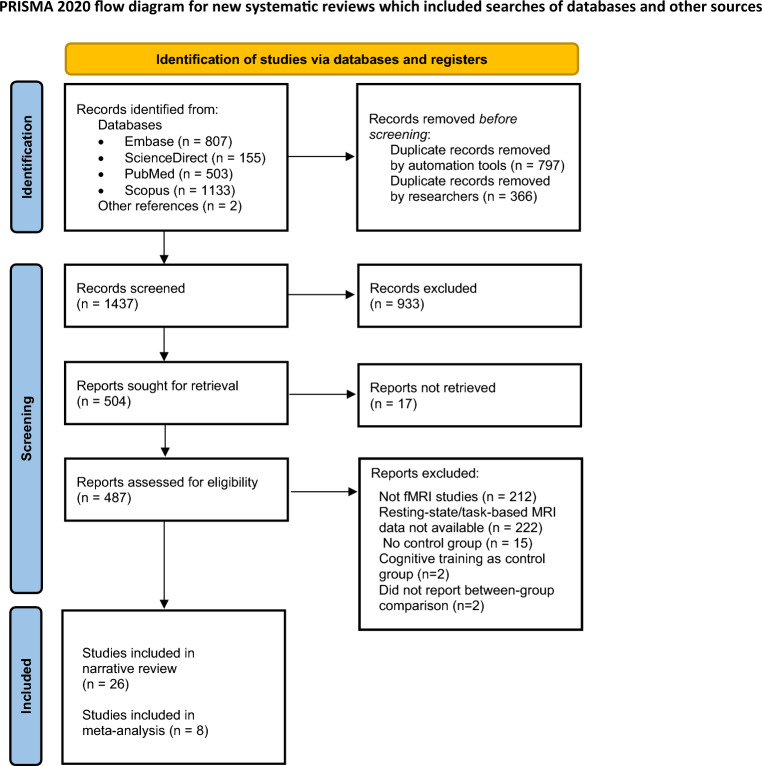
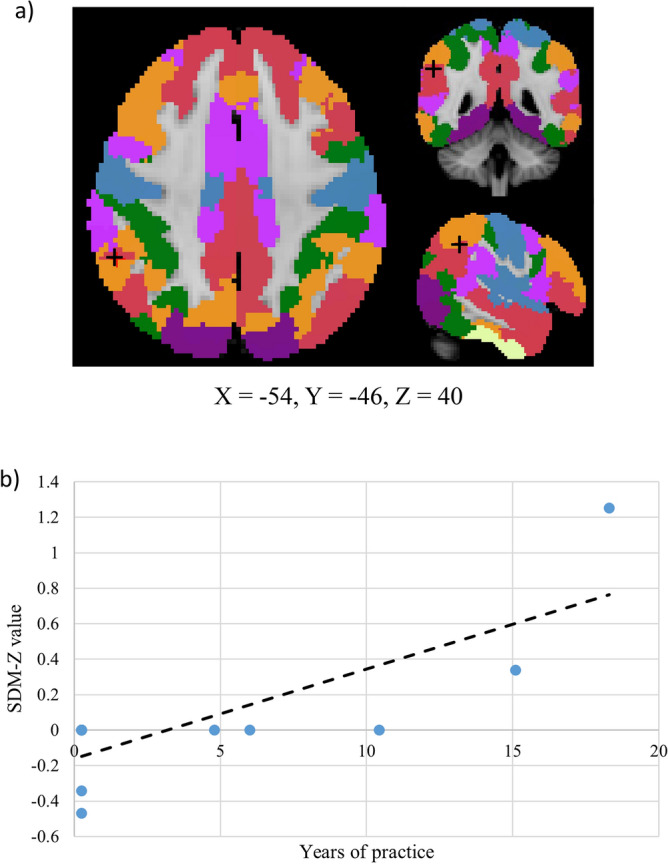
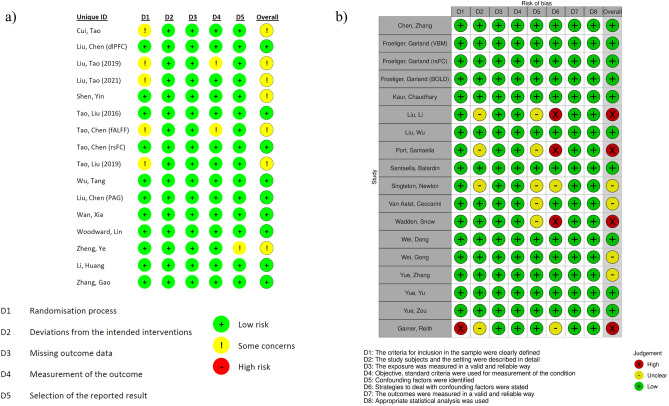
The neurobiological effects of mind-body exercise on brain activation, functional neural connections and structural changes in the brain remain elusive. This systematic review and coordinate-based meta-analysis investigated the changes in resting-state and task-based brain activation, as well as structural brain changes before and after mind-body exercise compared to waitlist or active controls based on published structural or functional magnetic resonance imaging randomized controlled trials or cross-sectional studies. Electronic database search and manual search in relevant publications yielded 34 empirical studies with low-to-moderate risk of bias (assessed by Cochrane risk-of-bias tool for randomized trials or Joanna Briggs Institute's critical appraisal checklist for analytical cross-sectional studies) that fulfilled the inclusion criteria, with 26 studies included in the narrative synthesis and 8 studies included in the meta-analysis. Coordinate-based meta-analysis showed that, while mind-body exercise enhanced the activation of the left anterior cingulate cortex within the default mode network (DMN), it induced more deactivation in the left supramarginal gyrus within the ventral attention network (uncorrected ps < 0.05). Meta-regression with duration of mind-body practice as a factor showed that, the activation of right inferior parietal gyrus within the DMN showed a positive association with increasing years of practice (voxel-corrected p < 0.005). Although mind-body exercise is shown to selectively modulate brain functional networks supporting attentional control and self-awareness, the overall certainty of evidence is limited by small number of studies. Further investigations are needed to understand the effects of both short-term and long-term mind-body exercise on structural changes in the brain.PROSPERO registration number: CRD42021248984.
身心锻炼对大脑激活、功能神经连接和大脑结构变化的神经生物学影响仍不清楚。本系统评价和基于坐标的荟萃分析调查了与等待名单或积极对照组相比,身心锻炼前后静息状态和任务态大脑激活以及结构脑变化的变化,这些研究基于发表的结构或功能磁共振成像随机对照试验或横断面研究。电子数据库搜索和相关出版物的手动搜索产生了 34 项具有低至中度偏倚风险的实证研究(通过 Cochrane 随机试验偏倚风险工具或 Joanna Briggs 研究所分析性横断面研究的批判性评估清单进行评估),符合纳入标准,其中 26 项研究纳入叙述性综合分析,8 项研究纳入荟萃分析。基于坐标的荟萃分析表明,虽然身心锻炼增强了默认模式网络(DMN)内左前扣带皮层的激活,但在腹侧注意网络内的左缘上回诱导了更多的去激活(未校正 ps<0.05)。以身心练习持续时间为因素的元回归显示,DMN 内右下顶叶回的激活与练习年限的增加呈正相关(体素校正 p<0.005)。尽管身心锻炼被证明可以选择性地调节支持注意力控制和自我意识的大脑功能网络,但由于研究数量较少,证据的总体确定性有限。需要进一步的研究来了解短期和长期身心锻炼对大脑结构变化的影响。PROSPERO 注册号:CRD42021248984。