Facultad de Ciencias de La Salud, Universidad Peruana de Ciencias Aplicadas, Lima, Peru.
Centro de Excelencia en Investigaciones Económicas y Sociales en Salud, Universidad San Ignacio de Loyola, Lima, Peru.
Lipids Health Dis. 2023 Jul 7;22(1):98. doi: 10.1186/s12944-023-01860-w.
BACKGROUND & AIMS: Apolipoproteins and lipoprotein(a) are associated with various cardiometabolic diseases, including insulin resistance, diabetes mellitus, hypertension, dyslipidemia, among others. This systematic review and meta-analysis was conducted to evaluate the association of these markers with metabolic syndrome (MetS).
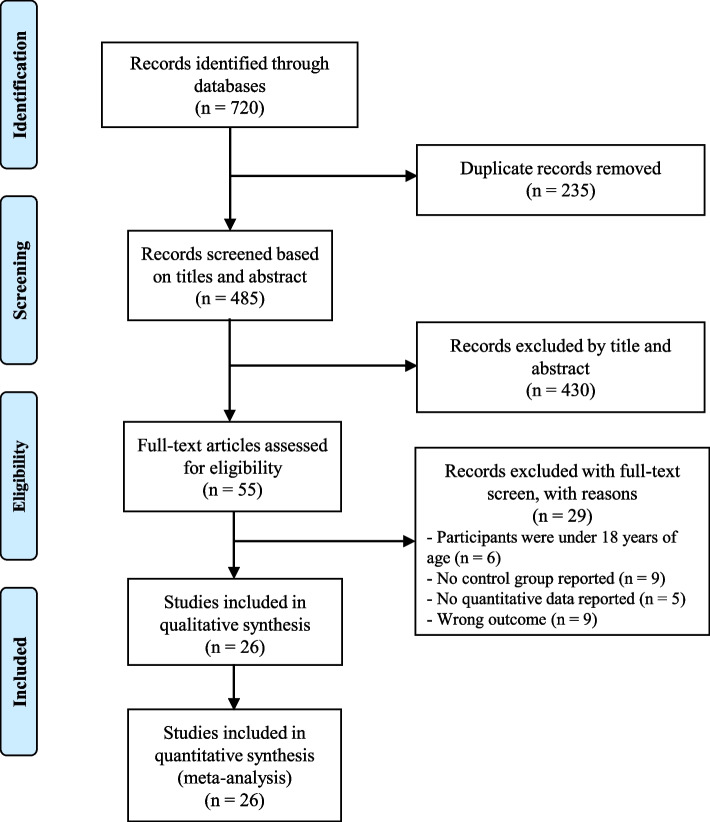
We ran a systematic search through PubMed, Scopus, Embase, Ovid/Medline, and Web of Science on March 15, 2023. No language or date restrictions were applied. The only synthesised effect measure reported was the odds ratio (OR) with its corresponding 95% confidence interval (95% CI). We utilised the random-effects model for the quantitative synthesis.
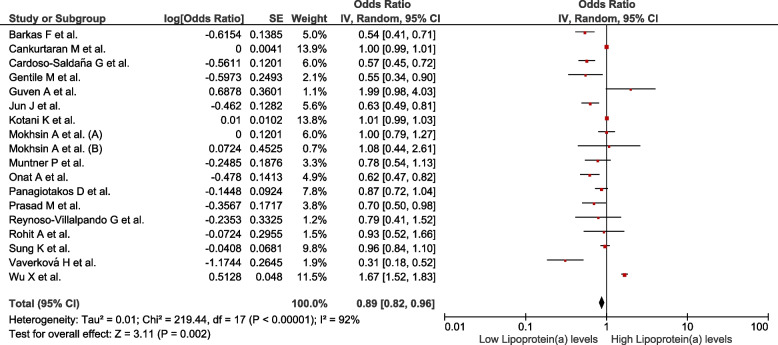
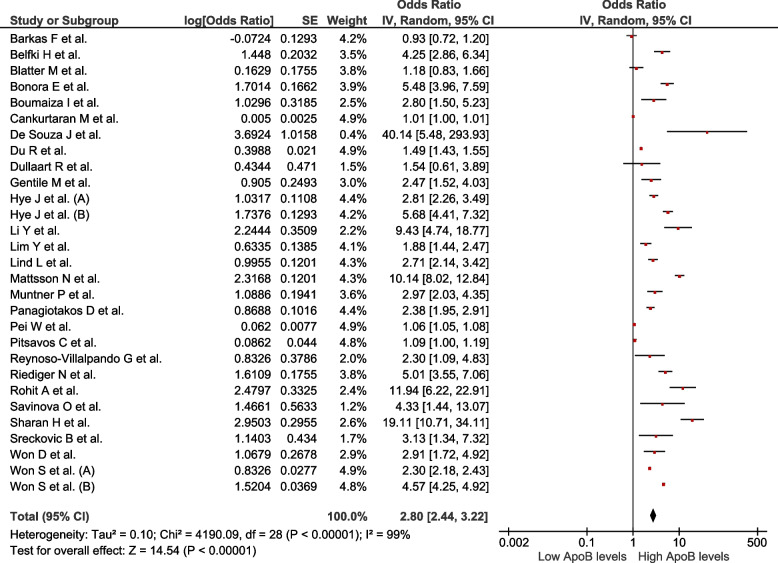
We analysed 50 studies (n = 150 519) with different definitions for MetS. Increased ApoB values were associated with MetS (OR = 2.8; 95% CI: 2.44-3.22; p < 0.01, I = 99%). Decreased ApoA1 values were associated with MetS (OR = 0.42; 95% CI: 0.38-0.47; p < 0.01, I = 99%). Increased values of the ApoB/ApoA1 ratio were associated with MetS (OR = 4.97; 95% CI: 3.83-6.44; p < 0.01, I = 97%). Decreased values of Lp(a) were associated with MetS (OR = 0.89; 95% CI: 0.82-0.96; p < 0.01; I = 92%).
Increased values of ApoB and ApoB/ApoA1 ratio are associated with MetS, while decreased values of ApoA1 and Lp(a) are associated with MetS. These findings suggest that these lipid markers may serve as potential indicators for identifying subjects at risk of developing MetS. However, further research is required to elucidate the underlying mechanisms of these associations.
载脂蛋白和脂蛋白(a)与多种心血管代谢疾病相关,包括胰岛素抵抗、糖尿病、高血压、血脂异常等。本系统评价和荟萃分析旨在评估这些标志物与代谢综合征(MetS)的相关性。
我们于 2023 年 3 月 15 日通过 PubMed、Scopus、Embase、Ovid/Medline 和 Web of Science 进行了系统检索,未对语言或日期进行限制。唯一综合的效应指标是比值比(OR)及其相应的 95%置信区间(95%CI)。我们使用随机效应模型进行定量综合分析。
我们分析了 50 项研究(n=150519),这些研究对 MetS 的定义不同。ApoB 值升高与 MetS 相关(OR=2.8;95%CI:2.44-3.22;p<0.01,I=99%)。ApoA1 值降低与 MetS 相关(OR=0.42;95%CI:0.38-0.47;p<0.01,I=99%)。ApoB/ApoA1 比值升高与 MetS 相关(OR=4.97;95%CI:3.83-6.44;p<0.01,I=97%)。Lp(a) 值降低与 MetS 相关(OR=0.89;95%CI:0.82-0.96;p<0.01;I=92%)。
ApoB 和 ApoB/ApoA1 比值升高与 MetS 相关,而 ApoA1 和 Lp(a) 值降低与 MetS 相关。这些发现表明,这些脂质标志物可能作为识别发生 MetS 风险的潜在指标。然而,需要进一步研究来阐明这些关联的潜在机制。