Longyan First Affiliated Hospital of Fujian Medical University, Longyan, China.
Front Endocrinol (Lausanne). 2022 Jul 14;13:935776. doi: 10.3389/fendo.2022.935776. eCollection 2022.
Increasing evidence highlighted that chronic inflammation involved in the development of metabolic syndrome (MetS) and Type 2 diabetes mellitus (T2DM). This prospective study was aimed to assess the association between MetS and novel pro-inflammatory indicators like monocyte-to-high-density lipoprotein and monocyte-to-apolipoprotein A1 ratios (MHR and MAR) in Chinese newly diagnosed T2DM.
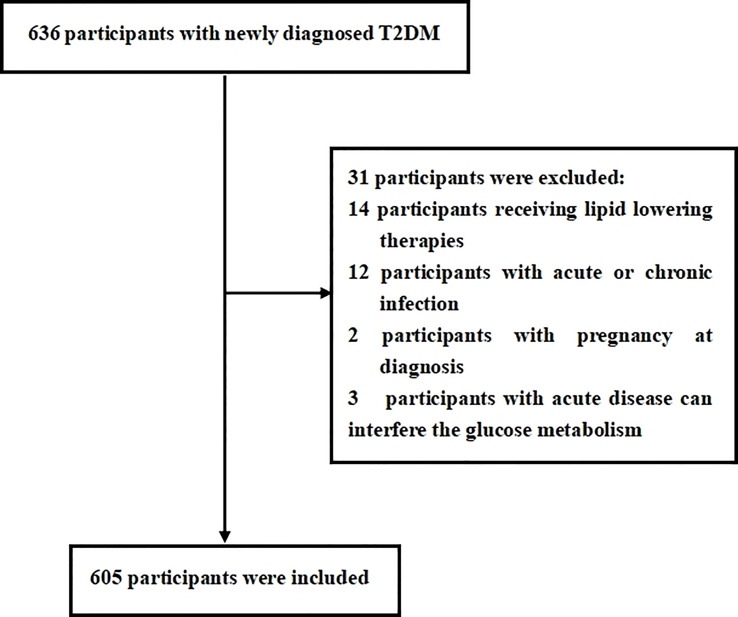
A total of 605 Chinese newly diagnosed T2DM with complete and available data were enrolled in this study. Demographic and anthropometric information were collected. Laboratory assessments were determined by standard methods. MetS was based on the Chinese Diabetes Society definition. Multiple binomial logistic regression model was used to estimate the independent variables of MHR and MAR for MetS. Receiver operating characteristic (ROC) curve was conducted to assess the optimal cutoff value of MHR and MAR in identifying MetS.
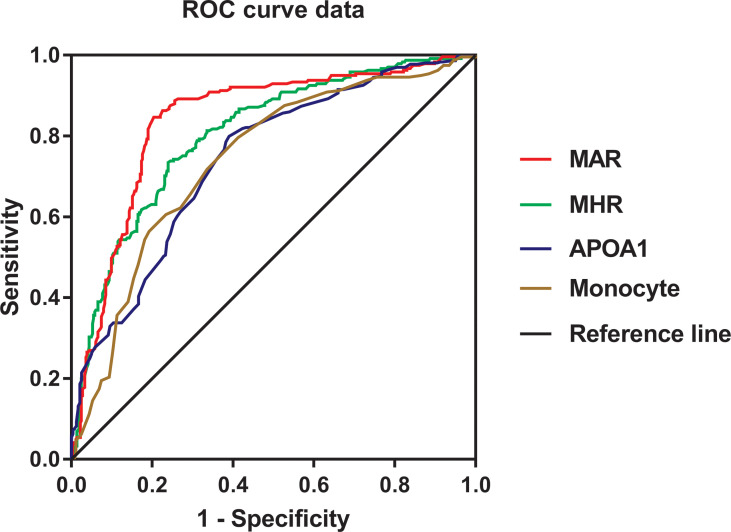
Overall, the prevalence of MetS was 60.2%. The correlation analysis showed that MHR and MAR were closely correlated with metabolic risk factors like body mass index, waist circumference, triglycerides, high-density lipoprotein cholesterol, systolic blood pressure, diastolic blood pressure, uric acid, and insulin resistance. MHR and MAR were also significantly associated with higher odds of MetS after adjustment for other confounders, the odds ratios (ORs) (95%CI) were 1.50 (1.14-1.97) and 2.26(1.79-2.87) respectively. Furthermore, MHR and MAR were also seemed to have higher area under the curve (AUC) for MetS than ApoA1 and monocyte alone from the ROC curve analysis ( < 0.05). The AUCs of MHR and MAR identifying MetS were 0.804 (95% CI: 0.768-0.839) and 0.840 (95% CI: 0.806-0.873) respectively ( < 0.001). The optimal cutoff values of MHR and MAR were 3.57 × 10/mmol (sensitivity: 76.1%, specificity: 73.4%) and 3.95 × 10/g (sensitivity: 79.7%, specificity: 84.6%), respectively.
MHR and MAR were significantly associated with MetS. These two novel pro-inflammatory indicators may be useful markers for MetS in Chinese newly diagnosed T2DM.
越来越多的证据表明,慢性炎症参与了代谢综合征(MetS)和 2 型糖尿病(T2DM)的发展。本前瞻性研究旨在评估中国新诊断的 T2DM 患者中 MetS 与新型促炎指标(如单核细胞/高密度脂蛋白比值和单核细胞/载脂蛋白 A1 比值(MHR 和 MAR))之间的关联。
共纳入 605 例中国新诊断的 T2DM 患者,纳入标准为:完整且可获得的数据。收集人口统计学和人体测量学信息。采用标准方法进行实验室检测。MetS 基于中国糖尿病协会的定义。采用多变量二项逻辑回归模型来评估 MHR 和 MAR 对 MetS 的独立变量。通过受试者工作特征(ROC)曲线来评估 MHR 和 MAR 识别 MetS 的最佳截断值。
总体而言,MetS 的患病率为 60.2%。相关性分析显示,MHR 和 MAR 与代谢危险因素(如体重指数、腰围、甘油三酯、高密度脂蛋白胆固醇、收缩压、舒张压、尿酸和胰岛素抵抗)密切相关。在调整其他混杂因素后,MHR 和 MAR 与 MetS 的发生风险显著相关,比值比(OR)(95%CI)分别为 1.50(1.14-1.97)和 2.26(1.79-2.87)。此外,ROC 曲线分析显示,MHR 和 MAR 对 MetS 的曲线下面积(AUC)也高于单独的 ApoA1 和单核细胞(<0.05)。MHR 和 MAR 对 MetS 的 AUC 分别为 0.804(95%CI:0.768-0.839)和 0.840(95%CI:0.806-0.873)(<0.001)。MHR 和 MAR 的最佳截断值分别为 3.57×10/mmol(灵敏度:76.1%,特异性:73.4%)和 3.95×10/g(灵敏度:79.7%,特异性:84.6%)。
MHR 和 MAR 与 MetS 显著相关。这两个新型促炎指标可能是中国新诊断的 T2DM 患者 MetS 的有用标志物。