
放射组学方法预测免疫治疗晚期非小细胞肺癌患者 PD-L1 和无进展生存期:一项多机构研究。
Radiomics approaches to predict PD-L1 and PFS in advanced non-small cell lung patients treated with immunotherapy: a multi-institutional study.
机构信息
Department of Mathematics and Computer Science, Université du Québec à Trois Rivières, Trois Rivières, Canada.
Centre de Recherche du Centre Hospitalier Universitaire de Montréal, Montréal, Canada.
出版信息
Sci Rep. 2023 Jul 8;13(1):11065. doi: 10.1038/s41598-023-38076-y.
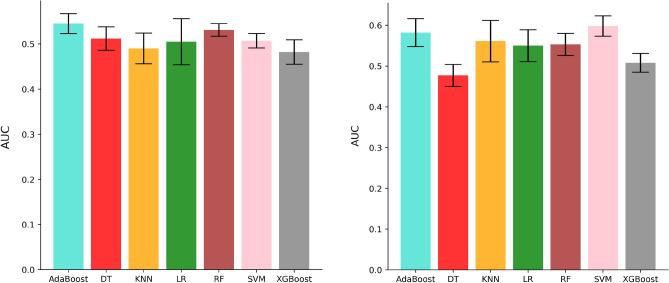
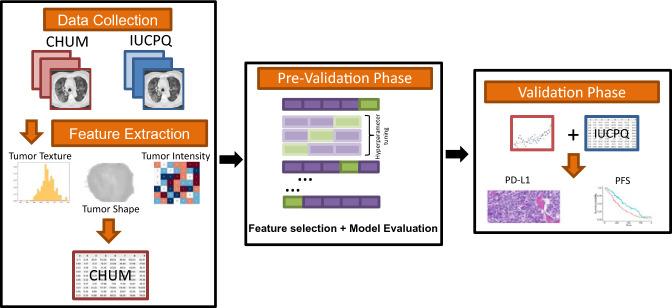
With the increasing use of immune checkpoint inhibitors (ICIs), there is an urgent need to identify biomarkers to stratify responders and non-responders using programmed death-ligand (PD-L1) expression, and to predict patient-specific outcomes such as progression free survival (PFS). The current study is aimed to determine the feasibility of building imaging-based predictive biomarkers for PD-L1 and PFS through systematically evaluating a combination of several machine learning algorithms with different feature selection methods. A retrospective, multicenter study of 385 advanced NSCLC patients amenable to ICIs was undertaken in two academic centers. Radiomic features extracted from pretreatment CT scans were used to build predictive models for PD-L1 and PFS (short-term vs. long-term survivors). We first employed the LASSO methodology followed by five feature selection methods and seven machine learning approaches to build the predictors. From our analyses, we found several combinations of feature selection methods and machine learning algorithms to achieve a similar performance. Logistic regression with ReliefF feature selection (AUC = 0.64, 0.59 in discovery and validation cohorts) and SVM with Anova F-test feature selection (AUC = 0.64, 0.63 in discovery and validation datasets) were the best-performing models to predict PD-L1 and PFS. This study elucidates the application of suitable feature selection approaches and machine learning algorithms to predict clinical endpoints using radiomics features. Through this study, we identified a subset of algorithms that should be considered in future investigations for building robust and clinically relevant predictive models.
随着免疫检查点抑制剂(ICIs)的应用日益增多,迫切需要确定生物标志物,以通过程序性死亡配体(PD-L1)表达对应答者和无应答者进行分层,并预测患者的特定结局,如无进展生存期(PFS)。本研究旨在通过系统评估几种具有不同特征选择方法的机器学习算法的组合,确定基于成像的预测 PD-L1 和 PFS 的生物标志物的可行性。在两个学术中心进行了一项回顾性、多中心的 385 例晚期 NSCLC 患者接受 ICI 治疗的研究。使用预处理 CT 扫描提取的放射组学特征来构建 PD-L1 和 PFS(短期与长期生存者)的预测模型。我们首先采用 LASSO 方法,然后采用五种特征选择方法和七种机器学习方法来构建预测器。通过分析,我们发现了几种特征选择方法和机器学习算法的组合,可以达到相似的性能。基于 ReliefF 特征选择的逻辑回归(AUC=0.64,发现和验证队列中为 0.59)和基于方差分析 F 检验的 SVM 特征选择(AUC=0.64,发现和验证数据集中为 0.63)是预测 PD-L1 和 PFS 的最佳模型。本研究阐明了使用放射组学特征适当地选择特征选择方法和机器学习算法来预测临床终点的应用。通过这项研究,我们确定了一些算法子集,这些算法子集应在未来的构建稳健且具有临床相关性的预测模型的研究中加以考虑。


 Zotero 插件