Centre for Forensic Science, School of Mathematical and Physical Sciences, Faculty of Science, University of Technology Sydney, PO Box 123, Broadway, NSW, 2007, Australia.
School of Life Sciences, Faculty of Science, University of Technology Sydney, PO Box 123, Broadway, NSW, 2007, Australia.
Anal Bioanal Chem. 2023 Sep;415(22):5487-5498. doi: 10.1007/s00216-023-04822-4. Epub 2023 Jul 10.
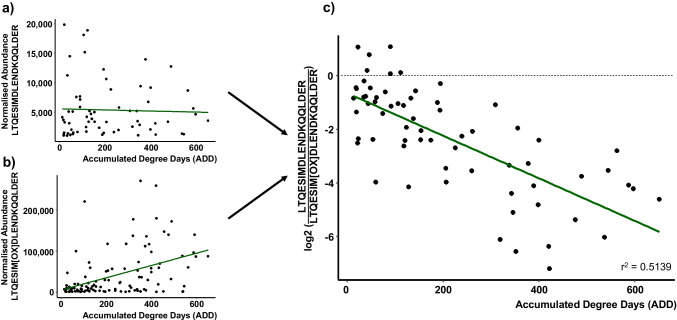
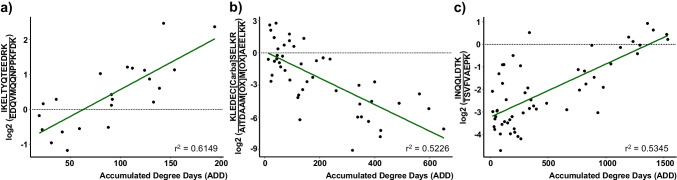
Accurate estimation of the postmortem interval (PMI) is crucial in forensic medico-legal investigations to understand case circumstances (e.g. narrowing down list of missing persons or include/exclude suspects). Due to the complex decomposition chemistry, estimation of PMI remains challenging and currently often relies on the subjective visual assessment of gross morphological/taphonomic changes of a body during decomposition or entomological data. The aim of the current study was to investigate the human decomposition process up to 3 months after death and propose novel time-dependent biomarkers (peptide ratios) for the estimation of decomposition time. An untargeted liquid chromatography tandem mass spectrometry-based bottom-up proteomics workflow (ion mobility separated) was utilized to analyse skeletal muscle, collected repeatedly from nine body donors decomposing in an open eucalypt woodland environment in Australia. Additionally, general analytical considerations for large-scale proteomics studies for PMI determination are raised and discussed. Multiple peptide ratios (human origin) were successfully proposed (subgroups < 200 accumulated degree days (ADD), < 655 ADD and < 1535 ADD) as a first step towards generalised, objective biochemical estimation of decomposition time. Furthermore, peptide ratios for donor-specific intrinsic factors (sex and body mass) were found. Search of peptide data against a bacterial database did not yield any results most likely due to the low abundance of bacterial proteins within the collected human biopsy samples. For comprehensive time-dependent modelling, increased donor number would be necessary along with targeted confirmation of proposed peptides. Overall, the presented results provide valuable information that aid in the understanding and estimation of the human decomposition processes.
准确估计死后时间(PMI)在法医医学调查中至关重要,有助于了解案件情况(例如,缩小失踪人员名单或排除/纳入嫌疑人)。由于复杂的分解化学,PMI 的估计仍然具有挑战性,目前通常依赖于对尸体分解过程中宏观形态/埋藏学变化的主观视觉评估或昆虫学数据。本研究旨在调查人类死后 3 个月内的分解过程,并提出新的与时间相关的生物标志物(肽比)来估计分解时间。本研究利用基于液相色谱串联质谱的非靶向从头蛋白质组学工作流程(离子淌度分离)分析了来自 9 名尸体捐赠者的骨骼肌,这些捐赠者在澳大利亚的开放桉树林地环境中分解。此外,还提出并讨论了用于 PMI 测定的大规模蛋白质组学研究的一般分析注意事项。成功提出了多个肽比(人源)(<200 个积累度日(ADD)、<655 ADD 和<1535 ADD 的亚组)作为一般、客观地生化估计分解时间的第一步。此外,还发现了供体特异性内在因素(性别和体重)的肽比。对肽数据进行细菌数据库搜索未得到任何结果,这很可能是由于在收集的人体活检样本中细菌蛋白的丰度较低。为了进行全面的时间依赖性建模,需要增加供体数量,并对提出的肽进行靶向确认。总的来说,所提供的结果提供了有价值的信息,有助于理解和估计人类的分解过程。