State Key Laboratory of Luminescent Materials and Devices, Guangdong Provincial Key Laboratory of Luminescence from Molecular Aggregates, School of Materials Science and Engineering, AIE Institute, South China University of Technology, Guangzhou, 510640, China.
Division of Thoracic Tumor Multimodality Treatment and Department of Medical Oncology, Department of Radiation Oncology, Cancer Center, State Key Laboratory of Biotherapy, West China Hospital, Sichuan University, Chengdu, Sichuan, 610041, China.
Adv Sci (Weinh). 2023 Sep;10(26):e2302395. doi: 10.1002/advs.202302395. Epub 2023 Jul 9.
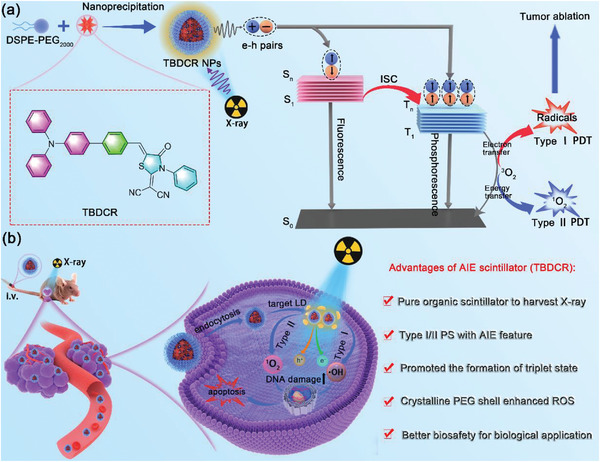
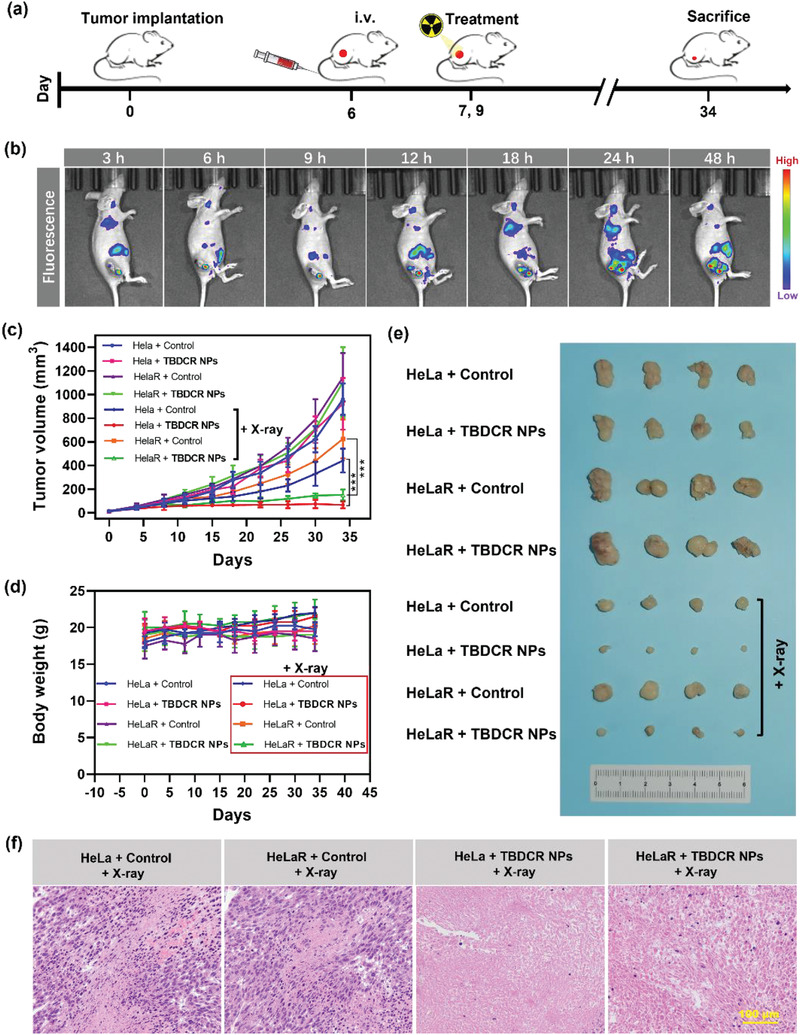
X-ray induced photodynamic therapy (X-PDT) circumvents the poor penetration depth of conventional PDT with minimal radio-resistance generation. However, conventional X-PDT typically requires inorganic scintillators as energy transducers to excite neighboring photosensitizers (PSs) to generate reactive oxygen species (ROS). Herein, a pure organic aggregation-induced emission (AIE) nanoscintillator (TBDCR NPs) that can massively generate both type I and type II ROS under direct X-ray irradiation is reported for hypoxia-tolerant X-PDT. Heteroatoms are introduced to enhance X-ray harvesting and ROS generation ability, and AIE-active TBDCR exhibits aggregation-enhanced ROS especially less oxygen-dependent hydroxyl radical (HO , type I) generation ability. TBDCR NPs with a distinctive PEG crystalline shell to provide a rigid intraparticle microenvironment show further enhanced ROS generation. Intriguingly, TBDCR NPs show bright near-infrared fluorescence and massive singlet oxygen and HO generation under direct X-ray irradiation, which demonstrate excellent antitumor X-PDT performance both in vitro and in vivo. To the best of knowledge, this is the first pure organic PS capable of generating both O and radicals (HO ) in response to direct X-ray irradiation, which shall provide new insights for designing organic scintillators with excellent X-ray harvesting and predominant free radical generation for efficient X-PDT.
X 射线诱导光动力疗法(X-PDT)克服了传统 PDT 的穿透深度差的问题,同时产生最小的放射抗性。然而,传统的 X-PDT 通常需要无机闪烁体作为能量转换器来激发邻近的光敏剂(PS)以产生活性氧物种(ROS)。在此,报道了一种纯有机聚集诱导发射(AIE)纳米闪烁体(TBDCR NPs),它可以在直接 X 射线照射下大量产生 I 型和 II 型 ROS,用于耐缺氧 X-PDT。引入杂原子以增强 X 射线捕获和 ROS 生成能力,并且 AIE 活性的 TBDCR 表现出聚集增强的 ROS 生成能力,特别是更少依赖于氧气的羟基自由基(HO ,I 型)生成能力。具有独特 PEG 结晶壳的 TBDCR NPs 提供刚性的颗粒内微环境,进一步增强了 ROS 的生成。有趣的是,TBDCR NPs 在直接 X 射线照射下显示出明亮的近红外荧光和大量的单线态氧和 HO 生成,这在体外和体内都证明了优异的抗肿瘤 X-PDT 性能。据所知,这是第一个能够响应直接 X 射线照射产生 O 和自由基(HO )的纯有机 PS,这为设计具有优异的 X 射线捕获和主要自由基生成能力的有机闪烁体以实现有效的 X-PDT 提供了新的思路。