Lee In-Hyoung, Choi Jong-Il, Ha Sung-Kon, Lim Dong-Jun
Department of Neurosurgery, Korea University Ansan Hospital, Korea University College of Medicine, Ansan, Korea.
J Korean Neurosurg Soc. 2024 Jan;67(1):14-21. doi: 10.3340/jkns.2023.0072. Epub 2023 Jul 10.
The primary treatment goal of current endovascular thrombectomy (EVT) for emergent large-vessel occlusion (ELVO) is complete recanalization after a single maneuver, referred to as the 'first-pass effect' (FPE). Hence, we aimed to identify the predictive factors of FPE and assess its effect on clinical outcomes in patients with ELVO of the anterior circulation.
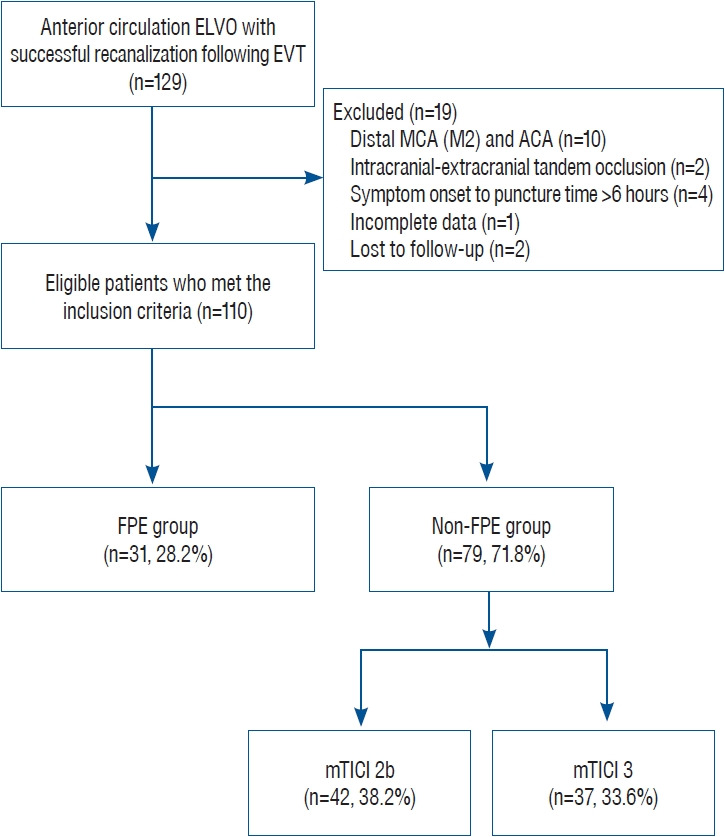
Among the 129 patients who participated, 110 eligible patients with proximal ELVO (intracranial internal carotid artery and proximal middle cerebral artery) who achieved successful recanalization after EVT were retrospectively reviewed. A comparative analysis between patients who achieved FPE and all others (defined as a non-FPE group) was performed regarding baseline characteristics, clinical variables, and clinical outcomes. Multivariate logistic regression analyses were subsequently conducted for potential predictive factors with p<0.10 in the univariate analysis to determine the independent predictive factors of FPE.
FPE was achieved in 31 of the 110 patients (28.2%). The FPE group had a significantly higher level of functional independence at 90 days than did the non-FPE group (80.6% vs. 50.6%, p=0.002). Pretreatment intravenous thrombolysis (IVT) (odds ratio [OR], 3.179; 95% confidence interval [CI], 1.025-9.861; p=0.045), door-to-puncture (DTP) interval (OR, 0.959; 95% CI, 0.932-0.987; p=0.004), and the use of balloon guiding catheter (BGC) (OR, 3.591; 95% CI, 1.231-10.469; p=0.019) were independent predictive factors of FPE.
In conclusion, pretreatment IVT, use of BGC, and a shorter DTP interval were positively associated with FPE, increasing the chance of acquiring better clinical outcomes.
当前用于治疗急性大血管闭塞(ELVO)的血管内血栓切除术(EVT)的主要治疗目标是单次操作后实现完全再通,即所谓的“首次通过效应”(FPE)。因此,我们旨在确定FPE的预测因素,并评估其对前循环ELVO患者临床结局的影响。
在参与研究的129例患者中,回顾性分析了110例符合条件的近端ELVO(颅内颈内动脉和大脑中动脉近端)患者,这些患者在接受EVT后成功实现了再通。对实现FPE的患者与所有其他患者(定义为非FPE组)进行了基线特征、临床变量和临床结局的比较分析。随后对单因素分析中p<0.10的潜在预测因素进行多因素逻辑回归分析,以确定FPE的独立预测因素。
110例患者中有31例(28.2%)实现了FPE。FPE组在90天时的功能独立性水平显著高于非FPE组(80.6%对50.6%,p=0.002)。治疗前静脉溶栓(IVT)(比值比[OR],3.179;95%置信区间[CI],1.025-9.861;p=0.045)、门到穿刺(DTP)间隔(OR,0.959;95%CI,0.932-0.987;p=0.004)以及使用球囊导引导管(BGC)(OR,3.591;95%CI,1.231-10.469;p=0.019)是FPE的独立预测因素。
总之,治疗前IVT、BGC的使用以及较短的DTP间隔与FPE呈正相关,增加了获得更好临床结局的机会。