Gande Nina, Hochmayr Christoph, Staudt Anna, Bernar Benoît, Stock Katharina, Kiechl Sophia J, Geiger Ralf, Griesmacher Andrea, Scholl-Bürgi Sabine, Knoflach Michael, Pechlaner Raimund, Kiechl-Kohlendorfer Ursula
Department of Pediatrics II (Neonatology), Medical University of Innsbruck, Innsbruck, Austria.
Department of Pediatrics I, Medical University of Innsbruck, Innsbruck, Austria.
Front Cardiovasc Med. 2023 Jun 23;10:1140990. doi: 10.3389/fcvm.2023.1140990. eCollection 2023.
Homocysteine (Hcy) has been associated with an adverse cardiovascular risk profile in adolescents. Assessment of the association between plasma Hcy levels and clinical/laboratory factors might improve our understanding of the pathogenesis of cardiovascular disease.
Hcy was measured in 1,900 14- to 19-year-old participants of prospective population-based EVA-TYROL Study (44.3% males, mean age 16.4 years) between 2015 and 2018. Factors associated with Hcy were assessed by physical examination, standardized interviews, and fasting blood analysis.
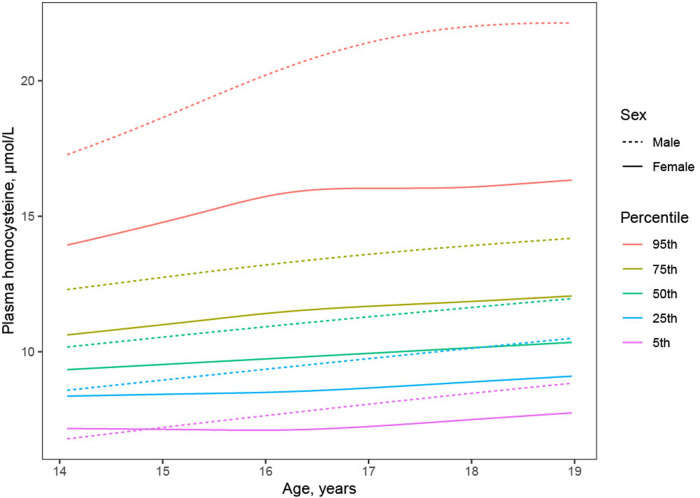
Mean plasma Hcy was 11.3 ± 4.5 µmol/L. Distribution of Hcy was characterized by extreme right skew. Males exhibited higher Hcy and sex differences increased with increasing age. Univariate associations with Hcy emerged for age, sex, body mass index, high-density lipoprotein cholesterol, and for factors pertaining to blood pressure, glucose metabolism, renal function, and diet quality, whereas the most important multivariate predictors of Hcy were sex and creatinine.
Clinical and laboratory factors associated with Hcy in adolescents were manifold, with sex and high creatinine identified as strongest independent determinants. These results may aid when interpreting future studies investigating the vascular risk of homocysteine.
同型半胱氨酸(Hcy)与青少年不良心血管风险状况相关。评估血浆Hcy水平与临床/实验室因素之间的关联可能会增进我们对心血管疾病发病机制的理解。
在2015年至2018年期间,对基于人群的前瞻性EVA-TYROL研究中的1900名14至19岁参与者(44.3%为男性,平均年龄16.4岁)进行了Hcy测量。通过体格检查、标准化访谈和空腹血液分析评估与Hcy相关的因素。
血浆Hcy平均水平为11.3±4.5 µmol/L。Hcy的分布呈极右偏态。男性的Hcy水平较高,且性别差异随年龄增长而增加。年龄、性别、体重指数、高密度脂蛋白胆固醇以及与血压、糖代谢、肾功能和饮食质量相关的因素与Hcy存在单变量关联,而Hcy最重要的多变量预测因素是性别和肌酐。
青少年中与Hcy相关的临床和实验室因素多种多样,性别和高肌酐被确定为最强的独立决定因素。这些结果可能有助于解释未来研究中关于同型半胱氨酸血管风险的研究。