Shi Yumeng, Wu Zuxiang, Wu Ji, Chen Zhiqiang, Li Ping
Department of Cardiovascular Medicine, The Second Affiliated Hospital of Nanchang University, Nanchang, China.
Front Nutr. 2022 Mar 29;9:818836. doi: 10.3389/fnut.2022.818836. eCollection 2022.
Physiologically, the levels of homocysteine (Hcy) and serum uric acid (SUA) are closely related; however, clinical studies on the relationship between Hcy and SUA have drawn different conclusions and have not analyzed this association among adolescents. This study therefore aimed to evaluate the relationship between Hcy and SUA levels among adolescents.
In this study, we performed a cross-sectional analysis of data from the National Health and Nutrition Examination Survey for the period 1999-2006, which included 5,404 adolescents aged 12-19 years. An elevated SUA level was defined as ≥5.5 mg/dL. Multivariate logistic regression and multivariate linear regression models were also applied in this study.
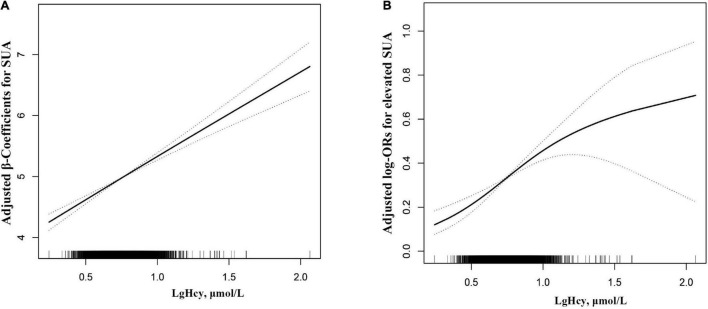
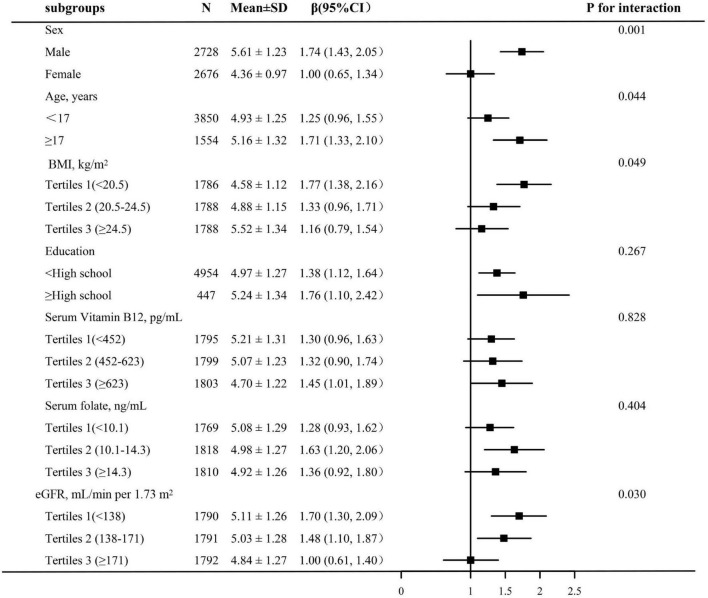
The mean concentrations of Hcy and SUA were 6.0 μmol/L and 5.0 mg/dL, respectively, and 33.6% of the participants had SUA levels of ≥5.5 mg/dL. There was a dose-response relationship between Hcy and SUA, and Hcy was linearly positively correlated with SUA. The β value [95% confidence interval (CI)] for SUA in the fully adjusted model was1.43 (95% CI: 1.18, 1.68). The multivariate logistic regression model showed that per 1 increment in log-transformed Hcy, the risk of elevated SUA levels increased by 8.80 times (odds ratio, 8.80, 95% CI: 4.25, 18.20). Subgroup analyses showed that the relationship between Hcy and SUA was significantly different according to sex, age, body mass index (BMI), and estimated glomerular filtration rate (eGFR) stratification (P for interaction <0.05).
Hcy levels were positively correlated with SUA levels and elevated SUA levels among U.S. teenagers, and this effect was more significant among boys aged ≥17 years and among people with lower BMI and eGFR.
在生理上,同型半胱氨酸(Hcy)水平与血清尿酸(SUA)水平密切相关;然而,关于Hcy与SUA之间关系的临床研究得出了不同结论,且尚未对青少年群体中的这种关联进行分析。因此,本研究旨在评估青少年中Hcy与SUA水平之间的关系。
在本研究中,我们对1999 - 2006年美国国家健康与营养检查调查的数据进行了横断面分析,该调查涵盖了5404名年龄在12 - 19岁的青少年。SUA水平升高定义为≥5.5mg/dL。本研究还应用了多变量逻辑回归和多变量线性回归模型。
Hcy和SUA的平均浓度分别为6.0μmol/L和5.0mg/dL,33.6%的参与者SUA水平≥5.5mg/dL。Hcy与SUA之间存在剂量反应关系,且Hcy与SUA呈线性正相关。在完全调整模型中,SUA的β值[95%置信区间(CI)]为1.43(95%CI:1.18,1.68)。多变量逻辑回归模型显示,经对数转换的Hcy每增加1个单位,SUA水平升高的风险增加8.80倍(比值比,8.80,95%CI:4.25,18.20)。亚组分析表明,根据性别、年龄、体重指数(BMI)和估计肾小球滤过率(eGFR)分层,Hcy与SUA之间的关系存在显著差异(交互作用P<0.05)。
在美国青少年中,Hcy水平与SUA水平呈正相关,且SUA水平升高,这种效应在17岁及以上的男孩以及BMI和eGFR较低的人群中更为显著。