Mukherji Reetu, Alqahtani Ali, Yin Chao, Caso Raul, Noel Marcus S, Khaitan Puja Gaur
Ruesch Center for the Cure of Gastrointestinal Cancers, Lombardi Comprehensive Cancer Center, Georgetown University Medical Center, Washington, DC, USA.
Department of Medical Oncology, King Faisal Specialist Hospital and Research Center, Riyadh, Saudi Arabia.
J Thorac Dis. 2023 Jun 30;15(6):3466-3487. doi: 10.21037/jtd-23-27. Epub 2023 Jun 13.
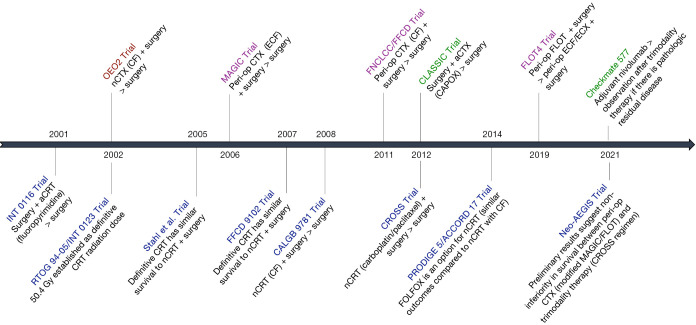
The poor oncologic outcomes associated with esophageal cancer (EC) are primarily due to its presentation at an advanced stage and patient comorbidities. While multimodal therapy improves overall outcomes, there is a lack of uniform practice in terms of perioperative management, partly because this is a rapidly evolving field in a heterogeneous patient population. With numerous recent studies incorporating precision medicine with radiographic, pathologic, and genomic biomarkers and with emerging trials using targeted therapies, it is necessary for providers who care for these patients to be familiar with the current and evolving treatment standards to optimize patient outcomes. The objective of this paper is to perform an updated review of the main historical and recently emerging studies that impact the perioperative management of patients with locally advanced, upfront-resectable EC.
We mined and reviewed PubMed and American Society of Clinical Oncology databases for pivotal works shaping the current perioperative treatment landscape in locally advanced EC.
EC are a vastly heterogeneous disease, and treatment options vary based on tumor anatomic location, histology, and patient comorbidities. Perioperative chemotherapy (CTX), chemoradiation (CRT), and, recently, immunotherapy have improved survival in patients with locally advanced disease. However, optimizing sequencing, de-escalating therapy, and incorporating novel targeted therapies in the perioperative setting are promising strategies that are under ongoing investigation to improve patient outcomes further.
There is an ongoing need to identify predictive biomarkers and novel treatment strategies to personalize perioperative approaches and optimize outcomes of patients with EC.
食管癌(EC)的肿瘤学预后较差,主要是因为其就诊时多处于晚期以及患者存在合并症。虽然多模式治疗可改善总体预后,但围手术期管理缺乏统一规范,部分原因在于这是一个在异质性患者群体中快速发展的领域。近期有大量研究将精准医学与影像学、病理学和基因组生物标志物相结合,还有新兴试验采用靶向治疗,因此,为这些患者提供治疗的医护人员有必要熟悉当前及不断演变的治疗标准,以优化患者预后。本文的目的是对影响局部晚期、可直接切除的EC患者围手术期管理的主要历史研究和近期新出现的研究进行更新综述。
我们在PubMed和美国临床肿瘤学会数据库中进行检索和综述,以获取塑造局部晚期EC当前围手术期治疗格局的关键研究。
EC是一种高度异质性疾病,治疗方案因肿瘤解剖位置、组织学类型和患者合并症而异。围手术期化疗(CTX)、放化疗(CRT)以及最近的免疫治疗已改善了局部晚期疾病患者的生存率。然而,可以优化治疗顺序、降低治疗强度,并在围手术期应用新型靶向治疗,这些都是很有前景的策略,目前正在进行研究,以进一步改善患者预后。
持续需要确定预测性生物标志物和新型治疗策略,以实现围手术期治疗方法的个性化,并优化EC患者的预后。