Department of Infectious Diseases, Public Health Service of Amsterdam, Amsterdam, Netherlands.
Department of Infectious Diseases, Amsterdam Institute for Infection and Immunity (AII), Amsterdam UMC, University of Amsterdam, Amsterdam, Netherlands.
Front Public Health. 2023 Jun 23;11:1166193. doi: 10.3389/fpubh.2023.1166193. eCollection 2023.
During the first wave of COVID-19 in Amsterdam, the Netherlands, a disproportional number of COVID-19 hospitalizations occurred in individuals with an ethnic minority background and in individuals living in city districts with a lower socioeconomic status (SES). In this study, we assessed whether these disparities continued throughout the second wave, when SARS-CoV-2 testing was available to anyone with symptoms but prior to the availability of COVID-19 vaccination.
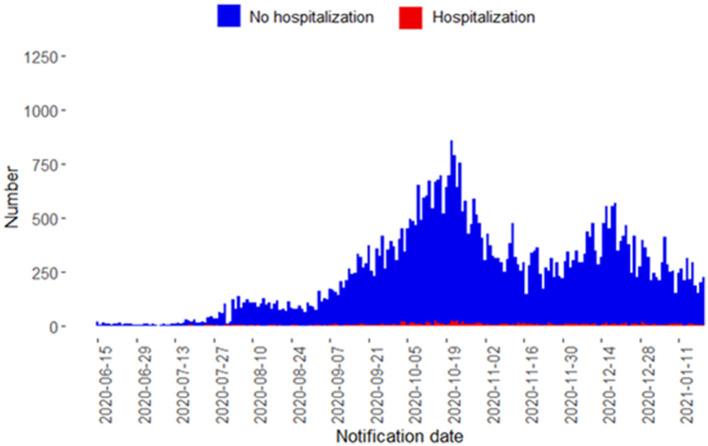
Surveillance data on all notified SARS-CoV-2 cases in Amsterdam between 15 June 2020 and 20 January 2021 were matched to municipal registration data to obtain the migration background of cases. Crude and directly age- and sex-standardized rates (DSR) of confirmed cases, hospitalizations, and deaths per 100,000 population were calculated overall, and by city districts, and migration backgrounds. Rate differences (RD) and rate ratios (RR) were calculated to compare DSR between city districts and migration backgrounds. We used multivariable Poisson regression to assess the association of city districts, migration backgrounds, age, and sex with rates of hospitalization.
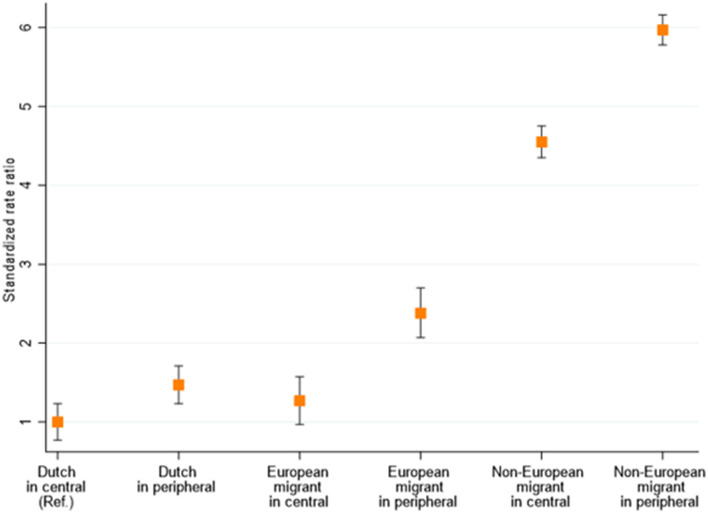
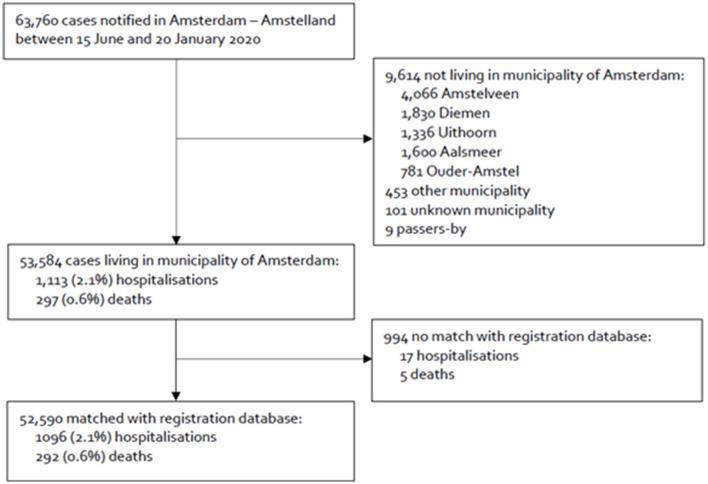
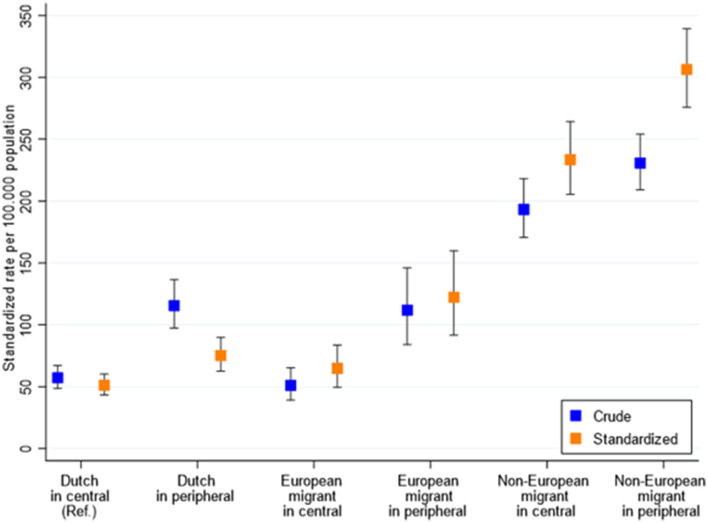
A total of 53,584 SARS-CoV-2 cases (median age 35 years [IQR = 25-74]) were notified, of whom 1,113 (2.1%) were hospitalized and 297 (0.6%) deceased. DSR of notified infections, hospitalization, and deaths per 100,000 population were higher in lower SES peripheral city districts (South-East/North/New-West) than higher SES central districts (Central/West/South/East), with almost a 2-fold higher hospitalization DSR in peripheral compared to central districts (RR = 1.86, 95%CI = 1.74-1.97). Individuals with a non-European migration background also had a higher COVID-19 burden, particularly with respect to hospitalization rates, with a 4.5-fold higher DSR for individuals with a non-European background compared to ethnic-Dutch (RR 4.51, 95%CI = 4.37-4.65). City districts, migration backgrounds, male gender, and older age were independently associated with COVID-19 hospitalization rates.
Individuals with a non-European background and individuals living in city districts with lower SES continued to independently have the highest COVID-19 burden in the second wave of COVID-19 in Amsterdam, the Netherlands.
在荷兰阿姆斯特丹的 COVID-19 第一波疫情期间,少数族裔背景的人群和社会经济地位较低的城市区的人群中 COVID-19 住院人数不成比例。在这项研究中,我们评估了在第二波疫情期间,当 SARS-CoV-2 检测可用于任何有症状的人,但尚未提供 COVID-19 疫苗时,这些差异是否持续存在。
对 2020 年 6 月 15 日至 2021 年 1 月 20 日期间阿姆斯特丹所有报告的 SARS-CoV-2 病例的监测数据与市登记数据进行匹配,以获取病例的移民背景。总体上以及按城市区和移民背景计算每 100,000 人口确诊病例、住院和死亡的粗率和直接年龄及性别标准化率(DSR)。计算率差异(RD)和率比(RR)以比较城市区和移民背景之间的 DSR。我们使用多变量泊松回归评估城市区、移民背景、年龄和性别与住院率的关系。
共报告了 53584 例 SARS-CoV-2 病例(中位数年龄 35 岁[IQR=25-74]),其中 1113 例(2.1%)住院,297 例(0.6%)死亡。每 100,000 人口的通知感染、住院和死亡 DSR 在社会经济地位较低的外围城市区(东南/西北/新西)高于社会经济地位较高的中心区(中心/西/南/东),与中心区相比,外围区的住院 DSR 几乎高出 2 倍(RR=1.86,95%CI=1.74-1.97)。具有非欧洲移民背景的个体也有更高的 COVID-19 负担,特别是在住院率方面,与具有欧洲血统的个体相比,非欧洲背景的个体 COVID-19 住院 DSR 高 4.5 倍(RR=4.51,95%CI=4.37-4.65)。城市区、移民背景、男性和年龄较大与 COVID-19 住院率独立相关。
在荷兰阿姆斯特丹的 COVID-19 第二波疫情中,具有非欧洲背景的个体和居住在社会经济地位较低的城市区的个体继续独立地承受着最高的 COVID-19 负担。