Department of Biology, Lund University, Sölvegatan 37, 22362, Lund, Sweden.
Department of Life Sciences, Georgina Mace Centre for the Living Planet, Imperial College London, Silwood Park Campus, Buckhurst Road, Ascot, Berkshire, SL5 7PY, UK.
Oecologia. 2023 Jul;202(3):535-547. doi: 10.1007/s00442-023-05411-z. Epub 2023 Jul 10.
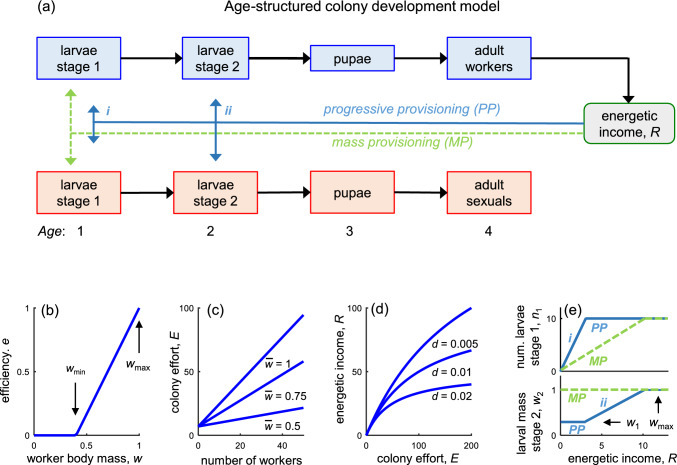
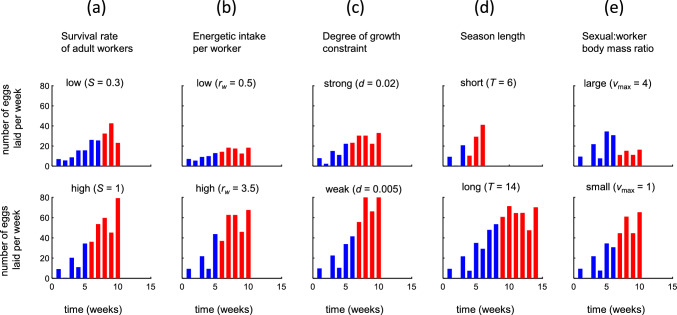
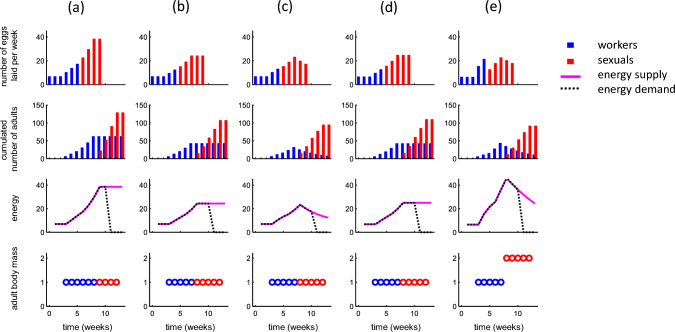
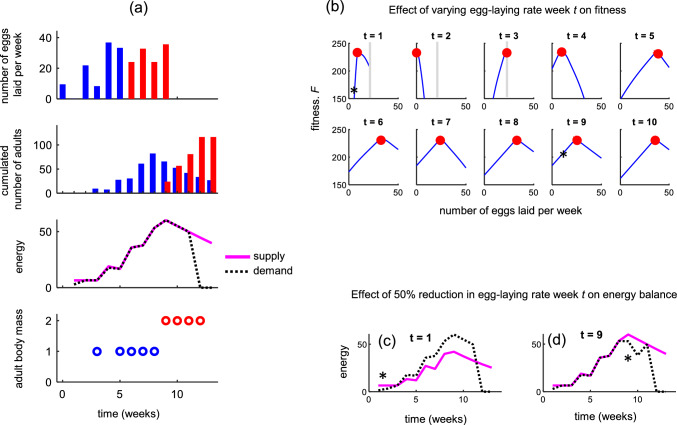
Annual social insects are an integral functional group of organisms, particularly in temperate environments. An emblematic part of their annual cycle is the social phase, during which the colony-founding queen rears workers that later assist her in rearing sexual progeny (gynes and drones). In many annual social insects, such as species of bees, wasps, and other groups, developing larvae are provisioned gradually as they develop (progressive provisioning) leading to multiple larval generations being reared simultaneously. We present a model for how the queen in such cases should optimize her egg-laying rate throughout the social phase depending on number-size trade-offs, colony age-structure, and energy balance. Complementing previous theory on optimal allocation between workers vs. sexuals in annual social insects and on temporal egg-laying patterns in solitary insects, we elucidate how resource competition among overlapping larval generations can influence optimal egg-laying strategies. With model parameters informed by knowledge of a common bumblebee species, the optimal egg-laying schedule consists of two temporally separated early broods followed by a more continuous rearing phase, matching empirical observations. However, eggs should initially be laid continuously at a gradually increasing rate when resources are scarce or mortality risks high and in cases where larvae are fully supplied with resources at the egg-laying stage (mass-provisioning). These factors, alongside sexual:worker body size ratios, further determine the overall trend in egg-laying rates over the colony cycle. Our analysis provides an inroad to study and mechanistically understand variation in colony development strategies within and across species of annual social insects.
年度社会性昆虫是生物的一个重要功能类群,特别是在温带环境中。它们年度周期中的一个典型特征是社会性阶段,在这个阶段,殖民地建立的蜂王会养育工蜂,而这些工蜂随后会帮助她养育有性后代(雌蜂和雄蜂)。在许多年度社会性昆虫中,如蜜蜂、黄蜂和其他群体,发育中的幼虫会随着发育逐渐得到滋养(渐进式滋养),从而同时养育多个幼虫世代。我们提出了一个模型,说明在这种情况下,蜂王应该如何根据数量大小权衡、群体年龄结构和能量平衡,优化其在社会性阶段的产卵率。补充了之前关于年度社会性昆虫中工蜂与有性个体之间的最优分配以及独居昆虫的时间产卵模式的理论,我们阐明了重叠幼虫世代之间的资源竞争如何影响最优产卵策略。利用对一种常见熊蜂物种的知识来告知模型参数,最佳产卵计划由两个时间上分开的早期产卵批次组成,然后是一个更连续的养育阶段,与经验观察相匹配。然而,当资源稀缺或死亡率高,或者当幼虫在产卵阶段完全得到滋养时(大量滋养),最初应连续地以逐渐增加的速度产卵。这些因素,以及性:工蜂体型比例,进一步决定了整个群体周期内产卵率的总体趋势。我们的分析为研究和机制理解年度社会性昆虫的种内和种间群体发育策略的变化提供了一个途径。